
 by
by 
When it comes to discussing the history of the computer role-playing genre in the US, there are several names that repeatedly come up; some of the most notable being Richard Garriott, the creator of Ultima, and the Wizardry creators, Robert Woodhead and Andrew C. Greenberg. However, there are also many other people who have had a sizable impact on shaping the genre into what it is today.
Kenneth Arnold, for instance, is one lesser-known name who rarely gets more than a footnote when people discuss the history of the genre, but he had a key part to play in its evolution. Not only did he help implement the tile graphics for the original Ultima alongside Richard Garriott, but he also later became the creator of one of the first (if not the very first) video game scores with the creation of Ultima III: Exodus.
In the past, he's rarely given interviews about his involvement with these titles, but Time Extension recently had the extraordinary opportunity to speak with Arnold about his incredible career, from his first memories meeting and collaborating with Garriott, to his work on Ultima’s graphics and his music and influences.
This helped not only paint a fascinating portrait of a somewhat unsung figure in RPG history, but also a time when home computing was still in its infancy, and the commercial video game industry was just starting to get up and running. First, though, it's probably for the best that we give you some background on Ultima and its beginnings, for those who may be too young to have played them back when they were originally released.
The Beginnings Of Ultima
Before there was Ultima, there was Akalabeth, Richard Garriott's first-ever commercial attempt at a computer role-playing game.
Developed throughout 1979 for the Apple II computer, mostly in Applesoft BASIC, Akalabeth was an attempt to bring the world of pen-and-paper RPGs to the Apple home computer, and saw players accepting quests from Lord British (Garriott's alter-ego) to slay various monsters hidden across the map. The game was divided between a top-down world view and a first-person “3D” perspective in dungeons — both of which would become a key part of the early formula used for Ultima. As a result, Akalabeth is sometimes referred to officially as "Ultima 0", and retroactively labelled the first game in the long-running series.
Originally developed by Garriott as a fun project to share with friends, his boss, John P. Mayer, eventually convinced the young creator to sell the game in the ComputerLand store in Texas, where he was working at the time, leading to interest from the publisher, California Pacific Computer Company.
Seeing the potential in what Garriott created, California Pacific Computer Company approached the young Tolkien-inspired computer fan for the publishing rights to his game, expanding both distribution and the promotion of the game. And this investment seemed to pay off, with California Pacific Computer Company selling 30,000 copies of the game at $34 each, according to Garriott’s book Explore/Create. As Garriott states in his book, he ended up earning $150,000 from sales of the game, twice his father's yearly salary.
Like many of his friends, he believed the game's success was probably a fluke, but set out nevertheless to work on a follow-up to the RPG, named Ultima, which he has since described as "his first virtual world". Ultima would take place in a brand new world called Sosaria and would introduce even more NPCs, dungeons, and towns. Because of this, it took a total of nine months to develop, which was a massive step up from the seven weeks that went into making Akalabeth. To help him realize his grand vision, Garriott, therefore, turned to Arnold, one of his ComputerLand co-workers, who was a few years older and at the time not only knew BASIC but also had an understanding of Assembly language. The pair had met a few years earlier, with Arnold having crossed paths with the future "Lord British" while taking out some trash.
"I think I'd worked at ComputerLand for maybe a year or so," said Arnold, "And I think we're now in the summer of '78, I suspect, because I was at college by then. And so there I am doing my job, and I went out to the back alley to throw away some cardboard, and here's this kid breaking down boxes to put in the dumpster. Well, ComputerLand wasn't a self-standing, all-alone building. It was part of a little shopping area. So there were other businesses. And one of them was our favourite place to eat, Burrito King. I just thought, well, this kid must be working for Burrito King. But I introduced myself, and it was Richard. So that's how we met."
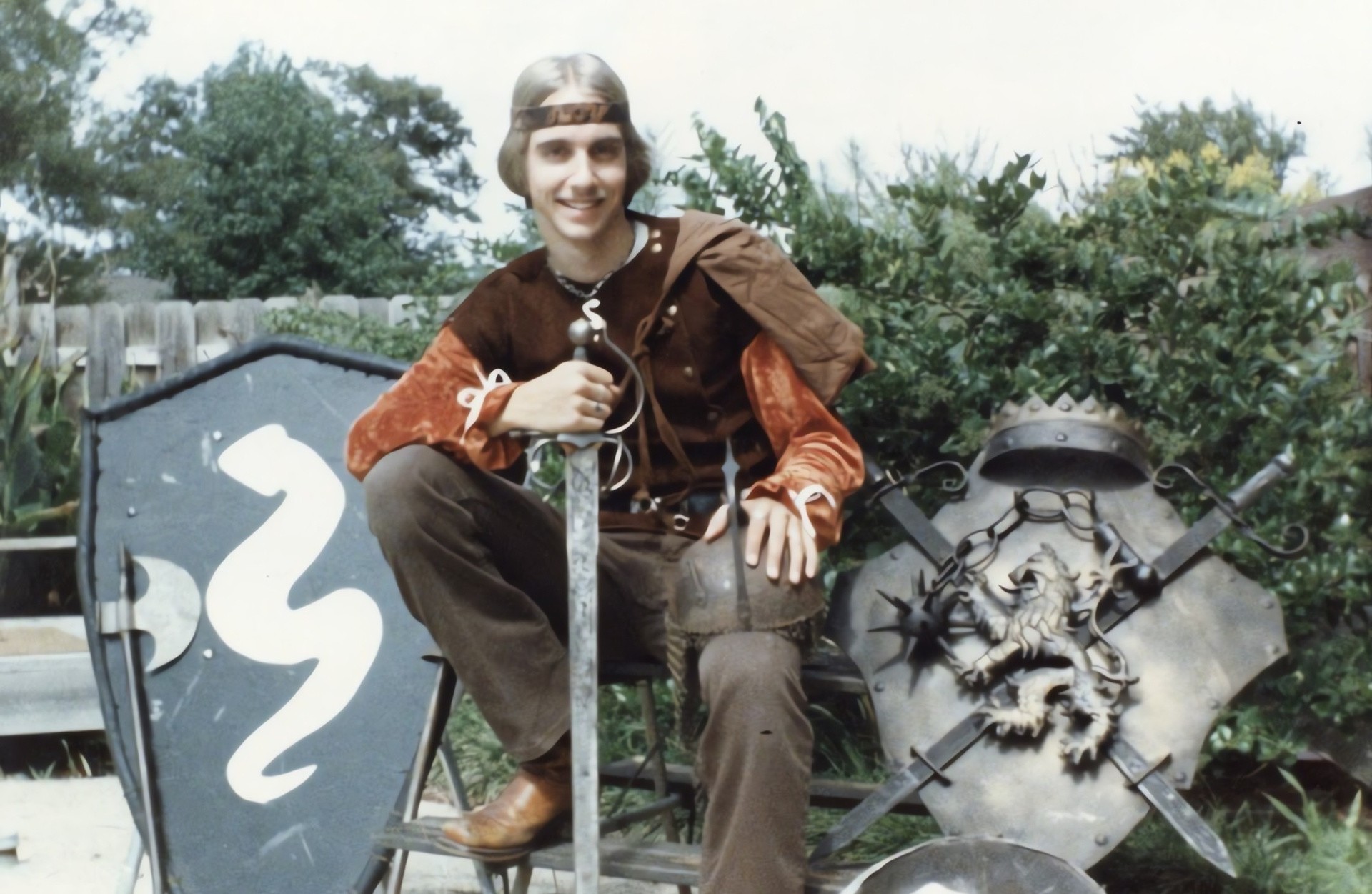
"We weren't super close friends. I was a college man, and he was a high school boy. But we enjoyed each other. We learned things from each other. He liked acting, and he had done well in the science fair and stuff, and his father was an astronaut, which was interesting in and of itself."
Arnold, by his own admission, didn't have much, if anything, really, to do with Akalabeth's development, besides giving some advice, but states he was part of the assembly line put together to duplicate and package the 200 or so copies that were sent out to ComputerLand stores around the country.
"The memory I have is being at his house," said Arnold. "We just made an assembly line. Maybe three people were duplicating tapes on different machines. And when I say duplicating, you were really recording off of an Apple II, because just a tape duplicate probably wouldn't be very reliable.
"In fact, these cassettes weren't reliable at all," he adds. "The Apple II cassette system was pretty basic. Not nearly as good as the Commodore PETs, as it happened. Because the Commodore PET actually had a built-in tape recorder. So we were ziplocking them, stamping them, putting a price sticker on them, or whatever. And at some point, we had this whole pile of stuff on the table, and the dog jumped up on it, and it went all over the place. It was all very homespun."
The "Whiz Kid"
Similar to Garriott, Arnold was another computer prodigy, living in the Texas area. The son of a pipeliner in the oil industry and a rancher's daughter, he had moved from Wyoming to Texas as a teenager on account of his father's work, settling in Clear Lake City — an area known for being in close proximity to NASA's Lyndon B. Johnson Space Center.

His first experience with computers came in high school, where he fought to get access to the school's teletype terminal — a keyboard/printer device that lacked a CRT monitor and allowed users to send and receive data from a remote mainframe computer, owned by the school district. It was using this machine that he would start writing his own programs in Dartmouth BASIC, including an early, unfinished computer RPG that foreshadowed his later involvement in Ultima.
"Even though it was entirely text and it was just printed, I wrote a program that sort of simulated the idea of a medieval kingdom," said Arnold. "So I would, in ASCII art, print a map as a hexagonal grid. +++ meant like a cathedral, and === would mean a field, and ^^^ would mean maybe a forest or something like that. It was a game, and you'd interact with it, but it was just command response, command response.
He continued, "You would print out the map, it would give you some information, you'd do something. I started; I never finished that program. I don't know that Richard's even aware that I did that. But I actually was kind of thinking along the lines of an Ultima-style game, even then."
From this simple teletype game, his experiments with computers only grew more bolder as he tried to teach himself the fundamentals of programming and learn what was possible. He got his hands on a board, a 6502 microprocessor, and some books on Assembly, learning the low-level language by reading and experimenting in his spare time, and also found himself collaborating with his friends James Vanartsdalen and Gary Morrison on a project to use Vanartsdalen's Commodore PET to control a homemade synthesizer.
This project was novel enough to get the group of high school students a quarter-page write-up in the Houston Post, as well as an invitation to an event that was being hosted by a local computer club for early computer enthusiasts, including NASA engineers who were new to the microprocessor. In attendance would be his future ComputerLand boss, Mayer, as well as Mayer's wife, Geraldine, both of whom had previously been employed at the NACA (National Advisory Committee for Aeronautics) – the forerunner to NASA.
"John was newly retired from NASA. He had been the director of the mission planning and analysis division, which was a key part of NASA, because they were the ones who figured out how to do the orbital mechanics, literally how to get to the moon. He and Geraldine had been part of NASA before it was even NASA. They were at Langley as part of the NACA, the National Advisory Committee for Aeronautics, to the United States Congress.
"In fact, John P. Mayer told me, 'I'm the one who first knew that Chuck Yeager had broken the sound barrier because we had all this detailed instrumentation recording data on film. And I was the one who analyzed the film.' Meanwhile, Geraldine had been one of the computers. You know, the Hidden Figures movie. Geraldine was one of those. Now, in the movie, it focuses on the African Americans. She wasn't one, but some computers weren't. And that was her career until they decided that they would both retire, and, 'Hey, wouldn't it be fun to have a little computer store?'
The Mayers watched Arnold's talk at the event, and thanks to his prowess with and knowledge of computing, they invited the young computer enthusiast to work at their store as a "Whiz Kid", someone responsible for demonstrating ComputerLand's latest products to the public.
"So my job was, when people came in unsure about this newfangled thing, I was there to explain things to them," said Arnold, "Do they really want one? Because at this point, it was not just hobbyists. At this point, it was also forward-looking business people, including lawyers, who wanted to do documentation and automation. So I was there to help. I also conducted some classes for adults and kids. We taught Logo, if you're familiar with that: turtle graphics. And we would also assemble, debug, fix, and repair things, and do other stuff like that."
The Making Of Ultima
When Garriott approached Arnold to discuss his latest project, Ultima, the developer was already in the process of replacing the plain black overworld of Akalabeth with more expansive and detailed backgrounds that would make up the four continents of Sosaria. However, the world was simply proving too large to draw using individual pixels. As a result, he came up with a solution to implement a pioneering technique that employed the use of pre-rendered tiled graphics to create the game's backgrounds.
This involved creating separate tiles representing the different landmarks that players would encounter before stitching them together onscreen to create the larger world. Originally, according to Arnold, Garriott was working on implementing this alone, but after the pair chatted with each other about some of the challenges Garriott was having, it became clear that the project would be able to benefit from Arnold's expertise.

"If I remember correctly, Richard was doing the tile graphics in BASIC," said Arnold. "And his size was 8 pixels by 8 pixels, and well, that's kind of logical on most graphical systems, because they're byte-oriented, but the Apple wasn't. It had seven pixels per byte, with the eighth one having a function of colour."
"I told him, 'Richard, Akalebeth is cool, but if you want something that's really commercial, you're going to have to learn assembly language.' And he said, 'Ah, it's just so tedious. I don't want to learn that.' I said, 'Well, I can do the graphics, and you can do the game, and we can make an interface between the two so that you get the speed you need and still you have control of your game,' and so that's kind of how that started. We ended up doing 14 pixel by 16 pixel tiles because in assembly language, it was tons faster. That's because you didn't have to do a bunch of bit shifting; you just blasted bytes. He's often said in interviews in the past, 'Ken invented tile graphics.' But he kind of did. I just implemented it better."
Working from Garriott's home, the pair came up with a revised system that saw each screen being divided into 200 14 x 16 tiles, arranged as 10 rows of 20 tiles each. Initially, Garriott and Arnold would draw the game's tiles by hand first on graph paper, before converting them into binary code and later hexadecimal. Once finished, they would then compile the game and check that everything had been drawn correctly, before going back and correcting any mistakes.
At the time, this kind of application wasn't widespread in the video game industry, with some even attributing Ultima as the first specific case of someone using tiled graphics in this manner. But following the release, it would later become a common way for video game developers to draw graphics for their games, thanks in part to titles like Ultima popularizing the technique.
Similar to Akalabeth, the game was to primarily feature a medieval-style setting, with Lord British this time tasking players with defeating an evil wizard named Mondain. According to the backstory, Mondain had created a powerful gem over 1000 years ago, granting him the power of immortality, and is using his powers in the present to spread terror and monsters across the land. So it falls to the player character to take up arms against them and put a stop to their evil reign. Initially, players are dropped into the world with little guidance on what to do, but will eventually discover that the only way to beat the wizard is to travel back in time and defeat them before the Gem of Immortality is finished.
Rather fittingly, given Garriott and Arnold's keen interest in space travel, this required players not only to explore their earthly surroundings and gather the lesser gems required to fuel the machine, but also to head to the stars and become a "space ace", to win the favour of a princess who guarded the secrets of time travel.
Speaking about this section of the game, Arnold said, "A big challenge was, 'How do you make an Apple II give you a decent hyperspace jump effect with control when it's a completely pull system and there's no interrupts?' You can't do what the Atari did. The Atari 400 and 800 were the inspiration for that. They've got interrupts. They can do it quite naturally. How do you do that on an Apple? Well, that was a big challenge, but I did it.
He explained, "So that effect is very carefully managing microseconds of time between updating the screen, doing the computations of where the stars are now, making sound, and following the input from the joystick, which is a difficult thing to do on an Apple II. It's not trivial. It's not just read the port. It needs to start a capacitor charging, measure the amount of time it took to discharge, etc. So I got all these things happening concurrently. And for its day, that was kind of advanced."
Further Adventures In Space & Time
After a lengthy development, Ultima was released into the world in 1981, initially under the same publisher as Akalabeth, California Pacific, who retailed the game for $39.95. Thanks to its captivating Dungeons & Dragons-inspired gameplay, expansive world, and colourful graphics, it went on to become an instant success, receiving a string of positive reviews from computer magazines over the next couple of years.
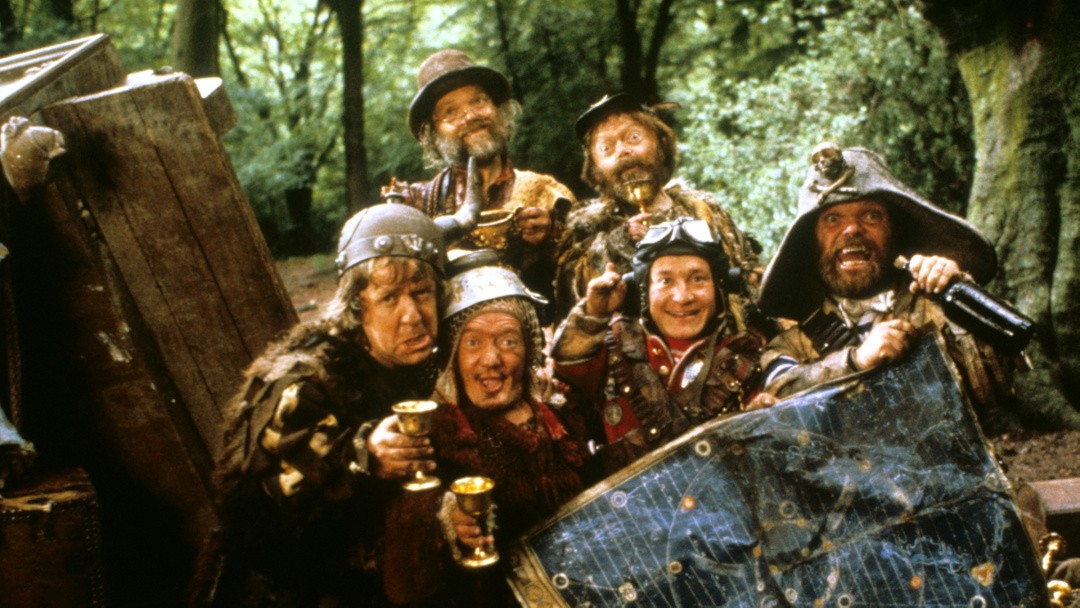
One of the leading computer magazines of the day, Softline, for instance, described it as "the best" of "the fantasy/role-playing adventure games available", praising its "high-resolution character graphics", while another publication, Computer Gaming World, labelled it "one of the best computer fantasy roleplaying games to date". It was clear from the reception that, working together, both Garriott and Arnold had managed to improve upon the formula that Garriott had previously established on Akalabeth, but Arnold would mostly be uninvolved with the creation of the game's sequel, the Time Bandits-inspired Ultima II: The Revenge of the Enchantress.
Instead, he made the conscious decision to put a pin in his video game career to become an engineer, having studied Electrical Engineering at the University of Houston and believing it to be the more sensible career option as the games industry was still in its infancy. His first job was designing logic circuits and PCB layouts of add-in cards for personal computers at Indigo Data Systems.
It was during this time that Garriott also went back to study at the University of Texas at Austin and began work on the game's follow-up, The Revenge of the Enchantress, over a period of 14 months, eventually working with Sierra On-Line to publish the title in 1982. Despite Arnold's lack of involvement with the finished product, he is notably still credited in the manual for the Ultima sequel as a programmer alongside Garriott (who had by this point learned Assembly) and Keith Zabalaoui (another one of Garriott's friends), thanks in part to his code being reused on the title.
Arnold's Ultima journey would be far from over, though. That's because, after Garriott returned from university, Arnold approached his former collaborator to work on the music to the third game in the series, Ultima III: Exodus — the first title released under the publisher Origin Systems (a company formed by Richard Garriott, Rob Garriott, Owen Garriott, and their family friend Chuck Bueche) and the first title in the series to include a score.
At the time, Arnold was still working primarily as an engineer, but had spotted a potential opportunity to add music to games on the Apple II, using The Mockingboard, a soundboard he had come across previously in his engineering studies. As a result, he came to Garriott with the idea of using the board to facilitate a video game soundtrack. At the time, video game music was, for the most part, relatively simple, being composed of looping jingles, while Apple II games rarely featured music at all, but instead the click of simple sound effects. What Arnold was suggesting, therefore, was incredibly ambitious and would prove to be an incredible step up over previous entries.
Reflecting on the Mockingboard technology today, he told us, "It was mainly kind of a sound effects generator. Explosions, stuff like that. But you could make three square wave tones with what we'd call a timer in electrical circuitry. So you could control the period of the timer, and therefore the frequency and the musical pitch. You couldn't change the waveform; it was still a square wave. But there was a little bit of a mixer, like an audio mixer in the chip, where you could give a volume control to each of the three voices, and the fourth one was noise.
"I basically said, 'Hey, Rich, I think we can perhaps put a score with your game based on this card.' And he said, 'Yeah, do it!' Then I told him, 'You know, we could probably use some sort of quasi-medieval renaissance kind of music because it won't have any royalties associated with it.' And he said, 'No, I want an original score.' And that's how I got to be a game composer in music. So that was quite a fun moment, but it was exciting and terrifying, because I didn't know if I could do it."
Switched On Bach
Although Arnold was admittedly slightly intimidated at the prospect of composing an all-new original soundtrack, this pivot from a programmer to a musician wasn't entirely outside of his existing skillset.
Just as he had grown up loving computers, he had also always had a fondness for musical instruments, coming from a family with a particularly musical grounding. His grandfather sang bass in a local choir, and his mother and grandmother both played piano, so he, too, ended up joining a choir from an early age and always had access to an instrument, which he eventually ended up learning.
"My mother gave me my first piano lessons," Arnold told us. "They were very simple. Here's middle C, things like that. But then, the first formal lessons I got, I was probably about eight years old.
"We were living in the little town of Newcastle in Wyoming, not far from South Dakota and Mount Rushmore. And there weren't a whole lot of piano teachers available, but my mom got me connected to an accordionist in a polka band, because polka was a big thing in those days, especially up there. Because I was trained with accordion beginner music, I had an early introduction to chords, and that gave me a grounding in harmony right away. Then, as I approached my teenage years, I played the organ at church for a time, and learned a little more about the electric organ."
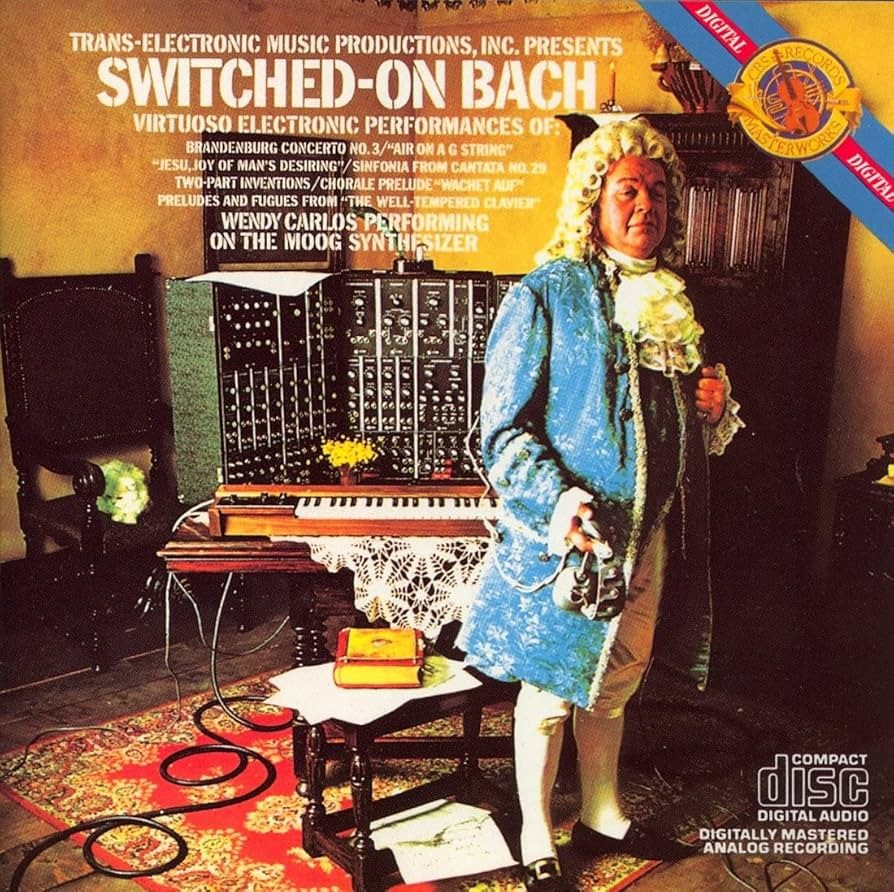
Growing up, Arnold's musical influences were incredibly diverse, including whatever was playing on his local radio stations and TV (from Elvis Presley, Chet Atkins, and Frank Sinatra, to Gene Autry and the Mitch Miller Orchestra). But it would be one album in particular that would expand his musical horizons and arguably lay the groundwork for his later explorations in electronic music: Wendy Carlos's groundbreaking 1968 album Switched-On Bach.
"I was in junior high school, and this would have been about 1972, and our little town had a new music teacher. His name was Pat Patton. I don't know if he's still alive today. I hope so. He was a really interesting fellow. He was from Hawaii. And he came into the school room that day with this album cover of an old-world European-looking room with lots of ornate decoration and decor.
"At the back of that room on the cover was a Moog synthesizer with all the patch cords, but standing in the foreground was J.S. Bach, replete in this very elaborate baroque outfit, with a set of headphones, looking rather confused. And that was Switched-On Bach, which was by Wendy Carlos. It just totally transfixed me. And I remember that album cover so well because I looked at it, and I was already kind of interested in math. So I was looking at this album cover and thinking, what could all those knobs possibly do?
"On my stereo, I've got like a tone control, and I've got a volume control, but what could all these knobs be actually doing? And how could that keyboard affect any of it? I remember spending a lot of time with a magnifying glass trying to look closely at that album cover and to read the legends on the Moog synthesizer, to try to get an understanding of what it was all about."
From there, he not only became fascinated with classical music and Bach, but began learning everything he could about electronic synthesizers, taking out any books he could find from his local library, petitioning a relative to send him a copy of John Donald Robb's album Electronic Music: From Razor Blades to Moog, and even flipping burgers to buy himself a kit to his very own synthesizer — the same synth he would use to get his name in the local paper. All of this would prove to be important grounding that he would draw upon when approaching his first-ever video game soundtrack.
"In addition to his many virtuosic pieces for organ, choir, and orchestras, Bach wrote several short training pieces for music students," said Arnold. "These included the Inventions and Sinfonias, which are short pieces using only a few voices. The 15 inventions use just two voices, and the 15 Sinfonias use 3. The Mockingboard had 3 oscillators (just timers, really, but they 'oscillated'), so Bach's pieces gave me some guidelines. Choral music uses 4 voices: Bass, Tenor, Alto, and Soprano. Lacking one of those, I would pivot between Soprano-Alto-Bass and Soprano-Tenor-Bass. But I wasn't really thinking in terms of music theory so much as looking for a 'feeling' that evoked Renaissance/Baroque/Medieval music. So I used special keys called Modes more than the traditional Major and Minor keys.
He elaborated, "Modes evoke a more primitive type of harmony, if I can say that. In some cases, I used simple time delays to imply strumming, thinking of a medieval bard playing a lute. In other cases, I attempted to suggest royalty with virtual trumpets and horns. With the ship music, I tried to sound like a Sea Shanty. Dungeon music was quirky, weird, and unexpected. I was partly inspired by a moment from W. Carlos' realization of J.S. Bach's Brandenburg Concerto #3, 3rd Movement. (if I recall correctly), off that original Switched-On Bach album."
Of course, there were also other influences too. The final victory music is a pretty straightforward recreation of "Rule Britannia" for the final victory music, while Arnold also namechecks Isao Tomita's album Snowflakes are Dancing as another favorite album, thanks to its superb interpretations of Claude Debussy's music, Patrick Gleason's The Planets and prog rock groups like Yes, Genesis, Jethro Tull, the Alan Parsons Project, and Kansas.
A Real Impact
Ultima III: Exodus launched in 1983 and was a tremendous success for Origin — once again earning enthusiastic reviews from computer magazines of the time.
Computer Gaming World, for example, labelled it "the best in the series" in the December 1983 issue, stating it had been "streamlined AND expanded", "the graphics are better", and that it was definitely "not one to miss", while Computer Entertainer gave it maximum points (four stars for its graphics and four for its "play action") in its May 1984 newsletter, highlighting the "enhanced" music and calling it "adventure gaming at its very best".
Following the development of this project, Arnold would continue to contribute scores for future Ultima games, including 1985's Ultima IV: Quest of the Avatar, while he was also working for NASA, and Ultima V: Warriors of Destiny in 1988, as a full-fledged member of Origin Systems. He would only be an Origin employee for a couple of years, however, before once again prioritizing his engineering career, to better support his family. Today, he is a senior embedded systems engineer at the Missouri-based manufacturer Leggett & Platt, a firm founded all the way back in 1888, but he still reflects fondly on his time in games, and occasionally finds himself confronted with the legacy of what he once helped to build.
"Usually, when I get fan mail, which I still get, it's people who heard the music on the C64 and not on the Apple. But there is one story I especially want to tell you, and I got permission from a fellow to tell it.
"Now and then, I'll get a hit on LinkedIn where somebody asks me, 'Are you the guy that wrote the music for Ultima?' And they talk about how they remember it fondly, and that's always very flattering. But this one was slightly different.
The fella said, 'When I was a young man, in junior high school, I was a really promising athlete, and I took it seriously. So, I saved up my money to buy a professional workout bench. I had that money saved up, I was almost ready to buy it, and I had a medical catastrophe that made it impossible for me to ever become a professional athlete. I was in the hospital for a long time and needed something to pass the time. So I took that money and bought a little computer. And it was an Apple II' — or maybe it was a C64. Whatever it was, he bought the computer, and he ran the Ultima games. And he said my music became so meaningful to him as a result.
"He still had his original Ultima V poster, so Richard and I both agreed to sign it. I found that so touching. That something I did meant more than something fun I did as a kid. It had this real impact that I didn't even know about."