
 by
by 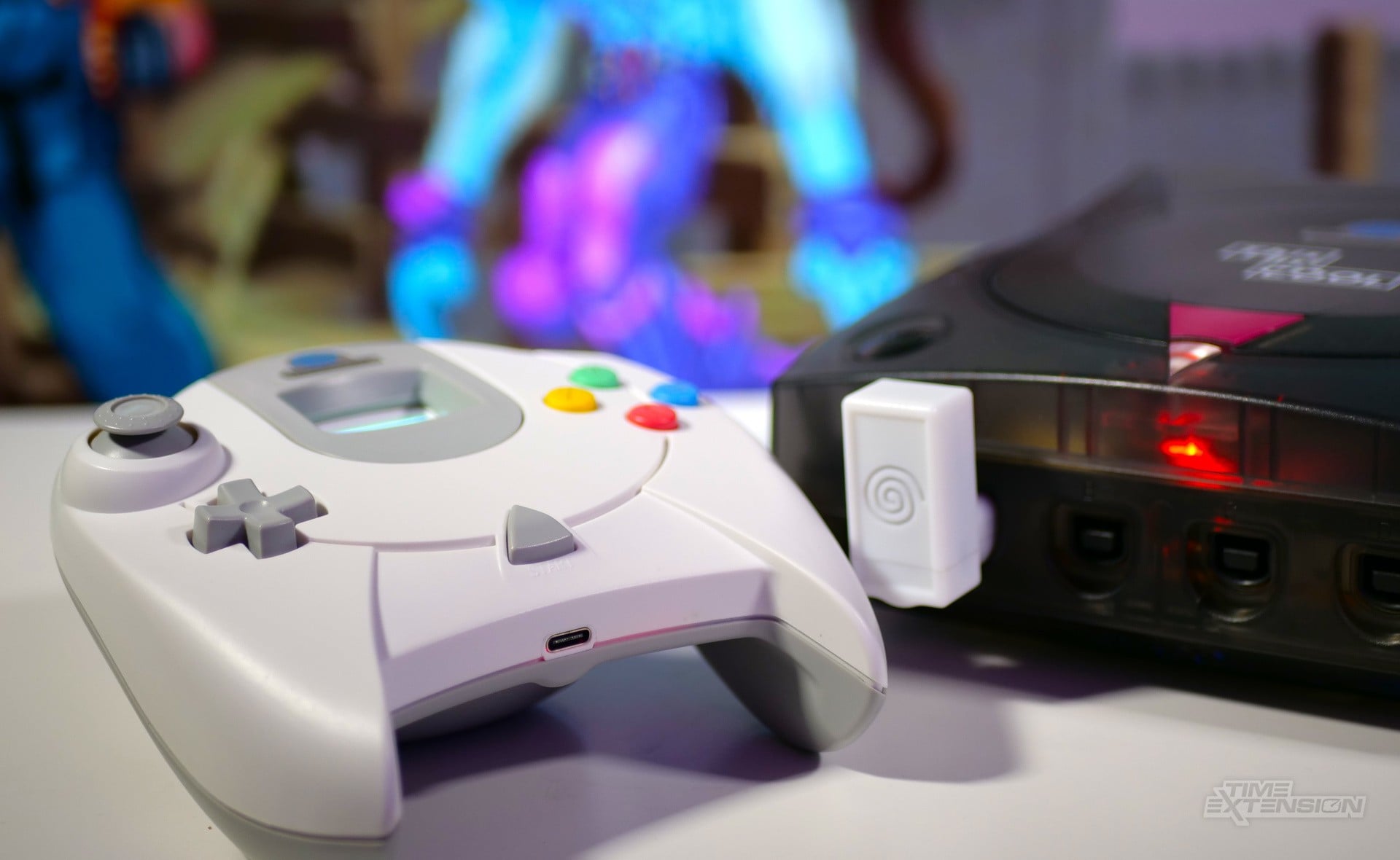
I'll get this out of the way early – as much as I adore Sega's last home console, I never loved the Dreamcast controller.
Sure, there were things I liked about it; it was pretty comfortable to hold, the Hall Effect stick was great (Sega used the same tech in its Saturn 3D pad, proving it was decades ahead of the game), and I really liked the fact that you could clip the cable to the pad's rear to prevent it from getting in the way during use – but, on the whole, I was disappointed that Sega dropped the six-button layout and gave it a D-Pad that was woeful for 2D fighting games (thankfully, ASCII came to the rescue).
I realise I'm perhaps on my own in this assessment, as there are many people out there who absolutely adore the OEM Dreamcast pad – hence the fact that Dreamware / DreamMods, the Greek company behind the superb VM2, has created the DreamConn S, a Bluetooth-based upgrade of Sega's controller which aims to be as faithful as possible to the original design.
The DreamConn S is actually a revision of Dreamware's previous DreamConn+ controller, and offers a wide range of new features. Before we get to those, however, it's worth mentioning how close a match the pad is physically to the real thing; the design is near-identical, and it's only the presence of a different analogue stick design and a USB-C port which hints that this isn't an official Sega product (the rear shell looks like it has been taken from an authentic Dreamcast controller as it has the 'HKT-7700' part number and Sega's logo, but it has actually been made by Dreamware).
The DreamConn S is so much more than a copycat pad, however. The most obvious improvement is the introduction of wireless connectivity. The controller features Bluetooth built in and is available with an optional dongle, complete with a Dreamcast swirl design.
This plugs into your console's controller port as usual and connects to the DreamConn S in seconds (the pad is powered up by a press of the Start button, by the way, and an internal LED shows when it's active). The DreamConn S's internal battery delivers approximately 12 hours of play on a single charge and is topped up via the USB-C port located on the bottom edge.
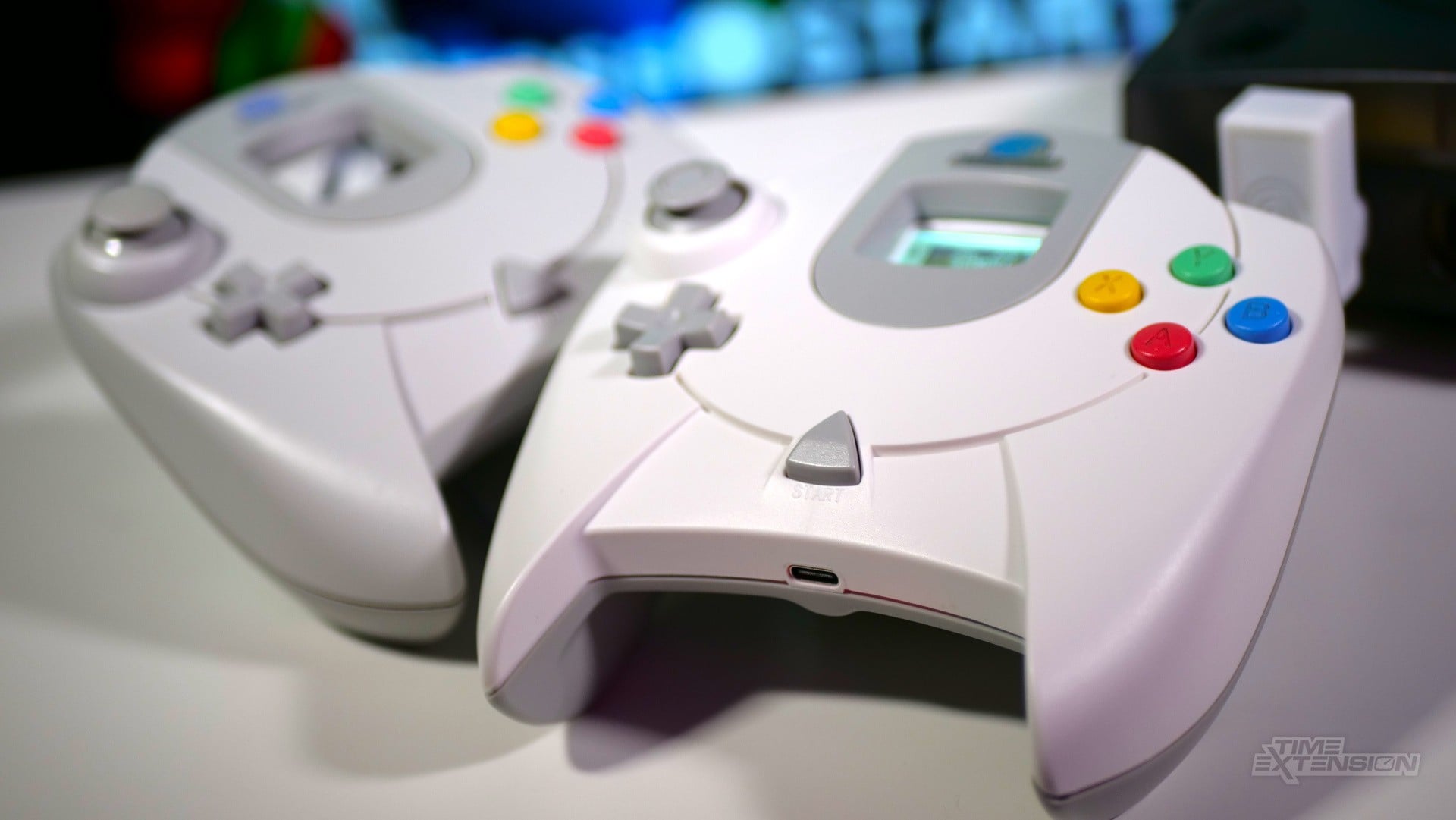
The next big change is that aforementioned analogue stick. To my understanding, the Hall Effect aspect of the stick is the same as the original pad, but Dreamware has created an entirely new plastic stick, which has a cut-away section in the middle. I don't know about you, but I always found the stick on the official pad to be a bit slippery, and this revised design offers far more grip, especially during sweaty (ahem) gaming sessions.
According to Dreamware, the D-pad and face buttons have also been upgraded. I must admit, it's harder to spot where the improvements have been made here, as both feel very similar to those on the OEM controller. The D-Pad perhaps has a little more pivot, and the buttons are somewhat firmer, but I'd need to spend a lot longer with the DreamConn S to see if they 'bed in' – on my original Dreamcast pad, the face buttons have taken so much punishment they feel very mushy. Hopefully, the improved design presented here will avoid such problems in the future. The Hall Effect shoulder triggers are also unchanged from the original, except that the glossy surface of each trigger has been replaced with a more tactile matte finish, which I appreciate.
Given that the DreamConn S and VM2 both come from the same manufacturer, it shouldn't come as a shock to learn they're designed to combine quite elegantly. Because the display on the VM2 is slightly smaller than the one found on the original VMU, Dreamware has included a replacement faceplate that you can swap out – this avoids having an unsightly gap at the bottom of the VM2's screen.
Speaking of VMU features, the DreamConn S has a neat way of showing you the controller's remaining stamina – a battery icon is overlaid in the top-right corner of the LCD screen. This isn't a feature that's totally unique to the VM2, either – it is displayed on standard VMUs and on the 8BitMods VMU Pro. However, using the VM2 with this pad means you'll benefit from faster VMU data syncing if you're using an ODE like the Terraonion MODE or GDEMU.
Another neat touch is that there's a VMU built into the DreamConn S itself, so you can save your game data even if you don't own a VMU. This 'virtual' VMU is assigned to the controller's second slot and can hot-swap with the official Dreamcast Rumble Pack, should you own one. It's also worth noting that the DreamConn S's internal battery is capable of charging the power cells found inside next-gen memory cards like the VM2 and VMU Pro.
Beyond using the DreamConn S with your Dreamcast, you can also pair it to your PC and use it in the FlyCast emulator. It's also possible to connect to a computer and manage your VMU save data using a dedicated application – this is very handy indeed, as it allows you to move your progress between emulators and original hardware with ease.
There's no denying that the DreamConn S takes the core design of the console's controller and improves it in many meaningful ways. In fact, with the introduction of wireless connectivity, improved control, and great support for 'new' VMU options, I'd go so far as to say that this is the pinnacle of controller design, as far as the official Dreamcast pad is concerned.
The biggest roadblock for most potential customers is likely to be the price – something that was equally applicable to the VM2, it must be said. Dreamware isn't a huge company and is hamstrung by the fact that it can't call upon vast reserves of manufacturing or R&D resources – it's effectively a single person. When you're dealing with that kind of 'cottage' industry, things rarely come cheap.
With that in mind, the DreamConn S costs a whopping 170€ with its Bluetooth dongle – that translates to almost $200 / £150, and that's before you factor in the 20€ shipping charge from Greece (you can also purchase the pad for 140€ without the dongle).
That's an astronomical amount of money for what some people will see as little more than an iterated Dreamcast controller with wireless support, especially when it's possible to pick up an original pad for considerably less – or, if you want wireless, the Retro Fighters StrikerDC, which boasts a different (and very nice) design but lacks a built-in VMU slot (this is located instead on its wireless reciever, which isn't quite as elegant).
If money is no object to you, you already own a VM2, and you adore the design of the original Dreamcast pad, then this is a more straightforward recommendation; Dreamware is working diligently behind the scenes to improve performance and features, which certainly bodes well for the future of the DreamConn S. However, if you don't tick all of those boxes, then, as much as I like this pad, I'm not entirely sure you need to splash the cash when there are cheaper alternatives available.
Please note that some external links on this page are affiliate links, which means if you click them and make a purchase we may receive a small percentage of the sale. Please read our FTC Disclosure for more information.
Thanks to Dreamware for supplying the DreamConn S used in this review.