
 by
by 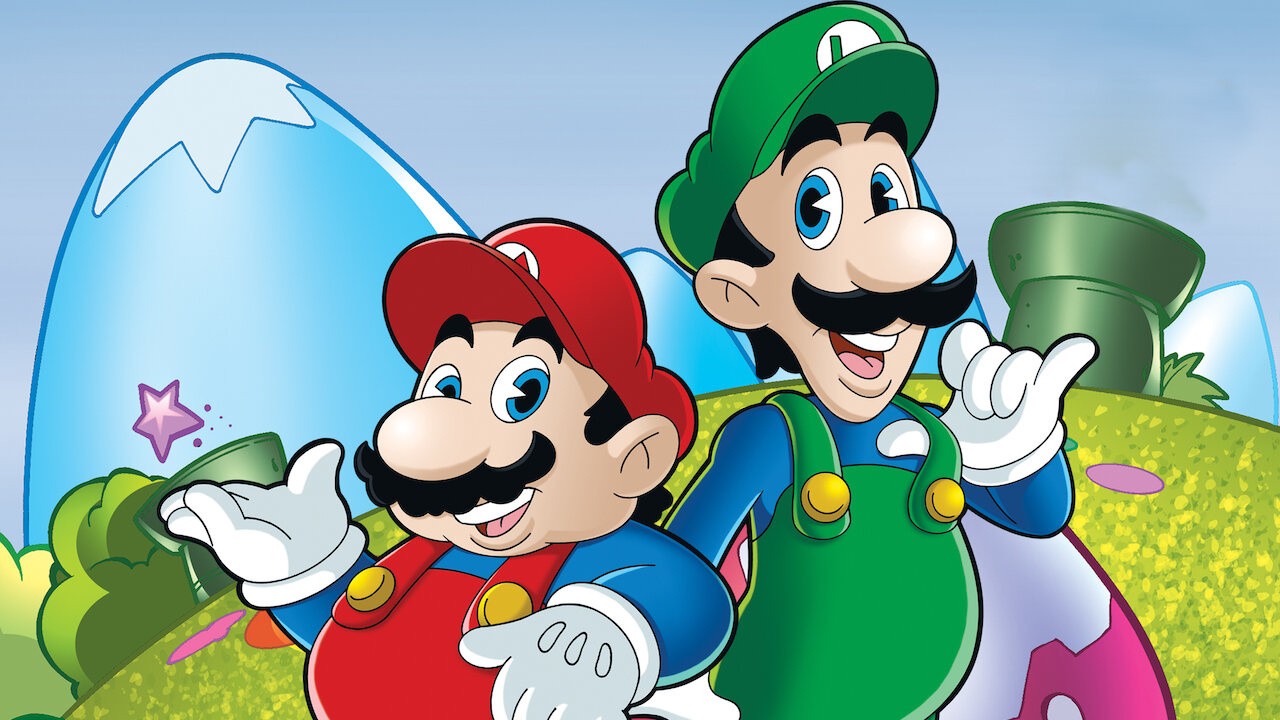
While the Super Mario Brothers had certainly appeared in animated projects prior to the launch of The Super Mario Bros. Super Show!, for many people growing up in the West, the latter proved to be the first time they ever saw the game's cast of characters represented outside of the games.
Debuting to audiences in 1989, the show (which was a mix of live-action skits and animation) was the brainchild of the (then) chairman and CEO of DIC, Andy Heyward, with the animated segments being developed for the screen by the father and son writing partnership of Bruce Shelly and Reed Shelly, alongside Bob Forward and Phil Harnage.
It was these individuals who were given the difficult task of interpreting Nintendo's characters for the new medium, with only two games to go on — Super Mario Bros. and Super Mario Bros. 2 — with the goal of creating a cast that could carry a 65-episode show.
Having grown up with Abbey Home Entertainment's UK releases of the show (which cut the live-action scenes, but kept "Do The Mario"), I've always wanted to dive a little bit deeper into the making of this show, so recently, I've been reaching out to Reed Shelly, Phil Harnage, the executive producer Robby London, as well as others involved in its creations, to find out more about its development. All of these interviews will be compiled into a longer article at a later date, but for now, I wanted to share some highlights from talking to the American television writer and screenwriter Phil Harnage, who helped develop the Super Mario Bros. Super Show! show bible. This includes why the team decided to turn Luigi (voiced by Danny Wells) into a scaredy-cat.
Prior to the show, Luigi had occasionally been shown as more cowardly than his brother before, such as in this live-action advert for the Atari versions of Mario Bros. However, according to Harnage, the decision to make him more fearful than his brother wasn't inspired by this, but came from a desire to create a set of distinct personalities for each of the show's five characters.
"There were basically five main characters that they were talking about," says Harnage. "They had Koopa, Mario, Luigi, the Princess, and Toad. And each one of those guys had to have a completely distinct personality. In the game, they don't. You know, there's very little personality in the game. So I kind of had to start from scratch, but also stay within the expectation that kids already had.
"So we had to ask ourselves, 'If I met Mario, what would he be like?' Well, he'd probably be a wise-cracking guy full of bravado, playing with his moustache and loving spaghetti. They would expect something like that, and they got that. But at the same time, Luigi was just a cypher; he just seemed to be in the background all the time. So we made him a nervous nelly. He was the guy who always said, 'Well, I don't know, maybe we should wait.'
"I keep going off on tangents, but it's just funny. I also did Super Mario World with Yoshi. And if you Google the line, ‘That's Mama Luigi to you,’ you will find tons of references to that. Because for some reason that became kind of an underground meme. I didn't even notice for years. And it was just a great line I got to toss in when Luigi was egg-sitting. And lo and behold, Yoshi popped out of the shell and called him, ‘Mama.’ Everybody made fun of him. But he said, ‘Well, that's Mama Luigi to you.'"
Besides talking about Luigi, Harnage also had a lot to say about the development of Princess Toadstool (voiced by Jeannie Elias), telling us the creative team didn't just want to repeat the same damsel-in-distress tropes people were already familiar with, but show her as just as capable as everyone else. This can be seen as early as the first episode, "The Bird! The Bird!" where she berates Birdo for kidnapping Toad and is the person who convinces Mario to go and rescue Toad, and also more directly in the second episode, "King Mario of Cramalot," when she takes on King Koopa's minions by herself.
"With the princess, we wanted to do something other than making her say 'Oh, I'm going to faint,' Harnage adds. "She was spunky. She always stood up for herself. And often she didn't even need Mario's help. So we really tried to go against the cliché there. Also, Toad was just such a great sidekick. He was always ready to jump in and go with Mario, whereas Luigi would hang back and the Princess would always be in front of him."
Today, it's hard to know exactly how influential these portrayals were on future depictions of the characters (after all, Nintendo of America was involved in the creative process in a limited capacity), but something that's always been fascinating to us is how closely they seem to line up to ideas that Nintendo and its partners have gravitated towards themselves with future games and movies.
Princess Peach, for instance, has since shed her image as the stereotypical damsel, becoming the star of her own games, Super Princess Peach for the DS and Princess Peach: Showtime! for the Switch, and has also been more recently depicted as a brave and capable leader in Illumination's Super Mario Bros. movies.
As for Luigi, meanwhile, he became the star of the Luigi's Mansion series, where once again, his nervousness and easily terrified nature became a defining feature of his personality. This seems to have also been the direction for Charlie Day's portrayal of the character in the recent animated movies, too.