
 by
by 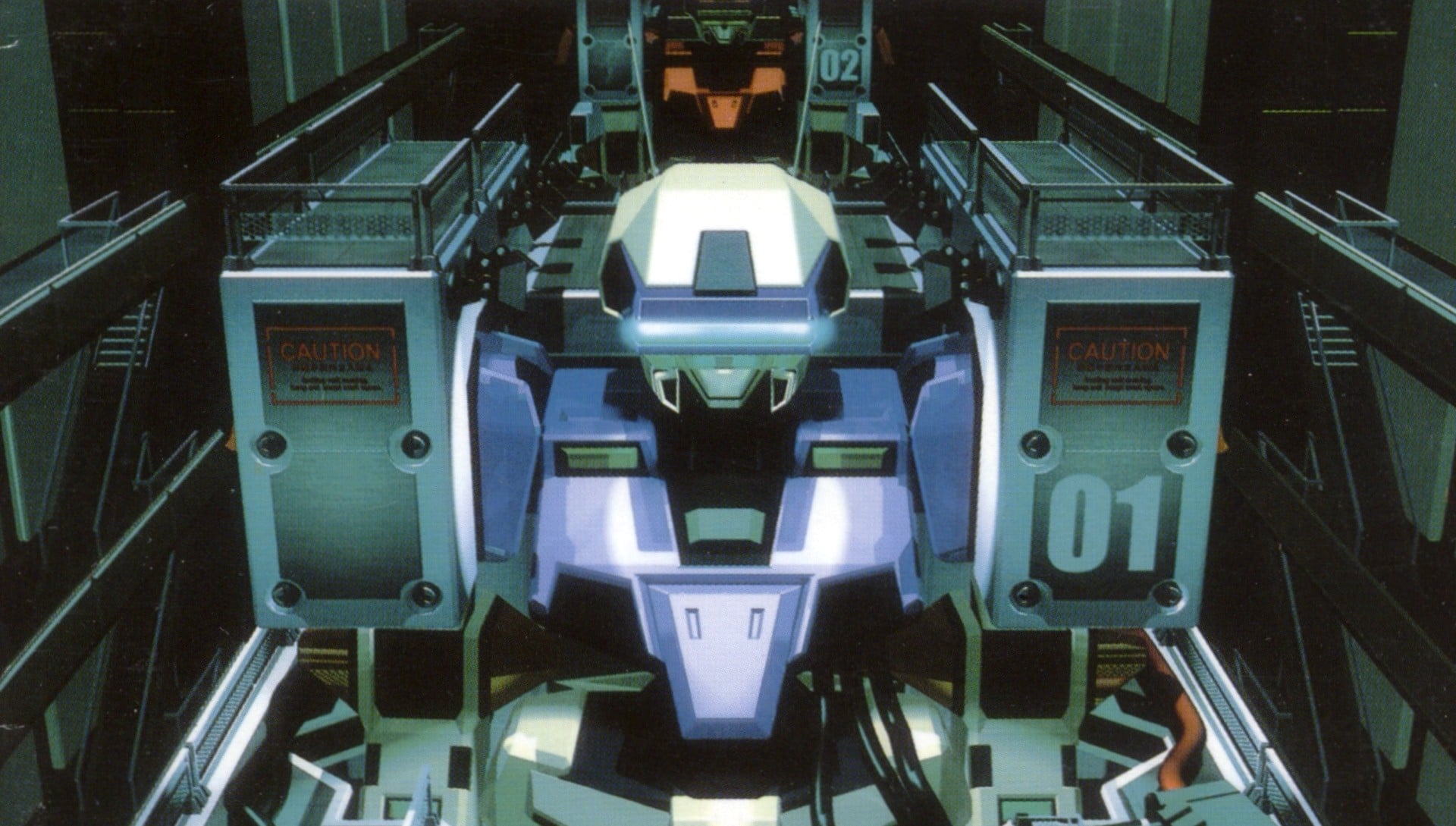
While Armored Core is the analog side of mecha gaming, Virtual-On has always been its digital opposite. To explain why, it’s worth looking at its arcade heritage and how the games evolved over the years.
Prior to Virtual-On, most mecha games tried to vaguely simulate how a mecha might be controlled. Virtual-On eschewed this philosophy in favour of something far more direct: fixed-length vectored dashes with a menu of very specific attacks, depending on the various weapons the mecha had.
Using bespoke TwinStick controls, these had two dash buttons on the top and two weapon triggers. The combination of the trigger inputs produced three types of weapon attacks for each mecha: an often defensive left weapon (left trigger), an offensive right weapon attack (right trigger), and a potent central weapon attack (both triggers together). While there were some variations of attacks assigned to these inputs, this is broadly how they were laid out.
The result of all this was less a manual simulator and more a digital combat game with a high degree of tactical and strategic depth.
The other major aspect of these games was the mecha designs by Hajime Katoki. A veteran Gundam mecha designer by this point, his debut work, Gundam Sentinel, is still highly regarded amongst mecha fans. Katoki also based the heads of the 'Virtuaroids' on Sega’s VR headset from the period, so whether a VR version of Virtual-On was originally planned is unclear.
Unsurprisingly, the Virtual-On games ruled the Japanese arcades back in the '90s.
Virtual-On: Cyber Troopers Arcade
Released in the Japanese arcades on Model 2 hardware back in 1995, the first Virtual-On was a mecha game unlike any other. Using TwinSticks to control your mecha, called Virtuaroids, two players used fixed-length vectored dash attacks across various arenas against other similarly agile mecha.
The dash attacks were also only half of the combat, as the other was up close and personal with an array of very potent melee attacks that could end up being decisive in matches.
The original arcade game also had a small movement freeze at the end of each dash attack, which resulted in a very tactical ballet as you tried to wrong-foot your opponent and catch them at the end of their dash attack.
Ported to the Sega Saturn, the game ended up playing very differently, not least because the dash attack movement freeze was absent (on the pad), resulting in a more reactive rather than tactical game. Weirdly, the TwinStick peripheral for the Sega Saturn version re-inserted this dash attack movement freeze, which put players at an obvious disadvantage against those on a pad.
Cyber Troopers Virtual-On Oratorio Tangram Dreamcast
Effectively a “grand remix” of the first game, Oratorio Tangram took the digital mentality even further, with single-press dash cancels and right-angle directional change “Watari” dashes, named after the creator of the Virtual-On series, Juro Watari. You also had new turbo attacks by combining the dash and trigger inputs.
Oratorio Tangram was also closer to the Sega Saturn port of the first Virtual-On, as the dash attack movement freeze was basically absent. The result was an even faster-paced and reactive type of mecha two-player combat.
Over the course of its life, Oratorio Tangram had multiple versions. The initial Model 3 version of the game was MSBS 5.2, which was balanced into MSBS 5.4. The Dreamcast release was further balanced still as MSBS 5.45. The final Naomi board iteration was MSBS 5.66.
While the Dreamcast version of the game received a US release courtesy of Activision, for many, the Xbox 360 port of MSBS 5.66 is what they know best.
Cyber Troopers Virtual-On Force Arcade
This is where the Virtual-On series started to come off the rails a bit. Force used the then-new Hikaru board and opted for a new four-player setup. The game was also slower and more clunky, partly to balance out the inclusion of four players in any given arena.
Force also used a wingman and leader setup, where killing the leader would net the opposing team a win. The idea here was to make people play as a team, with the wingman protecting their leader, but it often didn’t work out that way.
This was eventually ported to the Xbox 360 and saw limited success, and is often regarded as the official end of the Virtual-On series in the arcades.
Cyber Troopers Virtual-On MARZ PS2
This was effectively a single-player version of Virtual-On Force, set across numerous missions on Mars (hence the name).
However, while the focus was on single-player missions, the lock-on system from Force and prior games remained in effect. That meant negotiating large, complex maps while your mecha locked onto an enemy several rooms away, making navigation quite awkward.
On the upside, much of the complex and involved backstory to the prior Virtual-On games was fleshed out more directly in MARZ.
Arguably, the best aspect of MARZ was the reveal and unlocking of the Shirokis Temjin upon completing the game’s Ultimate Difficulty. This was a beautiful mecha that effectively allowed players to play MARZ at a similarly high speed to Oratorio Tangram.
A Certain Magical Virtual-On PS4
This was a crossover game with the A Certain Magical Index light novel series by Kazuma Kamachi. While obviously being more single-player focused, unlike MARZ, it kept the gameplay to arena battles.
Sadly, the game was mostly terrible and made odd changes to how you did damage to your opponents, which made battles somewhat unclear and confusing.
The game was also delisted on the PlayStation store in 2019, most likely due to the rights lapsing with A Certain Magical Index, leaving only the physical version playable.
In short, this was the whimper by which the Virtual-On series died, a shadow of its '90s arcade self.
Not All Is Lost…
The good news here is that in 2019, Sega released Cyber Troopers Virtual-On Masterpiece 1995~2001 for the PlayStation 4. This set included the original Virtual-On, Oratorio Tangram MSBS 5.66, and Force in one collection – all of which support online play.
Tanita, yes Tanita, also released arguably the best TwinStick peripheral for the PlayStation 4 around the same time, allowing diehard Virtual-On players to reignite their arcade skills online.
The good news in all this is that because PlayStation 4 games are backwards compatible on the PlayStation 5, you can still play this release, and it has a pretty active online community, too.
So while the Virtual-On series was killed off by a light-novel collaboration, the original arcade games live on in what can only be described as a state of mecha gaming Valhalla.