
 by
by 
One of my favourite things as a lover of retro games is coming across lesser-known versions of popular games, particularly obscure ports and reimaginings that may have never been released in the West.
So, as you can imagine, when I came across Super Mario Bros. Special a few years ago (essentially a remix of the original Super Mario Bros. for Japanese computers), I found myself growing absolutely fascinated by this bizarre version of Nintendo's smash hit platformer, wanting to find out everything I could about this unusual, official version of the popular game that I'm betting most people don't even know existed.
Super Mario Bros. Special, for the uninitiated, is a little-known version of Super Mario Bros. 1, developed by Hudson Soft — the first third-party developer for the Nintendo Famicom. Thanks to having helped develop FamilyBASIC, it ended up signing a cross-licensing agreement with Nintendo, allowing it to create versions of Nintendo's games for Japanese computers, including Punch Ball Mario Bros and Mario Bros. Special (both based on the 1983 Mario Bros. arcade game), Donkey Kong 3: Dai Gyakushū, Balloon Fight, Ice Climber, Golf, Tennis, and Excitebike. Super Mario Bros. Special was another one of these titles.
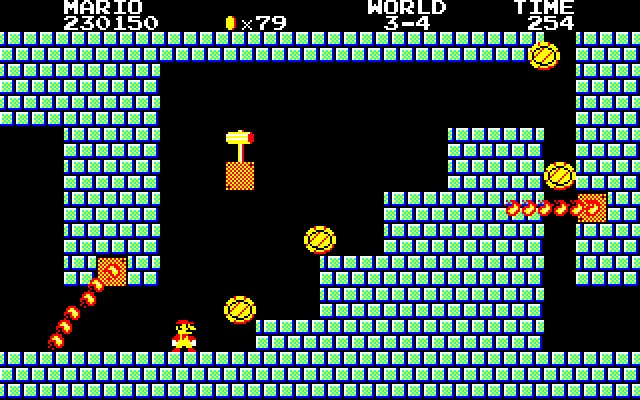
Developed for the PC-88 and Sharp X1, it isn't an exact replica of the version players were familiar with from the Nintendo Famicom due to the limitations of those platforms, featuring "page scrolling" on the PC-88 and delayed scrolling on the X1 in place of "smooth scrolling" people will no doubt be familiar with. This inevitably led to alterations in many of the courses to accommodate these changes, but, interestingly, these weren't the only differences on display. Elsewhere, the game also featured a reduced colour palette compared to the NES version and a bunch of additional items, enemies, and collectables, like the hammer from Donkey Kong, the crab enemies from the Mario Bros. arcade, and the Hudson Soft Bee (which grants you additional points if collected), respectively.
Despite its relative obscurity, I've come across some pretty amazing resources during my research that have provided detailed information about the game. The Super Mario Wiki, for instance, has a bunch of cool details about the game's contents and its differences from the original, while the Basement Brothers has an excellent retrospective on the PC-88 version. In John Szczepaniak's The Untold History of Japanese Game Developers Volume 2, there's even an interview with Hudson Soft's Takashi Takebe (who is credited on Super Mario Bros. Special as a producer, but described his involvement as being more akin to that of a game director). However, I've found that English conversations with the course designer, Ichiro Sakurada, and the programmer, Yukio Takeoka, are much harder to come by, if they exist at all.
As a result, with the help of the translator Stephen Meyerink, I've gone to the effort of contacting both men to get their thoughts on the game, with the only stipulation being that I acknowledge that decades have passed since the original release, so their memories may be a little fuzzy in some areas. The interviews below are presented together, but both individuals were interviewed separately over email, so please bear that in mind while reading. As for whether you should play the game yourself, I do recommend giving it a try if you are in the position to do so — not because the game is especially good, but because it's a fascinating curiosity offering a look at the popular game through the filter of a different team and hardware considerations.
Time Extension: How new were you to game development when you got the job working on Super Mario Special? How experienced was the rest of the team by comparison?
Takeoka-san: When I was in middle school, an article on single-board computers came out in a magazine called Radio no Seisaku, and that's what inspired my interest. I taught myself by reading magazines and copying programs written by others. I started doing it in earnest when I joined Hudson. I worked in sales for about two years after joining the company before transferring to development. As a result, my first development project was the Excitebike port, and Super Mario Bros Special was my second. Hudson's main office was in Toyohira Ward in Sapporo.
Sakurada-san: I joined the company right after graduating from high school, so I had basically zero development experience. They recognised that I had a lot of experience with Super Mario Bros, and so they had me working on level design. I helped out with debugging and such, but no programming. Just after I'd finished with the maps, I had to go to one of the All-Japan Caravan Festivals, so someone else took responsibility for enemy placement.
When I came back to check on things, there weren't any enemies placed in locations that could only be reached by jumping on a turtle/koopa, so I was making fixes right up until the deadline. The lead programmer was an experienced person from Hudson's early days, and the other staffers also had several years of experience each.
Time Extension: What was the relationship between Hudson Soft and Nintendo like at the time you were developing the game? Did they provide you with any assistance with the project?
Sakurada-san: Having developed FamilyBASIC and 4 Nin Uchi Mahjong for Nintendo, the relations between the companies were good. Hudson was also the first third-party developer for the Famicom. Thanks to a cross-licensing agreement, they also had permission to use Mario and had released other products like Punchball Mario Bros.
The only things [Nintendo] supplied us with were colour prints of the character designs. Algorithms, logic, and music data weren't provided. The score was transcribed by ear. And that's why one part of the main background music has a mistake. It's possible we would've received assorted advertising materials. Nintendo did not provide any development support in terms of personnel, either. Hudson handled everything with its own staff.
Takeoka-san: I believe the relationship was good in those days, as Hudson Soft was Nintendo's first third-party developer. And I recall them providing graphic data, course data, etc, though in printed form.
[Writer's note: As you can see, Takeoka seems to recall receiving more stuff from Nintendo than Sakurada does]
Time Extension: Could you describe more about what your personal working set-up was like for developing for PC-88?
Sakurada-san: I created a level editor on PC88. It's kind of like Mario Maker, where you can place the graphics, but it was only images—you couldn't play the levels. That data could be converted to CSV data, then imported into the main program to check how it functioned. I believe the code for the main program was written on PC98, assembled, and then run on PC88.
Takeoka-san: My development environment was a PC-9801. My memory of how I transferred program data to the target system is hazy, but I feel like I used a parallel interface board with an 8255. Prior to the PC-9801, the X-1 was the development hardware, and I remember switching to development just as the shift to the new machine was happening.
Time Extension: Looking at online footage of the game running on the PC-8801/X1, it’s clear it is pushing up against what the hardware was capable of. There are a few interesting quirks, such as the game having no “smooth scrolling” on the PC-88 and X1, and the colours being limited across versions. Do you happen to remember any of these challenges or how you approached them?
Takeoka-san: Graphics and the like were heavy on the PC-8801, so we gave up on drawing 8 colours on 3 planes and instead had to use 2 planes with 4 colours. Even with that compromise, horizontal scrolling was still heavy on the system, and the game required even more precise controls than Excitebike, so in the end, we settled on page scrolling. Because of that, I recall that the maps had to be entirely revised.
Sakurada-san: Switching screens means you can't see what's ahead, so it gets a lot harder. As a result, I redesigned the courses to avoid situations where you could suddenly die. The PC-88 version uses screen swapping, but I recall the X1 version scrolling when you reached the right edge of the screen. When it came to the colour choices, RGB colour reproduction varies, so we used colours that were close.
Time Extension: The game also has many other differences from the original Mario game, featuring redesigned levels and additional enemies. How do you personally describe it? Is it a port, a remake, a reimagining, or something else entirely?
Takeoka-san: I feel like calling it an "arrangement" is the most accurate way to describe it.
Sakurada-san: For me, it's more of a spin-off. Adding original tools and enemies is a very Hudson speciality, but I think it's unnecessary. The course structures are close to the original version, but the difficulty is slightly greater. Because we couldn't implement the looping in Bowser's Castle [World 8-4], I altered the level construction to use pipes at dead ends. When starting underground courses, we couldn't get Mario to automatically enter the pipes that lead underground, so the player has to enter them themselves.
Time Extension: Were you proud of what you achieved despite the challenges mentioned?
Takeoka-san: I was happy when the finished product was released to the public. That said, I did have some regrets about where I thought I might've been able to do more.
Sakurada-san: It was too much for the specs we had available, and I think it was hard to play. It was kind of interesting that there were some course gimmicks we did first, before they were introduced in later Mario series titles. (That's things like re-entering a pipe you'd already entered, spaces only small Mario could pass through, etc.) There was a surprisingly clear divide between home game console users and personal computer users, and there was demand for a personal computer version.
Time Extension: And finally, did you ever find out what Miyamoto or Takashi Tezuka thought about the game?
Sakurada-san: No. I don't think either of them is even really aware it exists.
Takeoka-san: I never especially heard anything about how it was received. However, I do think there was some sort of review that the game underwent at the time of release, so I believe there would've been some kind of feedback given to the sales team or someone thereabouts.
Time Extension: The game has developed an interesting legacy that you might not know about. There is actually a hack for the NES version that brings over the changes from the PC-88 version to the NES with scrolling. It’s been downloaded over 20,000 times.
Sakurada-san: I actually received a ROM of the Super Mario Bros Special version that runs on a real Famicom from some folks interested in the subject.
Takeoka-san: I did a quick search for this after hearing about it and learned of its existence. I feel a little bit embarrassed about it... You may or may not be aware, but the level design was primarily handled by Sakurada-san, who had just entered the company. I believe it may have been his first project.
Time Extension: Thank you both of you for your time.