
 by
by 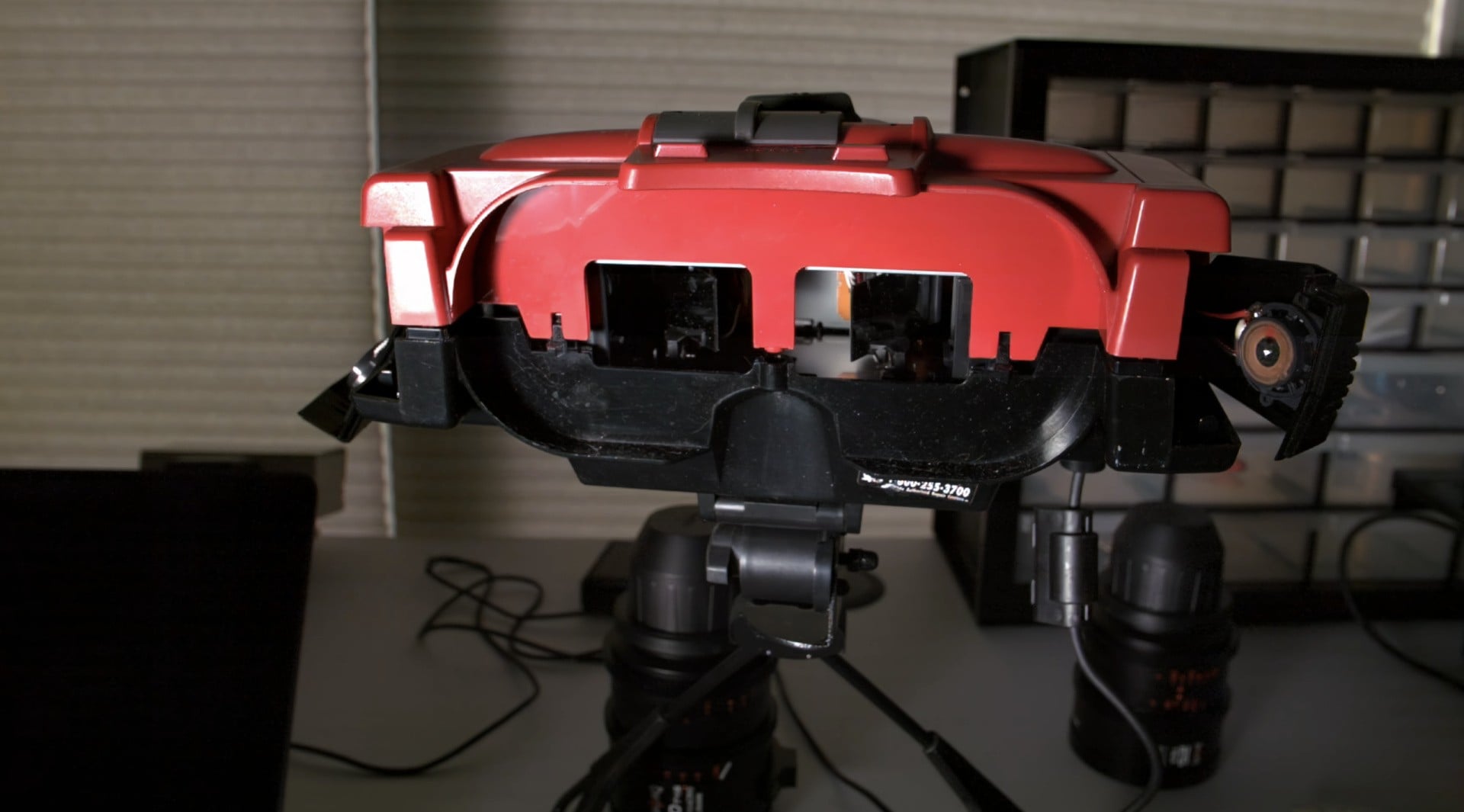
If you've ever been curious about how displaying images on Nintendo's ill-fated Virtual Boy worked, then you should definitely check out the latest video from The Slow Mo Guys.
Released last week, on Friday, January 16th, it sees The Slow Mo Guys host Gavin Free using a mixture of narration, slow-motion footage, and clever editing to demystify how graphics were rendered on the now-infamous machine.
The Virtual Boy, in case you've somehow never heard of it or need a quick recap, was a short-lived machine Nintendo released in 1995 in Japan and the US, between the launch of the SNES and the N64. It was a 32-bit portable console, developed by a team that included legendary Game Boy creator Gunpei Yokoi, and was advertised at the time as being the first video game console capable of displaying stereoscopic 3D.
Initially, Nintendo personnel had high hopes for the machine, believing it would further contribute to their status as innovators in the video games space. However, it ultimately ended up falling flat upon release, with users in the US complaining about its high initial price point, a lack of software, and adverse health effects brought upon by the red-and-black display.
Regardless of that, though, it has managed to build up a strong fanbase among nostalgic collectors and historians, many of whom see it as an interesting footnote in the company's history. This is a reputation that has likely led to Nintendo making the decision to resurrect it in the form of a new peripheral for the Nintendo Switch/Nintendo Switch 2.
While the Nintendo Virtual Boy is often considered today to be one of Nintendo's biggest failures, it is still a fascinating piece of kit, with the recent Slow Mo Guys' video doing a very good job of demonstrating why that is.
In the video, Free starts by taking apart the device before using a Phantom TMX7510 camera (at a frame rate of up to 1,750,000 FPS) to show the surprising way in which its two LED displays work in tandem with oscillating mirrors to create the image you see when placing your eyes up to the machine.
He explains:
"You might be imagining this display as a tiny screen, just like a miniaturised TV you might find in a headset you’ve seen like a Quest or an Index or a Vision Pro. But the displays in this Virtual Boy are very different. Orientated correctly in a vertical manner, they have a resolution of 1 x 224. The entire display is a single column of 224 red LEDs. […] However, when you’re looking through the eye piece, you get an incredible image that is actually 384x224."
As you'll see in the video, the image from the console is blasted into your eyes from left to right, with the mirrors oscillating one at a time to draw the image for each eye using the display on the side of the Virtual Boy headset. While one side finishes, the mirror of the dark eye uses this as an opportunity to reset back to its original position.
You can watch the full video here.