
 by
by 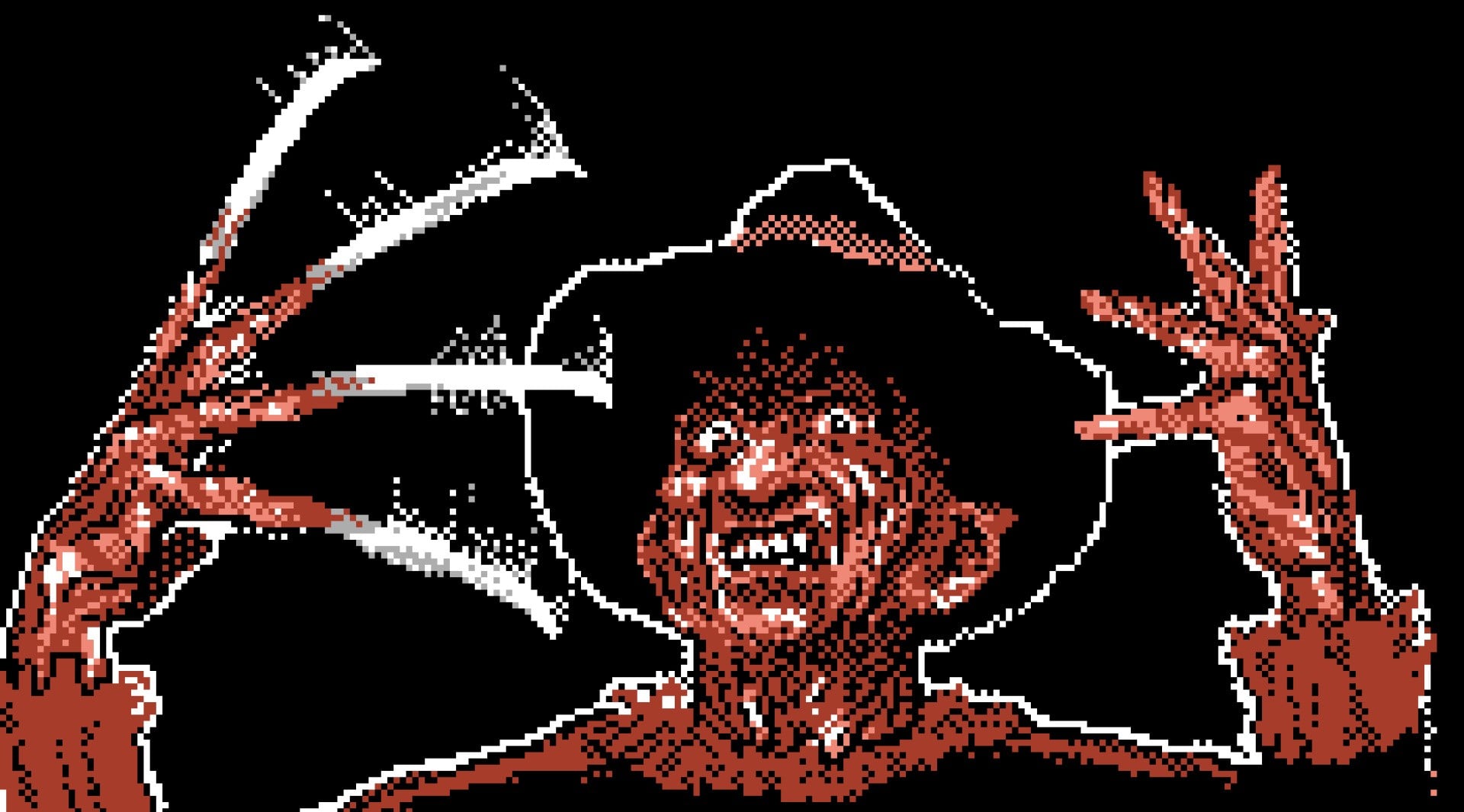
With the recent revelation of a new A Nightmare on Elm Street from Paramount Pictures, we felt it appropriate to examine the video games based on the property. There have been a few examples, including a cameo by Freddy Krueger in Mortal Kombat, and a DOS / C64 computer game – plus a mysterious unreleased title, which I'll get to later.
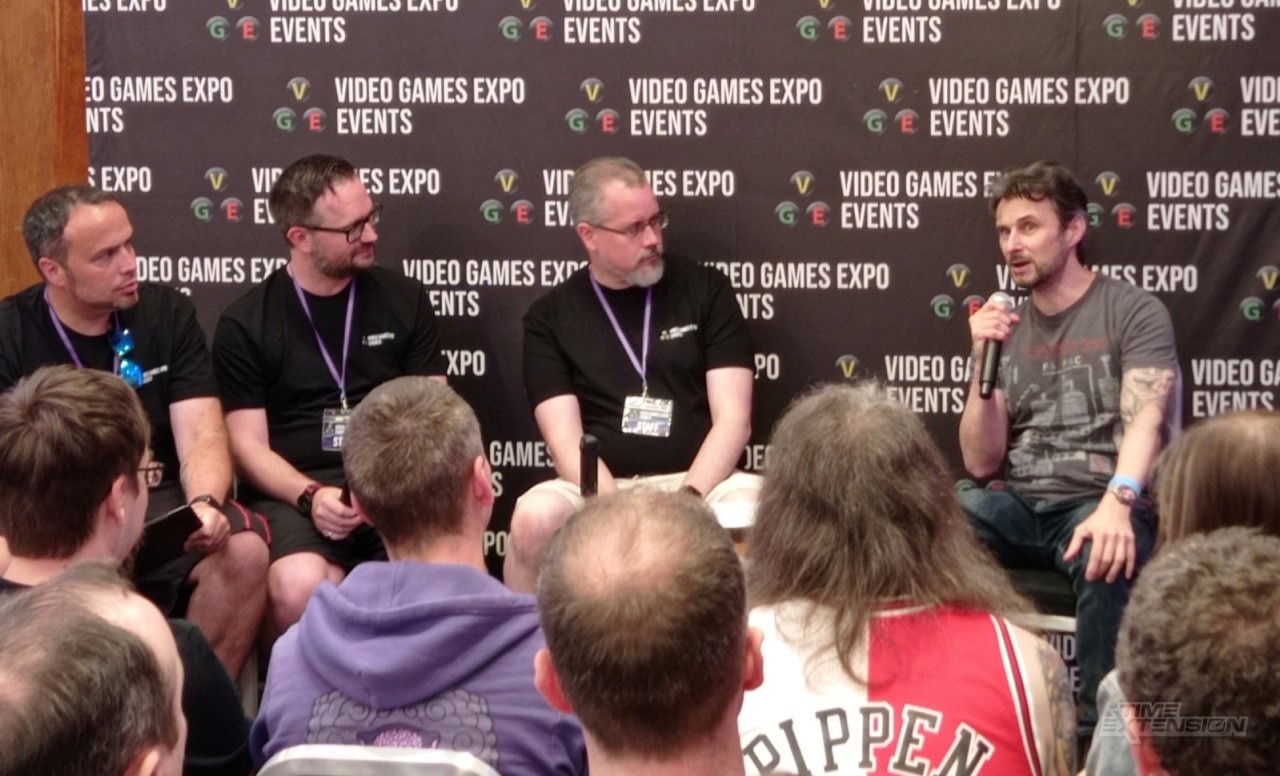
But our focus here is the NES version from October 1990. At the recent Nottingham Video Games Expo, former Rare artist Kevin Bayliss was giving a talk; Bayliss worked on games such as Donkey Kong Country, Diddy Kong Racing, Battletoads, Killer Instinct, Star Fox Adventures, and many others – but I cornered him before the talk specifically to discuss just one thing: his work on A Nightmare on Elm Street.
Development was attributed to Rare Ltd. and Rare Coin-it Inc., with publishing by LJN. Bayliss' recollections were sharp despite the time that had passed – the most astonishing thing is that he was just 18 years old when the project started.
But first, a little background on the timeline. The first Elm Street movie premiered in November 1984; a supernatural horror about Freddy Krueger, a child murderer killed in a fire, who continues his evil from beyond the grave by coming after teenagers in their dreams. The second arrived in 1985, the third in 1987, and the fourth hit the US in August 1988. This latter entry wouldn't reach UK cinemas until May 1989 (typically in the UK at this time VHS rentals would follow six months later, with VHS tapes available to buy roughly a year after the cinema release).
A fifth film appeared in US cinemas in August 1989, followed by the UK in May 1990. The sixth instalment, The Final Nightmare, wouldn't show up until 1991. The NES game was a US-exclusive released in October 1990, and I asked Bayliss how long it had been in development. "It would have been about six months," he confirms. "They went pretty quickly. But that was like one artist and one software engineer. And eventually a designer helping out."
As astute players have pointed out, while the game's title lacks a number, implying it's based on the first film, the central premise of collecting Freddy's bones makes it reminiscent of the third, Dream Warriors. In fact, the manual explicitly describes you as attaining the power of three different Dream Warriors: the Acrobat, the Necromancer, and the Shadow Warrior. But as Bayliss describes it, the game actually took inspiration from the first four films:
"I remember the best thing about making that game was when they said we were going to make it, through LJN - who gave us a lot of licensed projects to work on, like Who Framed Roger Rabbit and Beetlejuice. When we got Nightmare on Elm Street, I was quite excited because I was a bit of a ninja back then. I was totally into martial arts. And I hadn't seen the fourth film yet. I'd seen one, two, and three, Dream Warriors, so we decided we were going to make this multiplayer game, and you were going to become a Dream Warrior when you went into the game.
But then this new video came out, and I can remember sitting there watching it upstairs at Rare, and it was A Nightmare on Elm Street 4: The Dream Master. And there was a guy in that who was totally into karate. And it didn't come out too well for him in the film; I remember he got - just like everybody did - killed by Freddy. But I can remember thinking, well, I'm definitely putting a ninja in it. That means I can basically turn this into a martial arts game!
And so we had the wizard, and we had the athlete, who can jump extra high, and we had a little ninja."
The character Bayliss is referring to is Rick Johnson, who gets killed by an invisible Freddy during a martial arts fight. This anecdote speaks deeply to the creative atmosphere of the time. Given when development started, that VHS would have been in the post-theatrical period, sometime between rentals and sales – perfect timing for an 18-year-old Bayliss to discover it and take inspiration.
In his public talk, Bayliss also described the culture at Rare, how they basically put 20 unattached guys, single, carefree, in the middle of a field, with free coffee and food, and had them watching movies, playing games, having a laugh as friends, and – of course – making video games. It's easy to imagine an excited Bayliss getting the tape, watching it on company time, deciding to integrate this fresh material into his new project, and being allowed to do so. He was living a dream few could even imagine. If you've not read it yet, please check out our deep dive on the early years at Rare's Manor Farm HQ, with comments from Bayliss himself.
Credits for Elm Street are patchy online, with MobyGames, Wikipedia, GameFAQs, and other websites all giving slightly different variations. Who exactly worked on it, and was he the main designer? As Bayliss reveals:
"I worked on the game with a guy called Steve Patrick and we were sort of left to our own devices to make it. Steve was the software engineer on the game. There wasn't really any design, we just sort of made it up. So Steve Patrick did the software for it. Gregg Mayles eventually got involved in design. And of course Dave Wise did the music. And Tim Stamper also did the background graphics on it, or a lot of them.
The bigger things like the houses on Elm Street and... I think it was the junkyard, the entrances as you went along and went into a level. But all of the graphics on the actual platform levels, I did those - I remember them all because you spent so much time on it. And I can remember what everybody did."
This free-form style of creation was common during the 8-bit and earlier eras, before teams grew in size and development moved away from a single programmer designing the gameplay toward more delineated roles. Elm Street was in that periphery between two eras; everybody could contribute to the design and, as we'll see, it changed quite a bit over the course of development. While Bayliss would increasingly be involved in design at Rare, he'd originally joined the industry as an artist, contributing visuals to WWF WrestleMania,Cobra Triangle, Who Framed Roger Rabbit, Double Dare, Pin-Bot, and, of course, A Nightmare on Elm Street.
He describes his first artistic encounter with the sinister killer:
"I can remember sitting there with a huge technical drawing board, with lines inside it. And then I got a photocopy of Freddy Krueger doing this. [poses with hands in air] You know, doing the Freddy pose from some magazine or something, and I had to photocopy it and enlarge it, and slide it all underneath this grid paper, and then using a pencil sort of trace the image, and then break that down into three colours – and because it was on a black background you got a colour for free. And that's how we did the title page. And then somebody, some poor person, had to decode every character by hand and put that in."
This static image would have been drawn using the NES background layer, rather than sprites. Though Bayliss also went into detail on the difficulties of drawing NES sprites, referencing the graphics for WWF WrestleMania and WWF WrestleMania Challenge:
"The biggest problem, on the NES in particular, was sprites on the line. If you had anymore than 64 pixels on a scanline, at any one time, anything you tried to draw after that would disappear. So if you had a character here, [gestures] and you had a character there, [gestures] for example in a wrestling game, and one character fell over, which is part of wrestling, parts would start flashing off. So it was split into these 8x8 pixel sprites, and they were tiny, and when you went past that number of pixels – that terrible number you should not pass – something would disappear.
Or a horizontal shooter, for example Salamander, anything like that – if you drew a character with a long tail, his tail is going to disappear if you've got anything else on-screen on that line. So all that kind of stuff we had to take into account. The way you positioned all of the characters, it would just eat into that 8x8. Today you can just do it all in an editor, and it's instantly on the screen and a lot easier to see."
Some have complained that the title screen is inaccurate, since it shows Freddy without his iconic glove, but this is not true. The UK poster for A Nightmare on Elm Street Part 2: Freddy's Revenge is quite obviously what Bayliss traced from; the poster not only proves the title screen is canonical, but also shows that this one game was an amalgamation of elements from all four movies. However, for anyone who played the game, if you were wondering why the title screen music doesn't quite match any of the film themes, there was a reason.
As Bayliss explains:
"I remember when we put the title screen in, Dave Wise did the music for it. And I knew the films, because I loved the films. But it wasn't allowed. I said to him, that's not how Nightmare on Elm Street sounds. It goes, da-da-da-daaa, da-da da-da. [hums film tune] So I say to him, you've done da-da-da-da-daaa-da. <hums game tune> It's different.
And then later I called him again, and he said, I'm not allowed to use it because it's licensed. I'm not allowed to use that particular music. Because we'd got a spec on what we could and couldn't do. So we had to change and make a similar sounding thing. So from the start, I thought, well, everybody's going to pick up on that straight away, because if they know Nightmare on Elm Street, they're going to know that's not the music."
The earlier mention of Tim Stamper piqued our interest, so we asked for more details on the Stamper brothers' involvement. This brought up a surprising revelation regarding Konami's inadvertent involvement in the game. As Baylis describes it:
"Tim Stamper had done the backgrounds for all of the houses, as you went past on the big screens – because I wasn't really a background artist. And then I remember Chris got the Teenage Mutant Ninja Turtles game which appeared on the NES, which looked really great. Our game, however, wasn't fun.
So I can remember Chris Stamper came on. Because we were working on so many different games we didn't really – as I mentioned – we didn't really have a design team back then. Steve wasn't really a gamer, he was a software engineer, but he didn't really play games. And I didn't play many games other than fighting games, like Double Dragon or Street Fighter, hence the martial arts element.
And Chris came in, and sat down, and he says: 'Right, we're going to look at this, because it's not fun, but we need to make it better. Let's take a look at what's going on here.' Because Ninja Turtles was the closest thing you could compare it to. And you moved along on our game, on Nightmare on Elm Street, and instantly there were baddies everywhere attacking you.
So Chris says, 'Okay, so I know it feels like it's fun to make a game by just throwing things at you, but let's just now have a look at the Turtles game.' [gesturing with arms to show the gameplay] Chris explains, 'Right, I'm moving along, slowly the screen's moving, nothing happens. Oh, here's one scorpion, or something coming along. You've got to learn that you've got to jump that. It eases you in.'"
It's worth noting that Bayliss specifically said Ninja and not Hero Turtles, implying that they were looking at the US game, which came out in 1989. When it later arrived in the UK, it was renamed. Searching online, there's surprisingly no consensus on precisely when the US and UK versions came out. This fan Wiki has August 1990 for the UK; if Bayliss was accurate in recalling it took about six months to develop, working backwards from the October release would put the start sometime around April or May. Meaning if Chris Stamper used the UK release of Teenage Mutant Hero Turtles as a teaching aid, it would have been already past the halfway mark in the schedule.
Regardless of which version and exactly when it happened, this moment represents an evolution in how games would subsequently be made at Rare. As Bayliss says:
"So that was how Chris kind of drilled into us how we need to structure the game, at a different pace. And then I think we took on Gregg Mayles, who then got involved in design. Because I didn't have the time – because I was working on two or three games at once doing graphics, I hadn't got time to work out whether something was fun or not. I just drew characters and expected Steve, the software engineer, to know how to make a fun game.
So that was really a changing point at the company when we had a proper designer, someone who just loved games, wasn't a coder, wasn't an artist, but decided this is how it needs to be. And that changed everything."
This brings up the topic of the game's quality and how polarising it is. I'll get to the negative reactions of various critics shortly, but being honest, I've always been a huge fan of it. Plot twist: Paramount's recent revealing of a new film was not the impetus to corner Bayliss; that was purely coincidental. We'd been wanting to meet Bayliss since he was announced as a guest speaker in Nottingham months ago. Of all the games Bayliss has worked on, I'd specifically wanted to discuss Elm Street, because he'd never been interviewed about it, and indeed there is seemingly no interview material on the game at all. Which is a shame, because in our humble opinion it is quite excellent, and for multiple reasons.
Firstly, it has some banging tunes throughout. Have a listen and then look through the catalogue of NES games from around this time period – it is beset with terrible film licenses, and games which inflict gratuitous cruelty on players. For every fun example, such as Sunsoft's Batman (1989), there are multiple counter-examples such as Robocop 2 (1991), which seems designed solely to traumatise players, having instant death traps just before the exit.
In contrast, Chris Stamper's guidance to the team for A Nightmare on Elm Street is abundantly evident – the game's design is quite generous. Each character can take four hits before losing a life, having five lives and three continues (thus 15 attempts), respawning at the location of death with temporary invulnerability.
It's also filled with neat touches, such as enemies in the dream world taking on Freddy's face while spikes in the ground turn into Freddy's hands; it has an internally consistent thematic style strongly reminiscent of the source material. Also, the order of the first three levels is randomised, keeping the game fresh during repeat playthroughs.
The (second) absolute best part of Elm Street, however, was all Bayliss.
"The elements of the four-player mode were working," he explains, "and I can remember Mark Betteridge came in, picked up the controller, started playing, and he instantly chose the ninja. And Steve Patrick hated all this sort of martial arts stuff that I did. And he [Steve] says, 'why does everybody pick the ninja? Why does everybody, always, pick the ninja?' And I can remember Mark replying, 'Because he is by far the best character.' Those were his exact words. And I thought, 'Ha! I did something right!'"
Betteridge was correct – while all three of the available Dream Warriors have their own unique talents, the ninja (or Shadow Warrior, as the manual calls them) transforms the game into something else. The Acrobat has long-distance javelins to attack and a massive somersaulting jump; the Necromancer fires powerful magic blasts and can hover after jumping; while the Shadow Warrior throws shuriken and performs a flying kick.
The trick is, this flying kick makes you invulnerable, as long as it connects. Enemies or bosses can still cause damage if you clip them with your head or underside, but as long as your foot makes first contact, you'll damage them and fly through unharmed. And there is nothing more fun than leaping around the screen like Bruce Lee and utterly destroying the bosses while they're unable to touch you.
One might be able to argue that this power shift maybe makes the game too easy – but the sad thing is, most of the game's critics rarely even mention the ninja, giving the impression that they failed to read the manual, so don't know how to change characters, or they never got that far. All of the "comedic" performative rage you see online is directed at how difficult the start is, or how thematically dissonant the enemies are. Once you unlock the ninja, the experience becomes transcendent.
The only complaint is that to access the ninja, one has to enter the dream world. This happens when the sleepy ZZZ meter depletes, and the manual implies this is bad. Enemies are tougher in the dream world, and after a while Freddy will show up for a boss fight; thus, you're encouraged to find the coffee icons and boombox radios to stay awake – but this is misleading. It's far easier to shoot an enemy six times from a distance, or take them out with a flying kick, than it is to punch them up close just once while awake. As for the Freddy battles, if you're the ninja, this becomes a fun and easy diversion. Ignore everyone's advice: stay in the dream world forever, b***h!
There are a few flaws worth noting. Bones can sometimes blend into the background, notably on the junkyard, and there's no visual indicator of how many hits you've taken, or how many continues remain, requiring you to keep track mentally. Also, as mentioned, while the waking/sleeping cycle is interesting, as a sort of alternative to day/night cycles, it's implemented unintuitively with misleading information in the manual. Anyone playing as instructed would have found the game more difficult. But, seen as a whole, none of these is a deal-breaker when you factor in all the positives, especially the (number one) absolute best part of the game: the simultaneous four-player mode.
To really appreciate what this attempted, take a moment to think about all the simultaneous four-player games which exist. Go back before New Super Mario Bros. Wii, before the GameCube and N64's four controller ports, before the SNES with its multi-tap. How many 8-bit or earlier games allowed four people to play at the same time? There's Warlords on the Atari 2600, and some others. Plus a few other NES games which used the four-player adapters. But even then, four players was a rare option, and usually confined to sports games or similar, not platformers.
Which means that the Guinness World Record for "First simultaneous four-player mode in a 2D platform videogame" for 'Splosion Man (2009) is in fact false. Someone really should get them to correct that. Unfortunately, A Nightmare on Elm Street for NES also is not the first – that accolade belongs to Sid Meier's Floyd of the Jungle (1982) for Atari's 8-bit computers. Sadly, most online videos only show a single player; this one shows four.
Even though Elm Street wasn't the first, it was still a very early example and historically significant – and if you've been fortunate enough to experience it with three others, it is wildly good fun! The entire flow changes, and instead of simply trying to survive until the end, it becomes more like a crazy party game, with the sort of chaos you'd expect when trying to synchronise four friends.
But again, when you look at screenshots or videos from various reviewers, most show the single-player mode. Which we still contest is great fun, even when alone, but it's also clear that very few people have seen the full scope of what this game offers. We have seen it, keeping a Four Score adapter specifically for this and M.U.L.E. on the NES. Of course, taking screenshots from real hardware is tricky, so all those on this page were kindly provided by Sergei Partsigah from YouTube. When a game offers a multiplayer experience, it's essential to showcase its full potential.
Given its significance, I asked Bayliss if this was baked in from the start. "Yeah, yeah, yeah," he nods enthusiastically. "That was part of the thing – it was, we need to make it four player. We have to – I think it was one of the, part of the criteria was, you have to make it, it has to be four player, it has to support the four player peripheral. [The instruction] was either from Rare Coin-it or LJN. There was some discussion, but that was the goal: it has to be a four-player game, and it has to use this new peripheral. Because we'd had a relationship with Nintendo anyway at the time. They wanted us to make use of that device and that feature on our games."
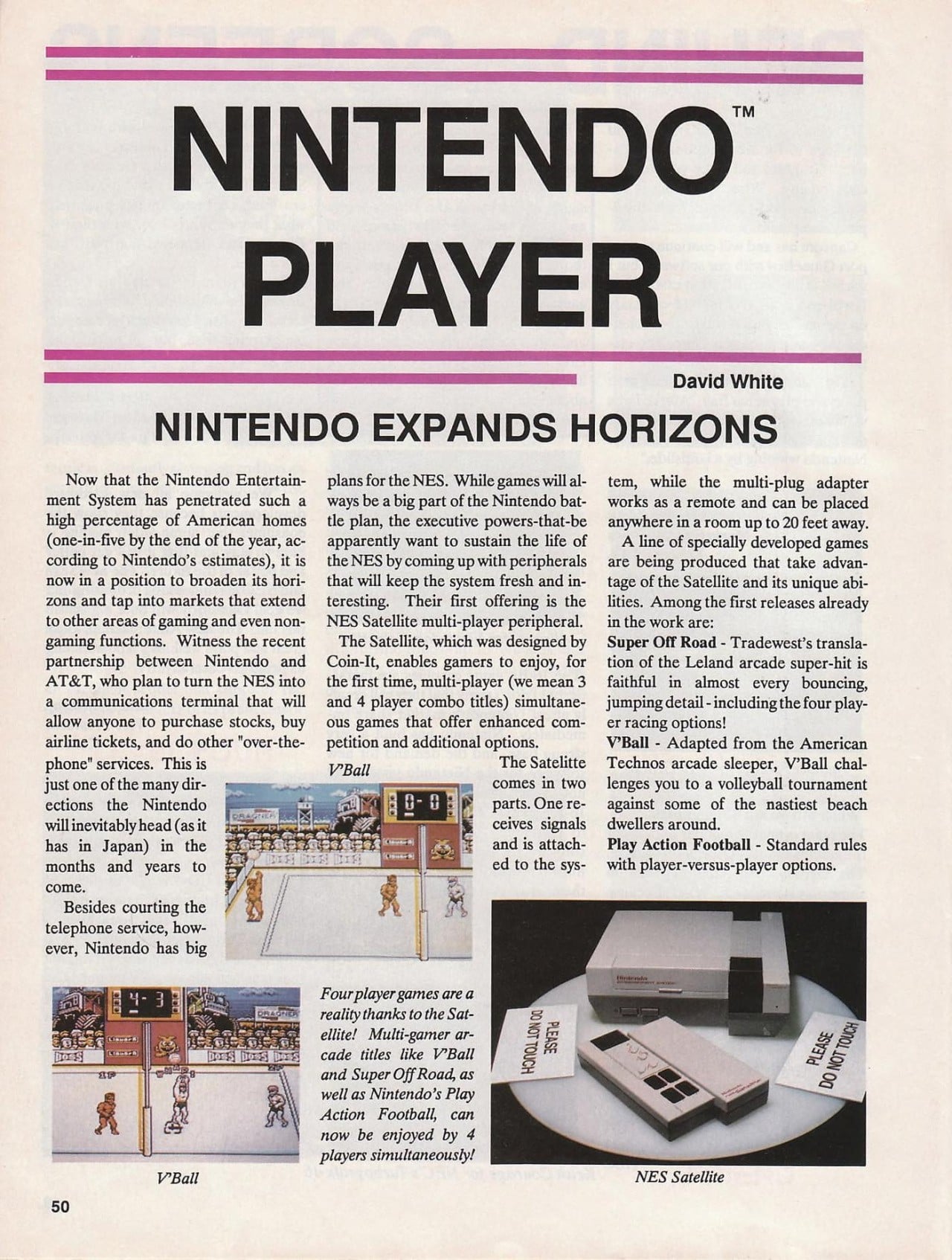
While Bayliss never made mention of it, and possibly wasn't aware, the emphatic need to make it four-player compatible makes a lot of sense when you realise that Rare Coin-It designed the NES Satellite adapter. Issue #3 of Electronic Gaming Monthly, September 1989, on page 50, David White talks about peripherals which will keep the NES "fresh and interesting", announcing the Satellite peripheral and the fact it was by Rare Coin-It.
Here things get a little confusing, since according to MobyGames: "Rare Coin-it, a sister company, was formed in Miami under separate directorship" – and while Rare Coin-It is partially credited on Elm Street, Bayliss and co were very much UK-based. But it makes sense they would be developing games which promoted their sister company's new peripheral.
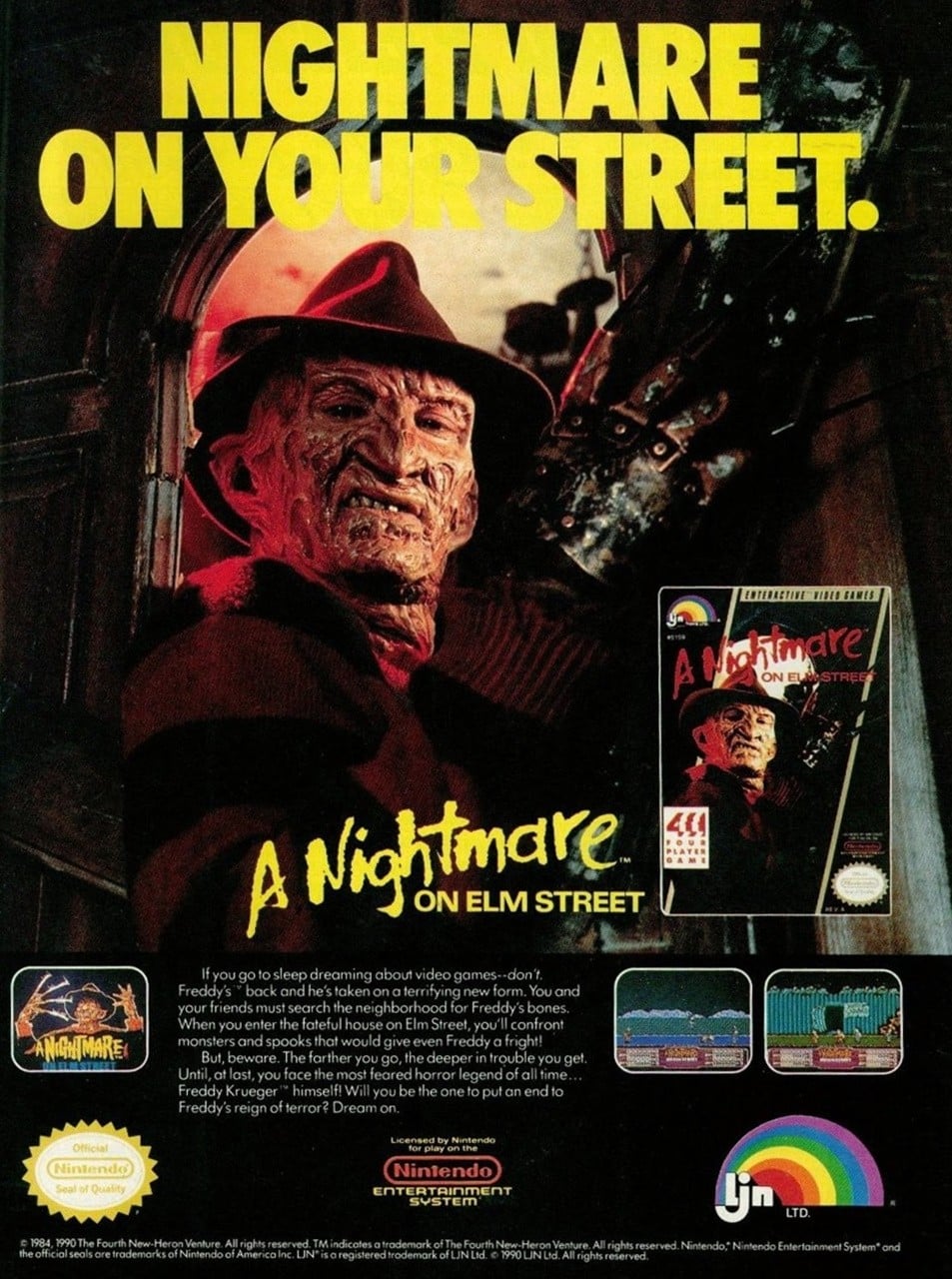
This also brings up another little mystery... EGM would later review Elm Street in issue 11, dated June; due to how magazines are published, this would have been available in May, and the review also states the game was to be released in May. Except it officially launched only in October, and given the six-month development time, it likely started around April (unless development was completed earlier and LJN just sat on it for several months until October).
The sole EGM screenshot shows it being played in single-player, and it looks mostly correct, except that the status bar is at the bottom, whereas in the final version it's at the top. How and why did EGM review it so much earlier than release? I don't have the answers. But it's worth keeping in mind that issue 33 of EGM, page 32, includes a review of The Guardians: Storm Over Doria (6/7/5/5), an unreleased Atari Lynx game whose prototype reached only 30% completion. The Atari Times quotes its developer, Tom Schenck, and I've bolded the pertinent part:
"[It] was dropped at about 30% completion. The multiplayer nature and cart cost were the reasons. The EPROMS were of a slide show with four pictures that was produced for the '92 CES show. EGM never saw a running copy of the game. They made it all up. No-one at Knight Technologies even spoke with them."
Schenck would say more in a Classic Gamer Magazine interview (PDF download). We've taken this side tangent because this incident shows that EGM would generate reviews without having even seen a game running – it's not proof regarding the Elm Street review, but it's a precedent to consider. EGM scored Elm Street 6/4/4/5, saying it's "pretty good in most respects".
In EGM's defence, GamePro magazine gave it a "ProView" even earlier, in the April issue (issue 9, p30), with screens also showing the status bar on the bottom. They described it as a "ripping good time". VideoGames & Computer Entertainment reviewed it in August (issue 19, p43), scoring it a 9/10 for playability and saying, "this game is much more fun than I expected it to be. Elm Street is a successful merger of two different entertainment mediums. Most importantly, the gameplay is good enough to stand up on its own." Their screens also had the bar at the bottom.
Finally, Nintendo Power covered it as a "Video Short" in September (issue 16, p84), again with the bar at the bottom. The text didn't say much, while their "Power & Player Meter" is incomprehensible. As you can see, the reception at the time was mixed, but none of the critics outright hated the game. In fact, some, such as VG&CE, liked it nearly as much as we do! Keep these in mind for when we bring up modern "influencer" reactions shortly.
As a long shot, I also contacted the representation of Robert Englund, the actor who portrayed Freddy, curious to know if he'd ever played the game, if there had been any whispers about licensing while shooting, and to what extent actors were cognisant of things like video game adaptations at that time. Had there been the expectation of merchandising? To my delight, I received a reply from Jennifer, the assistant to Nancy Englund (wife of Robert), who told me:
"Just heard back from Robert's team that he has never played a video game in his life. He does have a Nightmare on Elm Street pinball machine which he has on occasion played. Robert is old school. All the games and merchandise were licensed products and Robert had nothing to do with them. I do recall hearing stories from Robert about how Nightmare on Elm Street was a surprise hit. They all just expected it to be a low budget film and not really go anywhere. Robert accepted the role because he thought the character had possibilities and it was different from other characters he had played. Good luck with your article."
When chatting with Bayliss, we were cognisant of modern content creators and their vitriolic hatred for the game, so we made a point of reassuring him that we genuinely, sincerely liked it – we were not flattering him just to get answers. As it turns out, he was also aware of certain narratives circulating online, as he revealed:
"About 10 years ago, before I got into the whole retro thing, I started looking online at YouTube. I kind of discovered YouTube, and I remember somebody reviewed it, some American guy reviewed it, and said this is a terrible game. 'It hasn't held up over time.' Of course it hasn't - it was 8-bit! And he's saying, I don't remember this being in the movie, and I don't remember this, or this. And it got pulled apart so much."
You could hear the emotion in his voice, especially when he emphasised that it was an 8-bit game. Bayliss never named the YouTuber, but you probably know who it is without clicking this link. In the aforementioned Elm Street video, the host spends nearly 14 minutes eviscerating it before quite literally filming himself dropping his trousers and faux-defecating onto the cartridge.
It's obviously exaggerated for comedic effect – and we should always, always keep in mind that The Angry Video Game Nerd is a character and not a real reviewer – but I often wonder how many developers have shied away from telling the story of a game's development because, when they look online, all they see is outrage – comical or otherwise. While such videos are created for entertainment value and are admittedly amusing, they have a habit of colouring the critical perception of certain games over time. That certainly seems to be the case here.
It's important to stress, then, that not everybody wants to take a dump on this game. For positive modern coverage, this reviewer scores it 86% with a glowing write-up, while the always excellent U Can Beat Video Games describes it as surprisingly good, and gives a detailed video walkthrough on how to beat it.
To his credit, Bayliss never questioned me when I praised A Nightmare on Elm Street, but the lingering question is always whether an interviewee is holding back for fear that I'm just mining them for later criticism.
When the dominant public conversation around certain games becomes manufactured anger (which is itself a money-making enterprise), it discourages developers from speaking publicly about those games. Historians and researchers will thus have a harder time getting first-hand accounts. Elm Street is historically important, and it's an excellent example of why we need to change the style of discourse around older games.
For nearly 40 years, no one has thought to ask about its creation, or why it was missing elements from its source material. Thankfully, Bayliss was keen to set the record straight, going into great detail; but you could also sense his desire to defend the work he and the team at Rare produced:
"We were told by, or we had specific rules from Nintendo. You weren't allowed to put a bar [for drinks], any reference to religion, or alcohol, or blood, or murder, or any of the things that were in those Nightmare on Elm Street films! [laughs]
So that kind of made the game development very difficult. Because for the baddies, that means it can't be anything like a nun or a monk, or anything like that. It has to be... [dramatic pause] a rat! And then when the rat is in the nightmare room, it turns into some kind of monster. You had to get things passed by Nintendo. And if Nintendo aren't going to pass that, [gestures to one side] then it's got to be like this. [gestures to other side]
It's different in Japan. I knew that they could get away with far more, but if you were going to Nintendo of America with a game to get approved... I mean, it was already Nightmare on Elm Street. It was an X-rated film, let's face it; the film wasn't even a 15. So it was a difficult one to work on. Yeah, it was a hard one to do."
Listening to Bayliss describe each component of the development process makes it clear what a challenge it was. For one thing, he revealed how they had to acquire their own resources related to the franchise – getting the VHS of the fourth movie, finding a magazine or poster to photocopy and trace. So I pressed him on what it was like dealing with LJN, what sort of requirements they had, and to what degree the team dealt with Nintendo directly. His reply would also shed light on yet another mystery related to the game:
"LJN were a third party so it was up to them. It would go to Nintendo for approval, but we were just working with what LJN wanted. They would kind of tell us they would like this implemented, or that.
For instance in Roger Rabbit on NES they wanted a big element of the game to be Benny the Cab, which is why we had to have the overworld section to explore, so that you used Benny the Cab in those areas.
But doing film licenses was always difficult. So I remember the game, it came out okay, but I think it also got a bit of criticism, because it was basically a game about a not-so-nice guy with claws on his hands. And I think that's why, I didn't really look into it too much, but I think that's why we got given the license to it.
Because there was a previous version of it, where you controlled Freddy, I'm not quite sure. But it was canned, it wasn't released – or Nintendo decided it's not going to happen. So we did our version. And as you said, the thing that was most impressive about it was the four-player mode."
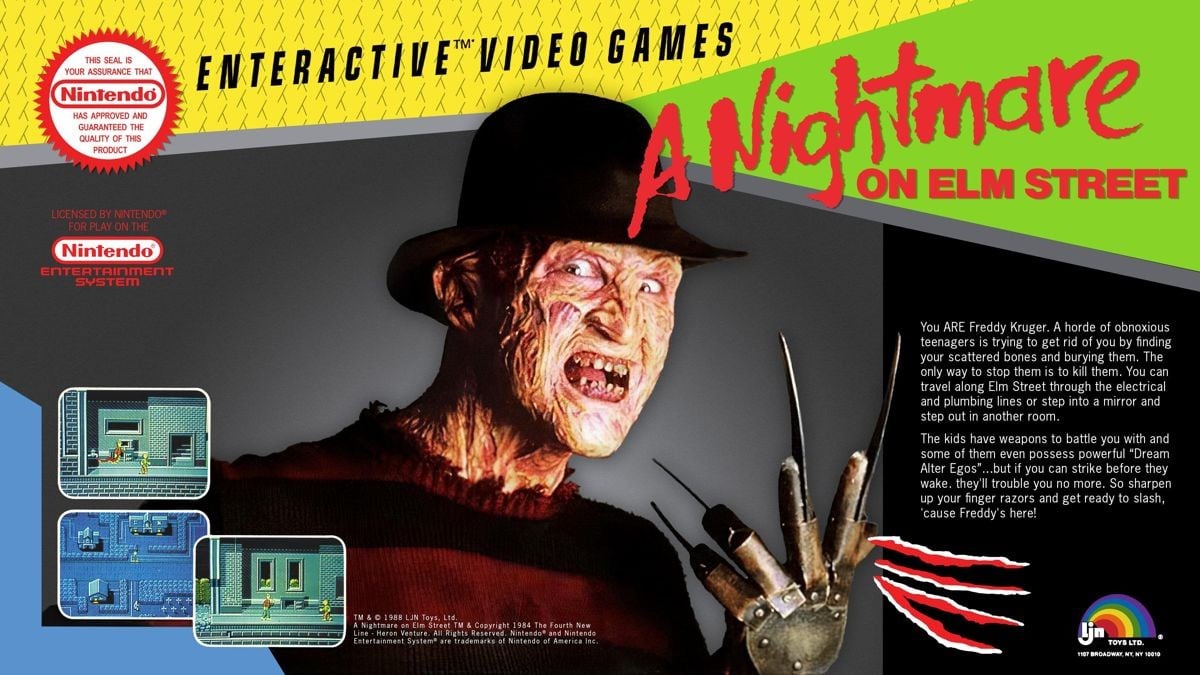
This cancelled "beta version", as fans have dubbed it, was a key topic we wanted to broach. A Nightmare on Elm Street adaptation for the NES was reported as early as 1988 in Nintendo Power (issue 2, p. 86), stating (sic): "YOU are Freddy Kruger". There would be further coverage on this version, with at least five screenshots surfacing: a title screen showing Freddy's iconic clawed glove, an overworld map screen, and three side-scrolling screens showing Freddy terrorising some teenagers (including one where he's erupting from a water tap). An LJN press kit poster had three such images and the following text (sic):
"You ARE Freddy Kruger. A horde of obnoxious teenagers is trying to get rid of you by finding your scattered bones and burying them. The only way to stop them is to kill them. You can travel along Elm Street through the electrical and plumbing lines or step into a mirror and step out in another room."
This beta version was advertised and attributed to the publisher LJN in all the press materials, but based on Bayliss' statement, this cancelled version was not undertaken by Rare. Unseen64 has a page on it. There is also debate that maybe the screens were mock-ups, and the beta never existed.
Finally, I ask Bayliss how he feels, looking back all those years ago. "There's the occasional game that slips my mind," he admits. "But that one in particular, I was excited about it because it was A Nightmare on Elm Street, but then when we got reigned in because of, you know, censorship and stuff, it didn't make it quite as much fun as I thought it was going to be. [laughs]"
Despite the challenges and restrictions, the team did a commendable job. It's just unfortunate that, as a licensed property, we're unlikely to see it released again; with loose copies selling for over £50 and CIB copies nearing the £300 mark, anyone curious to play it will need to get creative. Whether you can find three friends to join you is another matter.