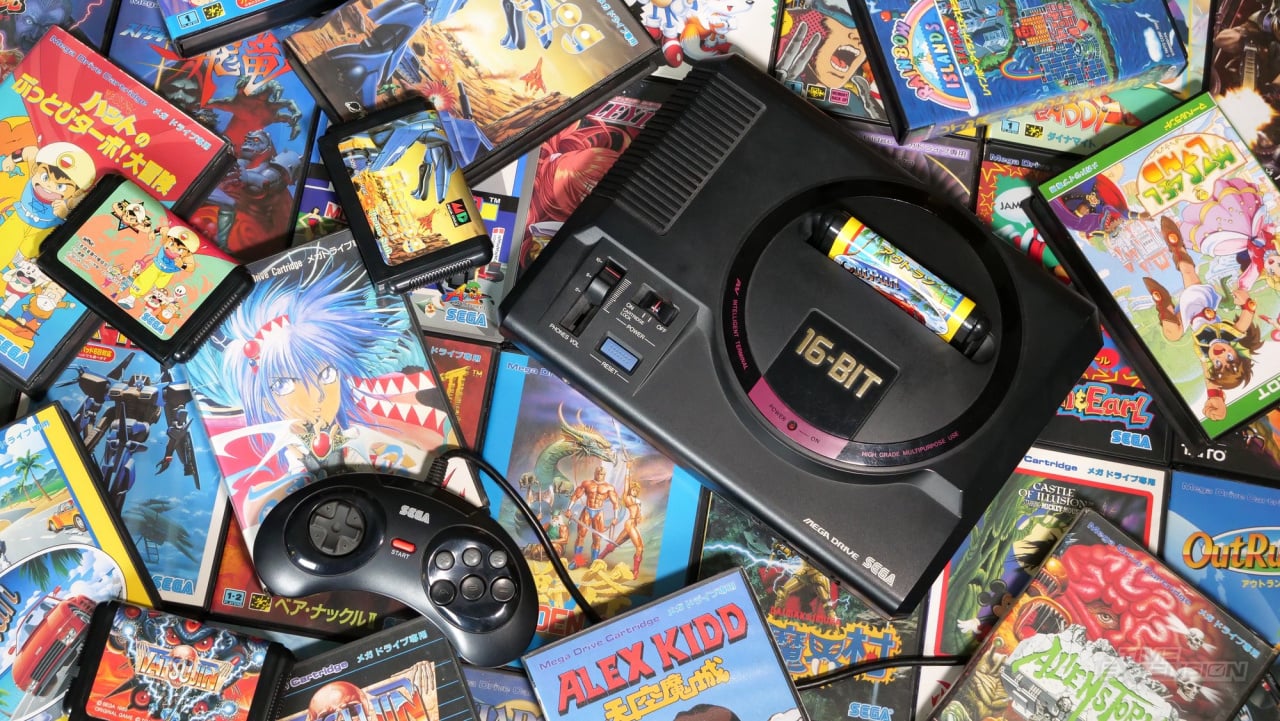
The singular vision of Paul Cuisset, Flashback is an action-platformer that does much to redefine what ‘cinematic video gaming’ means. Via the use of rotoscoped animation and stunning animated cutscenes, the game creates an immersive and compelling world to explore, complete with challenging puzzles, thrilling combat and entertaining platforming action. Released to almost unanimous praise back in 1992, Flashback has become a true cult classic and remains one of the best games of the entire 16-bit era. Utterly essential.
The NHL series – also known as EA Hockey in some parts of the world – ranks alongside Madden and FIFA when it comes to essential 16-bit sports series. This sequel is regarded by many fans as the apex of the franchise on the Mega Drive; it builds on the amazing multiplayer experience offered by earlier entries with new animations, abilities and the opportunity to save your records. Considered by some to be one of the best sports video games ever produced, NHL '94 is a must-have if you’re looking for two-player action on your Mega Drive.
Developed by Game Arts (Silpheed, Lunar), Alisia Dragoon distinguished itself in 1992 by offering sumptuous, anime-style graphics (thanks to the involvement of Japanese animation studio Gainax) and an engaging female protagonist. It’s an action platformer at heart – and a fairly traditional one at that – but the inclusion of four monsters that aid the player makes it stand apart. Sadly, when Alisia Dragoon was localised by Sega for its western release, the anime artwork on the packaging was replaced by standard-issue western fantasy art and much of the Japanese charm was lost. As you might expect, the Japanese version of the game commands high prices today, but if you’re not looking to drop a large helping of cash, then you’ll be pleased to know the game is included on the Mega Drive Mini.
Like Shadow Dancer, ESWAT is one of those odd Mega Drive titles which is based on an arcade machine but totally changes the visuals, gameplay and level design to come up with an entirely new game that has very little to do with its namesake. Also like Shadow Dancer, the Mega Drive version of ESWAT is arguably a superior game when compared to its coin-op sibling; the sense of progression is better (you start as a lowly cop and only earn your Robocop-style suit in level 3) while the stage design benefits from the fact that this is clearly aimed at a home console audience, rather than the arcade crowd which is expected to pump plenty of coins in to keep playing. The visuals are dark and moody but come with plenty of detail, while the soundtrack offers some of the best music from the console's early library. If you like Shinobi-style action platformers, then this is a must.
Coded by a young Yuji Naka – who would later have a hand in birthing Sonic the Hedgehog – this conversion of Capcom's seminal arcade title, like Strider, served as a solid indication of how powerful the Mega Drive truly was back in its early years. While there are visual differences between this and the coin-op original, the core gameplay and feel are incredible faithful, and it's fair to surmise that this version is the one that many fans grew up playing. It's a shame that Sega fans didn't get more from this series; the sequel, Super Ghouls 'n Ghosts, was developed by Capcom exclusively for the SNES.
The Mega Drive is home to a lot of shmups, some of which are better than others. What makes Steel Empire really stand out from its contemporaries is the brilliant steampunk setting; clearly inspired by the likes of Studio Ghibli’s Laputa: Castle in the Sky, the game’s visuals are packed with airships, industrial villages and shattered fortresses. This unique aesthetic really helps the game stand out from the crowd, but it’s the appealing gameplay that makes it all stick together; there’s a reason that Steel Empire has gone on to become something of a cult classic, and has been reissued on both Game Boy Advance and Nintendo 3DS. While the Japanese Mega Drive version is expensive on the second-hand market, the western versions are a lot cheaper and easier to find.
These days, the term ‘rogue-like' is bandied about with true abandon, but back in 1991, the genre was far less famous. It’s amazing to think, then, that Sega was bold enough to publish a title like ToeJam & Earl, which was produced by an external development team and was as oddball as they come. The titular characters are a pair of rapping aliens who crash-land on Earth and must explore randomly-generated levels and rebuild their spacecraft. The game’s two-player mode really opens things up and adds longevity, and the fact that ToeJam & Earl can only defend themselves with tomatoes makes the game stand out as surprisingly non-violent. ToeJam & Earl is unlike any other game on the Mega Drive, and well worth a look, even today.
Released in 2019, Xeno Crisis is a Smash TV-style shooter where you must work your way through an alien-infested base saving hostages and fragging anything even remotely hostile. Developer Bitmap Bureau does an excellent job of pushing the hardware to its absolute limit both visually and sonically, while the two-player mode keeps things interesting. Xeno Crisis was also released on modern systems like the Switch and PS4, as well as the Neo Geo AES and Neo-Geo CD.
Long before FIFA became the microtransaction-filled monster that it is today, it was a surprisingly refreshing isometric kickaround that solidified the Mega Drive’s reputation as the best console for sports games. This sequel – the first to have a year included in its title, fact fans – is a big improvement over the original, retaining the gloriously fast gameplay while adding in some welcome extras. FIFA would of course move into the realm of 3D with FIFA 96 on the PlayStation and Saturn (and it’s important to note that a 3D version also appeared on the ill-fated 3DO), but there’s something undeniably comforting about a FIFA which has a fixed, isometric perspective.
If Gunstar Heroes was Treasure showing what it could do on the Mega Drive, Alien Soldier is the studio taking things to the next level in every respect. One of the most technically stunning games ever released on the Mega Drive, this epic run-and-gun title is best described as one long boss rush, with short levels in between. Seen by many as the perfect swansong for the Mega Drive – the ‘hardcore gamer’ console – Alien Soldier is breathtaking in its scope, but hardly the most welcoming of action games for genre newcomers. It was only released physically in Japan and Europe back in 1995 (the North American release was limited to the company’s ‘Sega Channel’ service) so expect to pay high prices if you’re hankering for the original cartridge.
An enhanced port of Taito’s 1987 arcade smash hit, Rainbow Islands Extra was sadly denied a western release back in the day and is now quite an expensive purchase on Japanese import. It’s worth tracking down, however; it’s a fantastic facsimile of the coin-op boasting faithful visuals, sound and controls. The ‘extra’ in the title refers to the fact that this conversion includes ‘Rainbow Islands Extra Version’, which is a modified version of the original coin-op with new enemy and boss placement. You can choose to play the original game or the ‘extra’ version from the title screen.
While the SNES was positively drowning in amazing RPGs back in the ‘90s, there was a viewpoint shared by some which felt that Sega’s 16-bit console was sorely lacking in this particular department. Presumably, those same people hadn’t noticed the amazing Landstalker, an isometric action RPG from the same team that co-produced the Shining series with Camelot Software Planning, Climax Entertainment. The perspective meant that the developers could incorporate platforming elements into the gameplay, which makes Landstalker feel very different from other examples of the genre. Combat and puzzle-solving also play a part, while the sumptuous visuals really help the game stand out. A PSP remake was in development at one point, but sadly never saw the light of day. Climax Entertainment sadly shut down around 2014.
This manically-paced and stunningly inventive platformer proves that there’s more to Treasure than run-and-gun blasters. Like all of the company’s games, Dynamite Headdy is a technical showcase and really pushes the host hardware to its limits. However, it’s the core gameplay hook – Headdy’s interchangeable heads – which really sticks in the memory with this one. 17 different heads on available in the game, giving the gameplay a truly unique flavour. Another nice touch is that the levels you’re playing through are all set on a theatre stage, and you often catch glimpses of this fact in the backgrounds.
Lazy comparisons at the time of release wrote this off as a Zelda clone, but Crusader of Centy (Soleil in Europe, Shin Souseiki Ragnacënty in Japan) is very much its own thing. While it looks and plays similarly to Zelda: A Link to the Past, Crusader of Centy introduces animal helpers who can aid the player character in a wide variety of ways. Throw in a cool cameo appearance from none other than Sonic the Hedgehog and you’ve got a charming action RPG that absolutely deserves your attention, even today.

 by
by