
 by
by 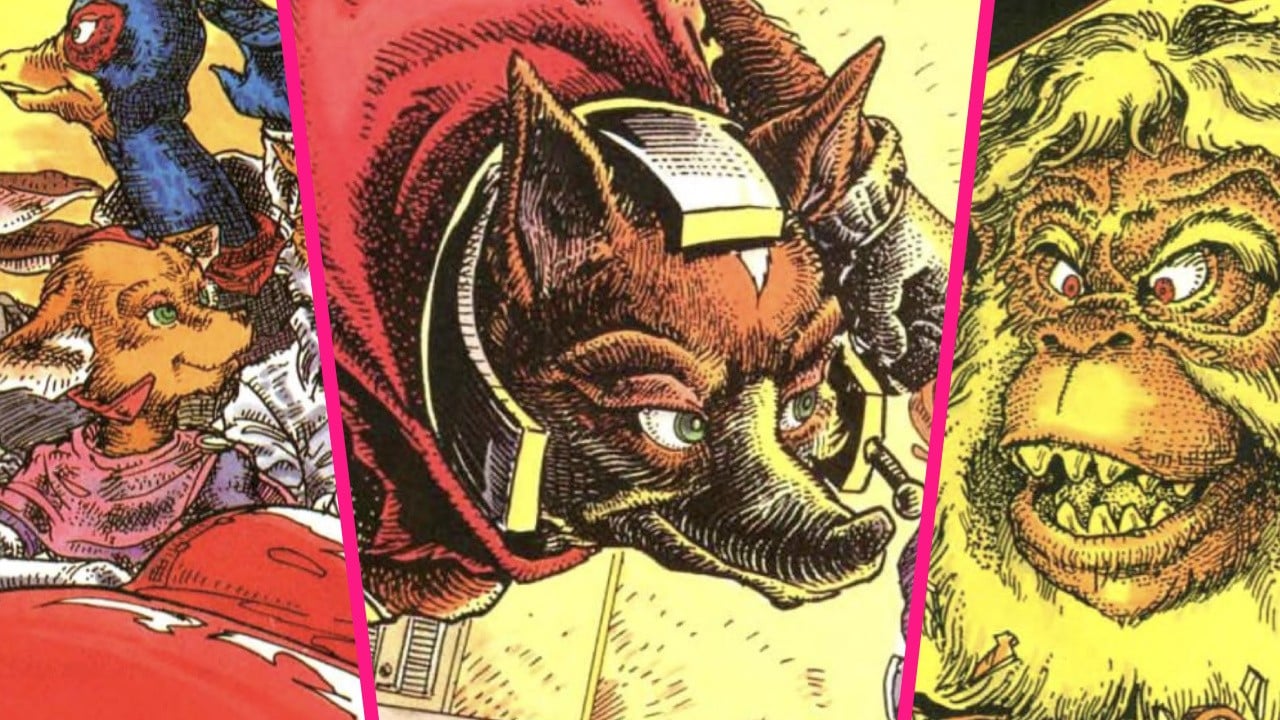
Growing up in the UK, I don't necessarily have the same fuzzy memories of Nintendo Power that a lot of my North American friends do, having grown up on our own official Nintendo magazines (which originated way back in 1992 with EMAP's Nintendo Magazine System).
As a kid, I probably had a vague idea of what Nintendo Power was, based on occasional references in the British games press at the time. However, it wasn't until much later, with the rise of the early video game YouTubers, that I came to understand its impact on American players and began seeking out copies myself to see what I'd missed out on, living on the other side of the Atlantic. Only then did I begin to discover some of the incredible artwork and stories in its pages, such as Benimaru Itoh's spectacular Star Fox comic, released to coincide with the promotion and launch of the original SNES game in 1993.
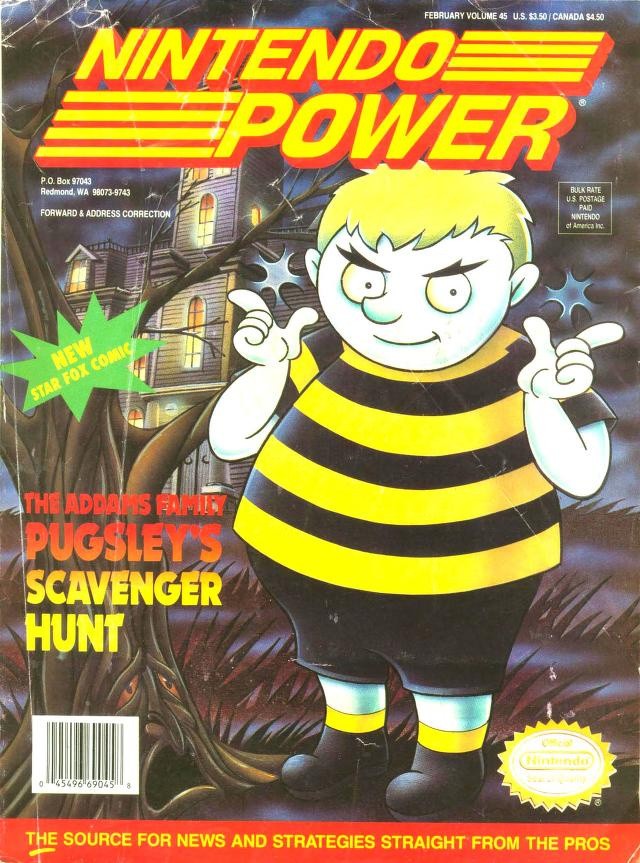
For the last few years, I've been trying to secure an interview with Itoh-san to ask him about his work on the comic and find out more about this early attempt to expand the world of Star Fox beyond the confines of the games. However, I struggled to get any response to my inquiries via the contact form on his website (which admittedly hadn't been updated in quite a while).
This was pretty much the situation through all of 2023, 2024 and 2025, until earlier this year, when I contacted the former Nintendo Power Editor-in-Chief (and all-around great person) Gail Tilden, who offered to put me in touch with Itoh-san, provided I had a Japanese-to-English translator to help assist with the interview (thanks for the assist, Stephen Meyerink!).
What follows is a rare interview with Itoh-san about the making of the comic, covering his artistic influences, the creation of the original character Fara Phoenix, and why he gave Andross his own tragic backstory. But before I get into all that, I thought it might be worth prefacing this interview with a brief history of Nintendo Power comics to give some additional context, in case you're like me and grew up without the magazine.
A Brief Introduction To Nintendo Power Comics
Right from the very beginning, comics were a feature of Nintendo Power, though early on they were usually limited to a series of strips called Howard & Nester, depicting interactions between the president of the Nintendo fan club, Howard Phillips, and a cocksure kid named Nester. The first couple of issues, for instance, saw Phillips interrupting Nester playing the original NES The Legend of Zelda to give him advice on how to find levels 8 & 9, or where to use the magic potion in Super Mario Bros. 2, with Phillips trying to impart his gaming wisdom to Nester and his friends, while Nester constantly ignores him and pokes fun at his bowtie.
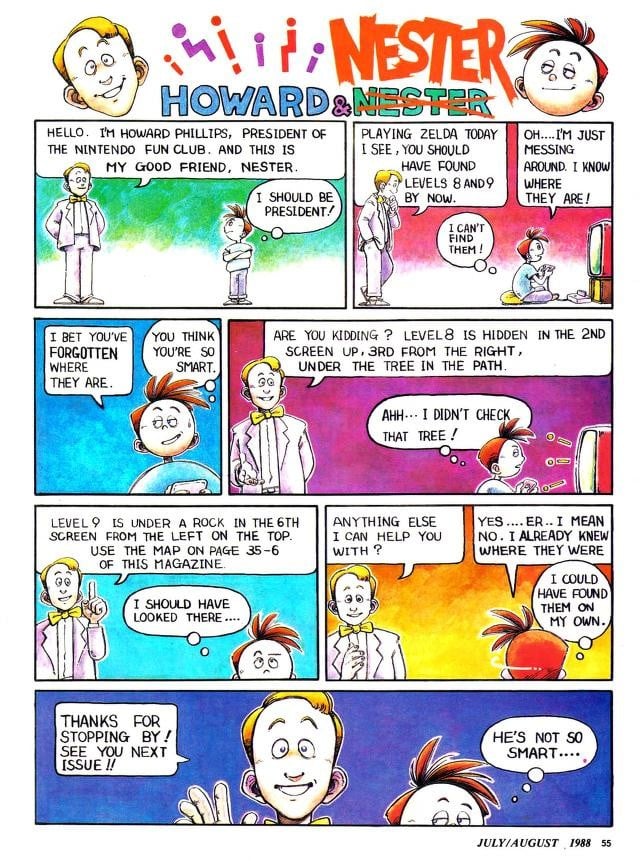
Based on comments Phillips has made in the past, these are believed to have been drawn by the Japanese artist Shuji Imai for the first 22 volumes, before a New York-based artist called Art Nichols took over from volume 23 onwards (as revealed in the back of the April 1991 issue).
Speaking to the Video Game History Foundation in February 2022, Phillips had this to say about the origins of the comic:
"Gail especially was driving for 'We can’t just have more of the same. We can’t just have more and more tips & tricks. We need to present things in a different way to make it interesting as a magazine.' And, I’m pretty sure [it was Gail] who said, ‘We’ll just do characters talking to each other, one of them is the know-it-all… and the other is the quintessential kid. The more we talked through it, the more it became quite clear it was a nice vehicle to present things without really spoiling the tip, but also having the kid act as the reader."
However, when I ran this past Tilden, she offered another potential reason behind their inclusion: the Nintendo of America president Minoru Arakawa, who had noticed the success of manga magazines like Shōnen Jump in Japan:
"The genesis of the comics in Nintendo Power was Mr. Arakawa's idea. He was aware of how popular weekly comics like Shōnen Jump were in Japan and had seen his daughters excited to read them (I was at their house for a PR event one day and saw the stack of manga myself). He thought there wasn't much difference between kids in Japan and the US and thought comics would be a good addition to NP."
A regular fixture of the magazine, Howard & Nester quickly became a core part of Nintendo Power's identity in its early days, with the character of Nester becoming the face of the Nintendo Power awards, and also later appearing in his own spin-off comic Nester's Adventures (after Howard Phillips left Nintendo for LucasArts in 1991). Other comics eventually followed, including an adaptation based on Rare's Battletoads, which featured in the magazine from May to June 1991. What was significant about this comic, in comparison to Howard & Nester, is that its initial volume didn't just seem to be a vehicle for delivering tips and tricks, but instead acted as an excuse to dive deeper into the story of the upcoming NES title, marking something of a change in direction.
Following that, Nintendo Power continued this trend with the legendary manga author Shotaro Ishinomori for The Legend of Zelda: A Link to the Past (which ran from January 1992 to December 1992), before partnering with Benimaru Itoh for a comic based on Nintendo & Argonaut Software's upcoming sci-fi adventure Star Fox, to be published the following year.
At this time, Itoh had already been active in the music and art world for a couple of decades, working as a freelance puzzle maker/illustrator for a broad range of clients, big and small, but reportedly came to Nintendo's attention through supplying artwork for various Nintendo game guides in Japan.
A Q&A With Star Fox Artist/Writer Benimaru Itoh
As you can imagine, given the base game's lack of exposition, Itoh's Star Fox comic couldn't just rely on what was present on the cartridge and in the game manual to make a compelling story. So, he set about expanding a lot of the ideas that the development team had already come up with. The comic, for instance, keeps the same basic setup of General Pepper drafting the young and inexperienced Star Fox team to battle Andross and save the Lylat system, but adds a few more wrinkles.
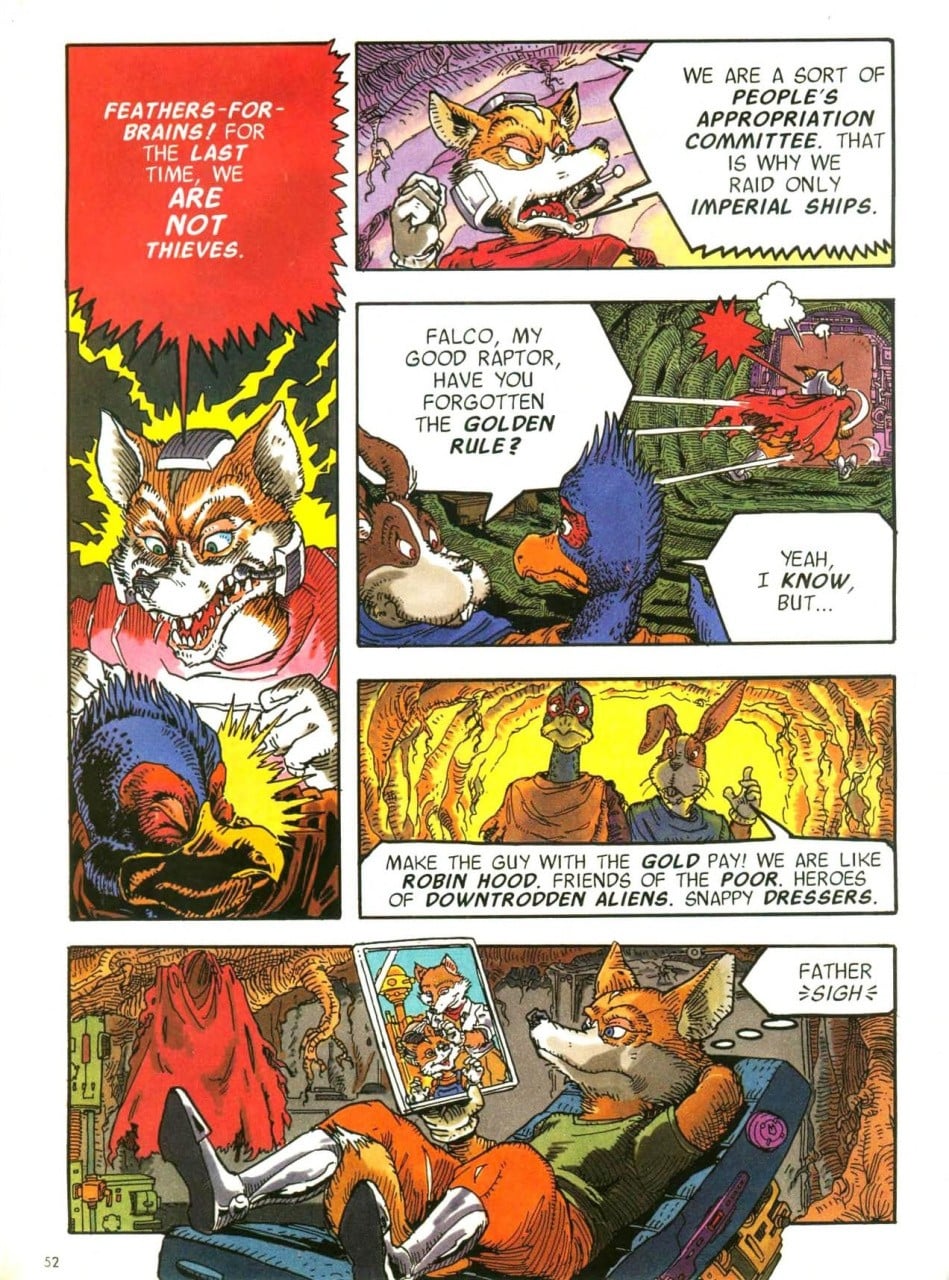
When we first meet Fox, for example, he isn't behind the controls of his Arwing ready to ship out to the planet Corneria, but is instead hiding out on his home planet of Papetoon, where he is busy stealing from imperial ships, acting as an almost "Robin Hood"-esque hero to the downtrodden. In addition to that, there are also more details on the fate of Fox's mother and Andross's role in her death, the whereabouts of Fox's father (inside a giant spaceship shaped like a whale, in case you're wondering), and Falco's origins as a motorcycle-riding street thug (yes, really!). The result is an engaging, yet often bizarre, dive into the world of Star Fox (translated by the now-Nintendo localisation senior manager Dan Owsen), which ultimately had a small yet fascinating impact on the future of the series (as you'll end up discovering below):

Time Extension: How did you get involved in the Star Fox manga?
Itoh: Back in those days, I worked as a freelance commercial illustrator doing posters and magazines and such. Some of that work included contributing puzzles and manga and the like to Shogakukan's various Nintendo Official Game Guidebooks. From what I understand, Mr. Miyamoto and the other Nintendo staff liked my super-stylised Mario and other character illustrations in those books.
Around that time, Shotaro Ishinomori's The Legend of Zelda series serialised in Nintendo Power had come to an end, and the decision was made to base the next work on Star Fox—and I was offered the chance to be the writer. Given how things had unfolded to that point, I first presented them with the concept of a manga in the style of my Mario art, but Mr Miyamoto rejected the idea, saying that such a style would've worked before, but not for this project. Also around that time, Shirogumi had created a stop-motion puppet animation for a Star Fox TV commercial, and it seems as if the expectation was more in line with something of that flavour. (That commercial never ended up being used, and only a photo of it was used for the package.)
So, I took that inclination and tried a different presentation, hunting for a style that merged Virgil Finlay and Mœbius (Jean Giraud). Virgil Finlay was a popular illustrator who worked on 1950's American sci-fi pulp magazines utilising the scratchboard stippling/crosshatch technique, and I was a huge fan of his. At the same time, there were many people within Nintendo who were fans of Mœbius' style, and I thought if I combined those styles, they would also be well-suited for serialisation in an all-colour graphic novel style, and in so doing create a new kind of comic. This was readily accepted, and so things began progressing towards serialisation.
Time Extension: When you were coming up with the story concept, did you have much communication with Mr. Miyamoto? Or did you have any directives from Nintendo?
Itoh: As you might know, the first Star Fox was a 3D shooting game equipped with an FX chip, and it didn't have any side stories, so Mr. Miyamoto requested that I develop the story freely. And so, I followed on with the game concepts like the Arwing and the Lylat System, and then created the rest on my own. During the pre-translation storyboarding checks, I didn't receive any requests for revisions.
Time Extension: Fara Phoenix debuted in the manga. She's a test pilot and somewhat looks like Fox's mother. Do you remember anything about the reason for her creation?
Itoh: I felt that adding a woman character would help bring out some depth in the story, and Fara Phoenix was one that I suggested. While she's still a fox, I based her on the fennec fox, whose cute ears and large black eyes made her well-suited to a female character. Fox being reminded of his mother's appearance was also an original suggestion by me (since his relationship with his father comes out in the game...)
Note: Later Star Fox titles feature a female character designed by Nintendo's Mr. Imamura, so I think this was a meaningful suggestion. (And I must say, Mr. Imamura has a style akin to Frank Frazetta.)
Time Extension: It seems that Planet Papetoon, Fox’s home planet, was first referenced in the comic. Did you come up with the setting yourself, or was that something Nintendo had already created? It doesn’t seem to be referenced in Star Fox (1993), but it appears in Star Fox 64 years later and is referenced in other games.
Itoh: Yes, that was something I proposed. Originally, the word "Puppetoon" referred to a technique that used transformable puppets that the stop-motion and special effects master George Pal started in the 1940's. And since the original TV commercials were also puppet animation, I named the planet out of my great respect for the master (I'm a huge George Pal fan, too). [Translator note: In English, the Japanese word "Puppetoon" is rendered as "Papetoon" in the Star Fox universe's localised entries.]
In addition, given the polygon display capabilities of the time, things in the game like the Arwing were put together thanks to great efforts by Mr. Imamura and the others at Nintendo, but in the manga, I thought a lot about the varied, detailed internal construction of those things (along with this, I came up with the name of concepts like the G-Diffuser anti-gravity device). The series kept on making use of these various details, which is why I continued to be accounted for in the credits of the games.
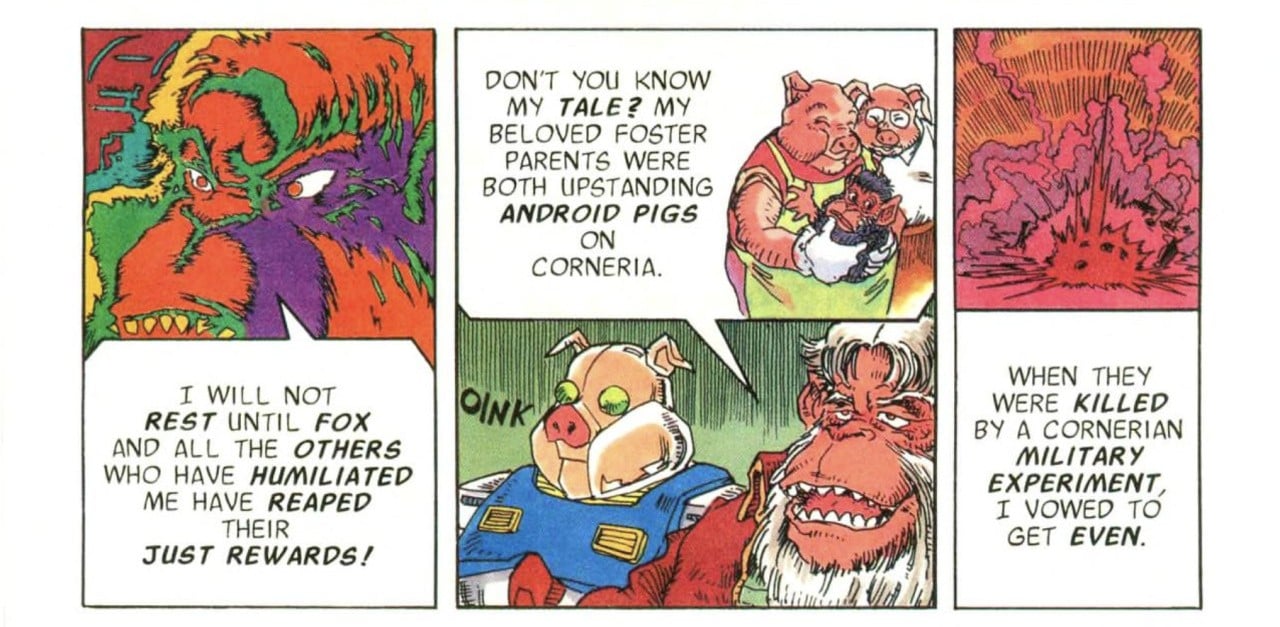
Time Extension: One of the interesting additions to the Star Fox lore you introduced is the decision to give Andross a tragic backstory in which his adoptive parents were killed by the Cornerian army. Why did you decide to give this other layer to Andross’s character, rather than simply have him be unambiguously evil?
Itoh: Back in those days, I felt there was a big difference between American comics' tendency to portray a strong sense of "reward good and punish evil," and Japanese manga's propensity for trying to accurately depict the logic of the enemy. And in this case, I felt that the concept of asking why the enemy, Andross, came into existence added depth to the story (this thinking was also shared by my lifelong hero and inspiration, Osamu Tezuka-sensei)
Time Extension: Finally, it seems there are many references to other forms of media in the comics, including The Beatles, the story of Robin Hood, and even the Commodore Amiga (there’s a poster in the Papetoon Telegraph). Do you have any favourite easter eggs that you think fans may have missed?
Itoh: You've got a sharp eye. I'm humbled. Star Fox originally came from an Amiga game called Starglider developed by the British studio Argonaut Software, and you might be aware that staff from that game joined Nintendo to help make Star Fox.
I used an Amiga in those days, so I included one as an Easter egg to pay homage to this excellent, advanced system that had disappeared. I also included various other hidden details like Robin Hood, The Beatles, and a robot painted red, white, and blue, too [like a Gundam]. In Japan, we called this a "gakuya ochi" or inside joke, and it was another thing I picked up from Tezuka-sensei's method (and in those days, calling them by the term "Easter eggs" wasn't yet a thing).
I've answered with about everything I can recall. If you have any further questions, please don't hesitate to ask. And once again, thank you for your interest in my work.
Time Extension: No, thank you! We really appreciate you agreeing to do this! We may just have to take you up on that offer.
What Happened After
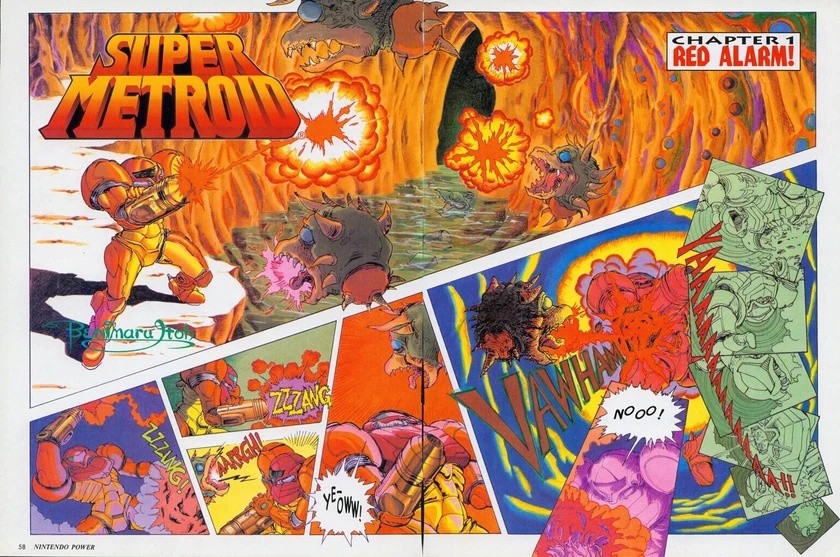
Just in case you're wondering what happened to Itoh after his work on the Star Fox comic, he famously would later end up contributing his artistic talents to another serialised comic for Nintendo Power based on a Nintendo property: Super Metroid.
This was a loose adaptation of the story featured in the SNES game of the same name (which was released during the comic's run), seeing the bounty hunter Samus (depicted here as a cross of "Princess Leia and Ripley from the Alien series") once again going in search of Ripley, who has stolen the last Metroid larva. In total, this ran for five issues from February to June 1994, and marked the first mention of Samus's home planet, K-2L, which would later be referenced in various other pieces of Metroid media as well as Super Smash Bros. Melee (similar to how Papetoon and G-Diffusers continue to be used in the Star Fox series to this day).
?file=SM_comic.jpg)
Notably, Star Fox and Metroid would by no means be the sum of his contributions to the world of Nintendo, however, with Itoh later joining the Japanese game company Creatures Inc. as a founding member in 1995, where he would also go on to work on various Pokémon projects (including video games, merchandise, animation) as well as other projects like the unreleased Mother 64. As he notes on his website, he stayed at Creatures for six years before leaving in 2001 to join Hal Laboratory in an advisory role.
Since then, his name has appeared in the credits of a bunch of different Kirby games, including Kirby: Nightmare in Dream Land, Kirby Air Ride, and Kirby Super Star Ultra.
Nintendo Power, on the other hand, continued to run independently until 2007, at which point Future US accepted a contract to take over the magazine. Under Future, the magazine would run for a further five years before Nintendo decided not to renew the licensing agreement. Its final issue was released in December 2012.