
 by
by 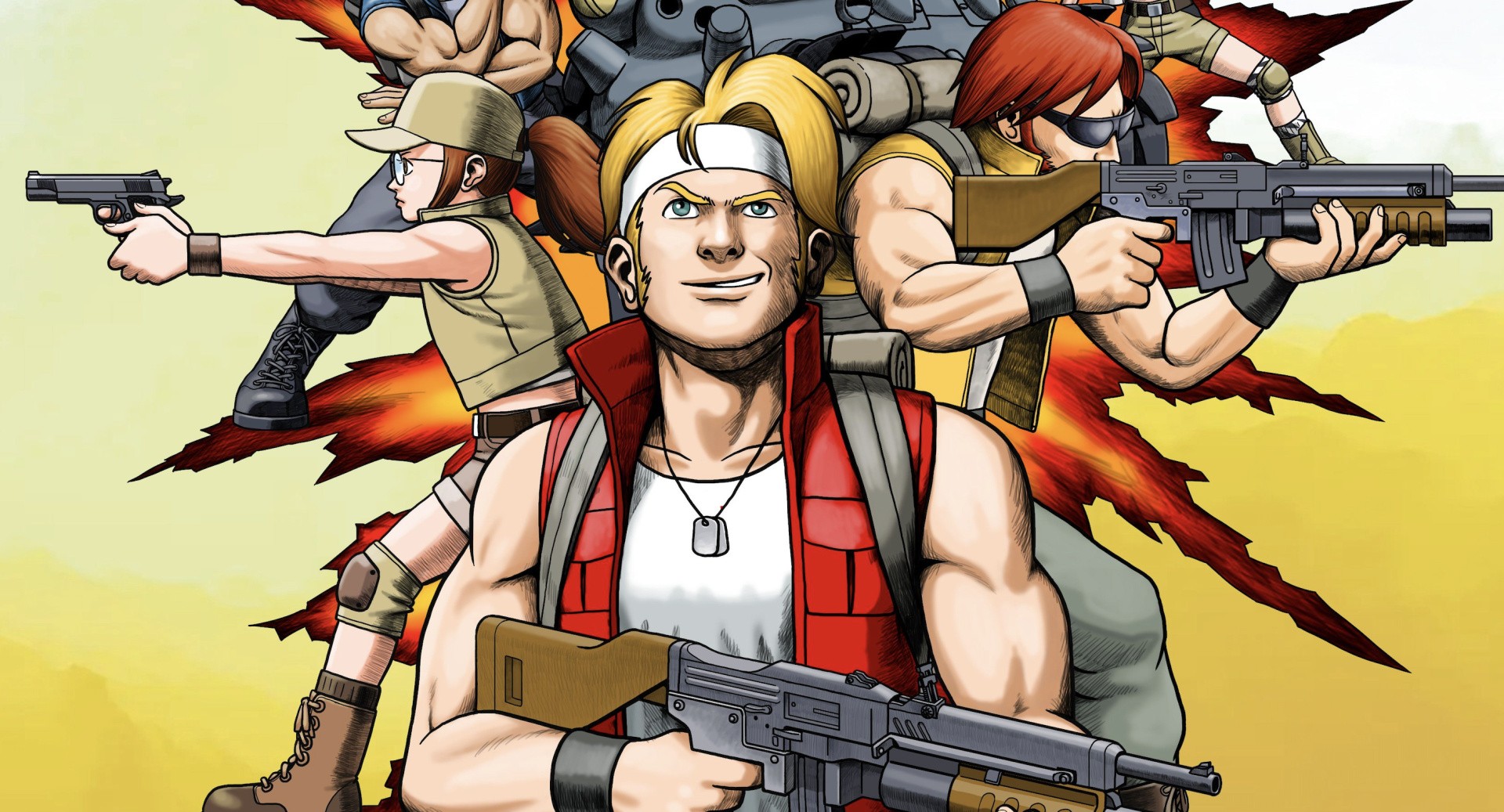
"At first only the tanks were to be the main characters, [...] but in the end we had soldiers like Marco and Tarma," reveals Kazuma Kujo, director of the first Metal Slug, dropping a bombshell that would resonate through interviews for years to come. He's describing the fabled "Metal Slug Zero"; in its original completed form, the game did not have playable humans, only the eponymous Metal Slug Super Vehicle 001. It was a radically different game, and its very existence was due to a series of unfortunate events.
But we're getting ahead of the story.
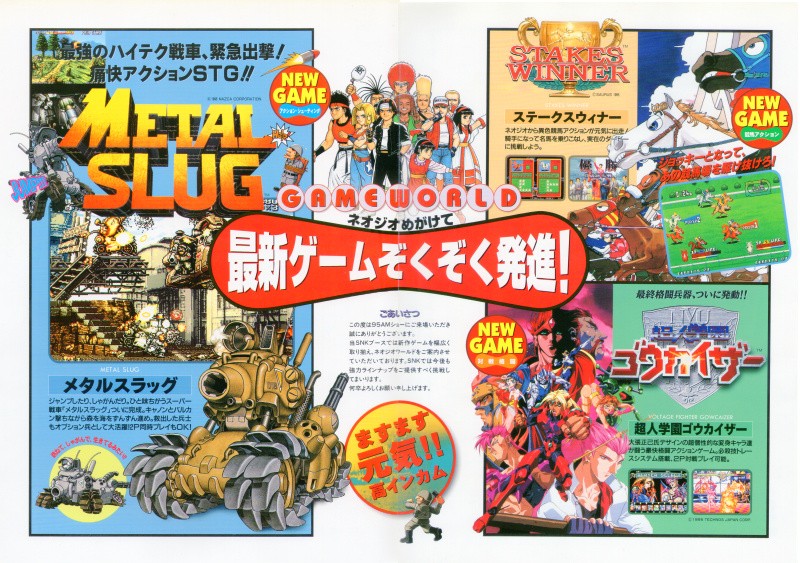
We're seated in a posh VIP business lounge at a fancy Tokyo hotel, and this is not our first interview with Kujo. Metal Slug was released on the Neo Geo MVS in April 1996 (and is therefore 30 years old this year), and while the series is beloved and well-documented today, for around 12 years, no one knew who actually worked on it. The end credits used pseudonyms, with Kujo credited only as Kire-Nag.
A breakthrough came when Time Extension contributor and mecha expert Ollie Barder posted an interview on the old pre-deletion Insert Credit forums, circa January 2008. Barder had interviewed Kujo about R-Type Final, and while they didn't discuss Metal Slug, it was listed in his portfolio. It would take four more years, but your author would track down and conduct an email interview with Kujo, the first of its kind for Metal Slug (in English anyway), for Retro Gamer magazine issue #98. Answers were brief, and the translation was done by two Japanese school friends.
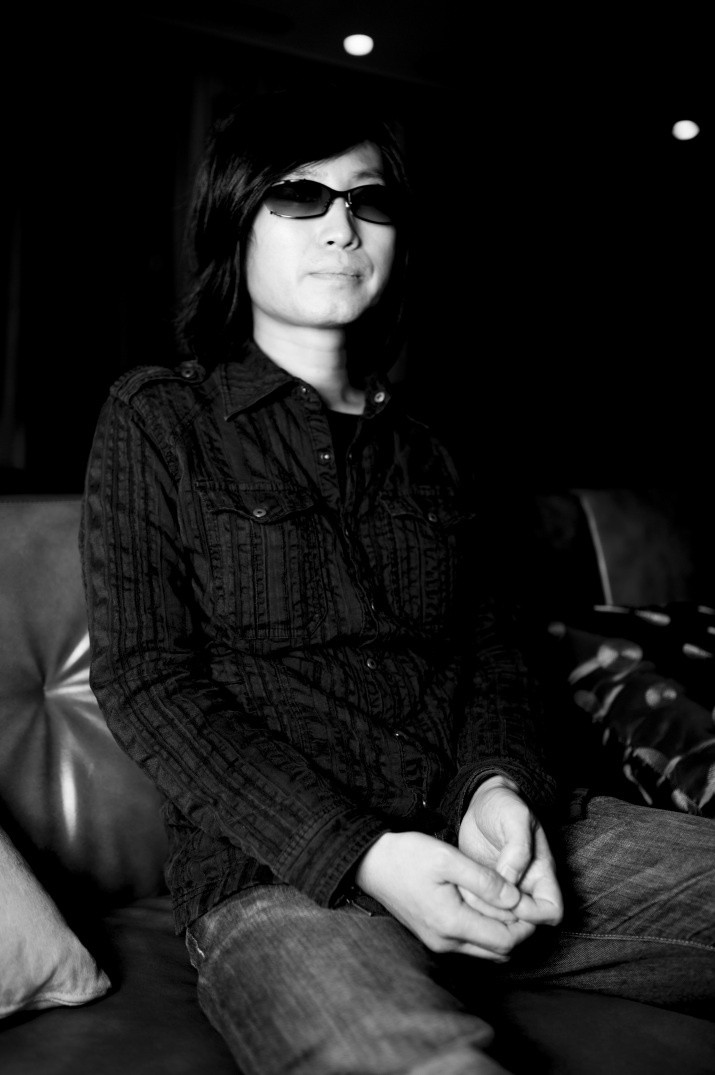
Thus, when your author was later living in Japan for three months, interviewing over 80 developers for The Untold History of Japanese Game Developers trilogy, meeting Kazuma Kujo was a priority. The three-hour Tokyo interview yielded a wealth of information: his history, joining Irem, co-founding Nazca, working with SNK and the Neo Geo hardware, and creating In The Hunt (resulting in this Making Of feature), Metal Slug, Steambot Chronicles, multiple R-Type titles, and the Disaster Report series. We're unashamed to admit we're keen enthusiasts of his work.
Kazuma Kujo's career at Irem began in 1989 on R-Type II as a tester. "The head of the business division was looking for someone who was really bad at shooting games," he explains. "He came to the department for planners and asked, 'Who is the worst at shooting games?' <laughs> They said it was me, so that's how I got involved in testing for R-Type II. I actually played it for 30 minutes, and they told me that I was too bad at it, so I was actually taken off that role. So bad... I am the worst at shooting games. <laughs>"
This is ironic, given that Kujo would go on to create In The Hunt, a magnificent shmup which subverts most of the genre's tropes. After R-Type II, Kujo was involved in Shisenshou: Match-Mania (GB, 1990), Air Duel (ARC, 1990, credited as "Tsumi-Nag"), and Superior Soldiers (ARC, 1993, "Oni-Nag"), before helming In The Hunt (ARC, 1993, "Tobi-Nag"). We had to ask, why did everyone only use nicknames at Irem? Why did he keep changing his nickname, suffixing "Nag" to them?
"For several games, I am credited under my nickname," Kujo tells us. "At that time, the majority of Japanese companies did not allow you to put your real name in the credits; Japanese game companies were closed off and insular, and prohibited the disclosure of staff names. That's why we used nicknames. Certainly, for Kaitei Daisensou [In The Hunt], because I was the director. But I'm also credited for some other games as planner. I think I was always quite angry when I was in my 20s. I was frustrated about my shortcomings as a game developer and also about things that didn't go as I wanted. So that's why in my 20s I had nicknames like Oni, or Kire, or Tsumi, because I was angry. Oni is an ogre, or demon. Kire means anger, or it can mean snapping. Tsumi means sin, or wrongdoings."
We pressed for details on his colleagues - for example, who were Susumu, Hamachan, and (most importantly) co-designer Meeher? The last of these played a key role in Undercover Cops, Geo Storm, and the Metal Slug series, taking over the reins after Kujo left Nazca. He was reticent, though; he remembers all of them, they were his friends, but if they had not come forward to reveal their own identities, he did not feel comfortable outing them.
At this point, we should also introduce Bitmap Books, since portions of both our Kazuma Kujo interviews were later integrated with permission into Metal Slug: The Ultimate History (2019), alongside a fresh interview with Kujo (we put Bitmap in touch), and ten further interviews with other staff, by other writers.
To delineate, quotes acquired by this article's author will be attributed as such, even if reused by Bitmap, while fresh material by Bitmap will be attributed to them. Bitmap does a wonderful job exploring not only the entire Metal Slug series, but also how Irem's Major Title 2: Tournament Leader dev team would make Neo Turf Masters at Nazca. Significantly, not only was Bitmap able to build on our earlier interviews, but it also discovered the identities of other staff.
- HIYA! = Takushi Hiyamuta (composer; music & SFX)
- T.Okui = Takeshi Okui (graphics; other credits include Geo Storm, Final Fantasy VII, Xenogears, and Breath of the Wild)
- A.Kurooka = Atsushi Kurooka (programmer; now works for Platinum Games)
- Hamachan = Shinichi Hamada (programmer)
- Andy = Andoh Kenji (programmer)
Unfortunately, several other listed staff remain a mystery: Susumu (graphics), Tomo (graphics), Kozo (graphics), Meeher (planning), Jim (sound), H.Yamada (program), and Pierre (program). While MobyGames suggests the following three:
- Akio = Akio Oyabu (graphics)
- Max-D = Kazuhiro Tanaka (programming)
- T.Yokota = Tetsuya Yokota (programming)
While Metal Slug is synonymous with SNK and its Neo Geo hardware range, to understand the creation of this series, you need to frame it as an Irem game in all but name. All of the Nazca staff were previously at Irem's Osaka branch, with SNK being one of their main rivals, also located in Osaka.
Kujo described the formation of Nazca:
"When Irem announced they were backing out of the gaming business, there were more than 100 staff involved in games. Those people went to companies like Konami, Hudson, and Atlus. What we did was, there were about 15 of us, and SNK gave us some funding, and we established a company called Nazca. I was one of the founding members, although I quit Nazca after about two years. Then I spent one year doing freelance work; then Irem announced they were going back into the gaming business, and asked if I could come back. So I did."
Bitmap Books went into even more detail, with Kujo sharing: "It was hard to comprehend we had to make games for a company that, until just a few days ago, were our rivals. We had been working at Irem with a certain amount of pride and sense of rivalry toward SNK, Capcom, Namco, and others. To go from that to making games for them required some time to adjust. SNK were very respectful towards us. We were also in a different building, so there weren't a lot of opportunities to interact. I think it was their way of respecting and preserving our spirit. They probably figured it wouldn't work to try to force our team into SNK's culture."
Thus, while the company was nascent, each member of the team brought with them years of experience and a rich arcade heritage. It would be easy to suggest Metal Slug has a lineage attributable to other legendary run-and-gun series, such as Contra, but this would be incorrect. Three key games inform its DNA: In The Hunt, by Kujo; Undercover Cops, by Meeher; and Geo Storm (aka: Gun Force II), which had Hiyamuta, Kurooka, Okui, and also Meeher as staff. Metal Slug carries not just the aesthetics of these games, but the spiritual design ethos of them.
Speaking to Bitmap Books, Kujo explained how gameplay design was split between Meeher and himself:
"Meeher made a game called Undercover Cops before working on Geo Storm, and I was mostly working on side-scrolling shooters. So, he created games where the screen would scroll and stop, scroll and stop. When we [joined] forces on the same game, we agreed to work in a way that wouldn't overlap. Metal Slug's fundamental game mechanics were created together, but we split the level design. You can tell which levels were designed by Meeher by the way the stage progresses. There's a lot of stopping and shooting in Meeher's stages, but the levels that I designed just keep on scrolling. By alternating the levels we were able to give the game variety."
Meeher spoke with us directly and described his method of level design, including the differences between checkpoints VS respawning, and designing for a game that allows simultaneous two-player action, such as Metal Slug:
"I always kept in mind the word 'novelty', rather than simply imitating genres popularised by our competitors, incorporating original ideas into my game development. The advantage of respawning is that it works well with simultaneous multiplayer games. Combined with multiplayer, the game can earn several play sessions worth of credits in the equivalent of a single sitting. Players get to see a little further into the game. It's easier to design a game where player excitement and engagement is retained. The disadvantage is it creates unintentionally 'rough edges' to the game design, where players can take advantage of invincibility during respawn to brute force their way through. As for my personal preference... There is no one-size-fits-all answer, but for me, the issue is whether the system makes sense in terms of the game design. As the game continues, even if the player dies with a life remaining, enemy placement and difficulty needs to take this into consideration. Care should be taken to ensure that the moment of respawn is both dynamic and dramatic."
The main side-scrolling shooter Kujo referred to earlier is In The Hunt, which he'd envisioned while taking a nap in a park one day. The underwater theme helped differentiate the game. "Thinking about what would happen inside the water itself was really new," Kujo says. "I would talk with the people working on the visuals about - for example - what a missile would look like when it's launched and what would happen to the water, to the flow. I think having submarines and having the underwater setting brought a lot of originality."
You need to view this in the context of 1993, in a post-Gradius and R-Type world, but before danmaku or modern indie shmups like Sine Mora. There had been a lot of shooters before In The Hunt, but this was a fresh approach. Your vertical weapons are affected by underwater physics, giving them a delayed idiosyncratic sensation. Players need to deal with enemies in the air, floating on the surface, and moving beneath the water, along with sometimes navigating maze-like scenery.
The highly animated mechanical designs and slower vehicular combat of In The Hunt would evolve into Metal Slug since, as mentioned at the start, it originally featured only tanks. This version would take 18 months for Nazca to painstakingly build; poor results from two location tests would then force a major redesign, adding another 6 months to development.
In the Retro Gamer interview, Kujo explained:
"The most difficult point was significantly changing the configuration of the player. Originally, the combat vehicle was the only character you controlled. However, when we did location tests, we did not get a good response from customers playing. So, we changed the game so that the soldiers were the central characters you controlled. I think some parts of the stages were remade, but I can't remember clearly."
This makes the original Metal Slug sound almost like a direct vehicular-based sequel to In The Hunt, and so later in Tokyo, we inquired further. Were Marco Rossi and Tarma Roving only added later, after the game had been completed and location tested?
"Yes, at first the tanks were the main characters," laughs Kujo, reiterating his previous answer, adding: "But we realised that tanks were very different from submarines, in that they were difficult to manipulate. We found that out when looking at the players during location testing. But the management, and also many of the staff members, wanted to keep the tank as a main character in the game. However, I felt like it was too difficult to have the tank as the main characters, so I proposed we should have soldiers, and we had quite a bit of debate on that. The director of the company at that time saw us debating, and he said fine, just make them soldiers already. So the boss did not like me for pushing that idea! <laughs> but in the end we had soldiers like Marco and Tarma as the main characters. I like the fact that the central characters, the soldiers, can only shoot directly upward and not diagonally. We spent a lot of thought on this, and I believe this is the way to do an action shooter."
Rechecking the interview audio, Kujo's tone makes it sound like the boss was exasperated and approved of having soldiers just to end the debate among the team. It also raises a fascinating mechanical point: the tank allows precise diagonal firing at multiple angles, while the soldiers can only fire horizontally or vertically, which makes the control of space even more similar to In The Hunt, which similarly restricted one's firing directions. (The heavy machine gun allows partial diagonal firing, though you waste ammunition.) The fact that Kujo specifically cites the restricted firing as one of his favourite aspects is a lens through which to ponder how every enemy position would have needed readjusting after they chose to remake it.
This hint of conflict within the team, debating how to fix the game, hides a gruelling account of 6 months of hard crunch, requiring not only the main characters to be redrawn and animated, but every aspect of the game to be rebalanced and tweaked. The opening stage was extended to account for faster movement, while the beginning of stage 3 was completely overhauled from a horizontal trek through snowy forest into a vertical mountain climb.
As you can imagine, every bullet programmed to fire at the player in the first incarnation had to be adjusted, since instead of targeting a slow-moving tank on treads, these bullets were now targeting nimble humans. This ordeal to remake the game was so exhausting, in one instance artist Takeshi Okui discovered programmer Andoh Kenji passed out on the toilet floor.
Programmer Shinichi Hamada described a scrapped level to Bitmap Books:
"The pre-human version of Metal Slug's third stage had a great first half; the tank was driving through this snow-covered forest, and there were tree trunks in the foreground and background with soldiers trying to creep around them and attack. That all got cut, and we ended up with the player jumping up a series of snowy ledges. It's a shame; I really liked that part."
Bitmap Books also has a fascinating account from Kujo. He doesn't contradict his earlier answers with us, but there's an inescapable feeling of reticence in fully describing the tension between colleagues - over three interviews, he revealed a little more each time:
"We used the same backgrounds, but objects and enemies had to be adjusted to match the new character. The game's uniqueness was that the player [was] a tank; Mr Akio was especially protective about that. But, as the level designer, I found it challenging to create a game around trying to move a big tank around the screen. The movements became too bulky. So, when the location tests came back unfavourably, I proposed we switch the main character to a soldier, but it was not accepted easily. I made the suggestion in a big meeting with SNK executive managers and the room went quiet. I didn't really think they would go for it, but changes had to be made in response to the poor ratings. Even after [the] decision was made, there was a lot of uneasiness in the studio. I think the change allowed for more humour, but the team didn't feel that way for quite some time. It also opened up possibilities in level design and scenery. Needless to say, there was no acknowledgement by the team that it was the right decision. <laughs>"
This change in player characters shifted the game in the direction of Geo Storm, which was a phenomenal run-and-gun in its own right. This missing link deserves its own examination, since, as we stated previously, Geo Storm is fantastic - there's tremendous kinetic energy and swagger in absolutely everything.
You duel-wield your weapons; there are no grenades, but there's a wide selection of sci-fi weapons which can be paired with a standard machine gun. This pairing can be aimed in any direction, including diagonally. You can also cling to most surfaces: walls, ceilings, fences, vertical chains, horizontal lines, you name it. While hanging from these, you can again aim in any direction. Metal Slug gave you the eponymous tank to ride, while Geo Storm has a multitude of outlandish vehicles, including a miniature Gundam-style robot. Everything is backed by an intense, heavy-metal soundtrack. It should have attained critical acclaim; in some ways, it's even better than Metal Slug.
Atsushi Kurooka told us:
"Firstly, it's important to note that Geo Storm was not completed. This is because part way through development, Irem's Osaka development studio was shuttered. My strongest memory is that while the other project staff stopped coming into work so they could look for new jobs, I worked with Meeher from the game design department to connect the five stages that were already done, so they looped and the game would at least be in a condition where it could be released. That's why there's no ending."
Meeher added:
"Geo Storm was mainly designed with the overseas market in mind, and the rank promotions between stages were intended to promote competition amongst four players. Unfortunately there were numerous issues, including slowdown and freezes."
Looking at these three Irem titles, the staff of which came together for Metal Slug, the lineage is obvious. Each in its own way helped carve the path for Nazca's 2D masterpiece. The detailed 2D pixel art and fluid animation have been documented often, receiving high praise from critics and players, so it's perhaps worth reflecting on the fact that the Sony PlayStation and Sega Saturn had been launched at the tail-end of 1994. When Metal Slug began development, the industry was already experiencing the "puberty pains" of ushering in 3D.
Kujo has already explained how Nazca formed as a funded subsidiary of SNK, but we still asked for his thoughts on the era and choice of hardware:
"Originally when I joined Irem I wanted to make games for home use," he reflects. "But I was placed in the arcade department. We were making games for Game Centres, or arcades as you call them, when we were in Irem. So that's why we made games for the Neo Geo at Nazca, since that was the hardware of Game Centres. I did not specifically intend to make 2D games. It was just because the hartdware, Neo Geo, which we were working on at that time, was 2D hardware. After I left Nazca I made R-Type Delta and other 3D games. So in my 20s I was involved in making arcade games, like Kaitei Daisensou and Metal Slug, but in my 30s I became involved in making console games. In terms of which I prefer, I prefer console games just because that was what I originally wanted to do.”
Given the intense beauty of the visuals in Metal Slug, we also broached the topic of influences. In the Retro Gamer interview, Kujo revealed: “Oh, there were definitely influences. We were very much inspired by the book, Hayao Miyazaki’s Daydream Note.” First published in 1992, the book is exquisite - as one would expect from anything bearing the Miyazaki name. It depicts a variety of wartime vehicles, albeit with an adorable veneer - a soldier passes breakfast to another through a porthole, anthropomorphic pigs live their life inside a tank more akin to a small home, while others get up to mischief outside such lumbering vehicles. The influence on Metal Slug is undeniable.
Given Kujo's willingness to discuss influences, we then show him Masamune Shirow’s design for the Bonaparte tank from the Dominion manga and anime, alongside an image of the eponymous Slug tank. This does not go over quite as well, and he replies: “It was not taken from Dominion. I can not answer about this anymore.” However, in the later interview with Bitmap Books, he was more relaxed, admitting it was likely an influence: "Yes, I think so. Mr Akio was a fan."
As the Tokyo interview draws to a close, our professionalism slips for just a moment, and we can't help but praise not only Kujo's wonderful portfolio, but also the Metal Slug series as a whole, conveying how beloved the various games are amongst enthusiasts. "Thank you very much for saying so," he laughs, adding, "I was only involved in the first Metal Slug, and the reputation of the first game inside the company was not very good. So I never thought that it would have sequels, like Metal Slug 2 or Metal Slug 3. They sound good, especially the part where you can ride camels, but I don’t know because I have not played the sequels much."
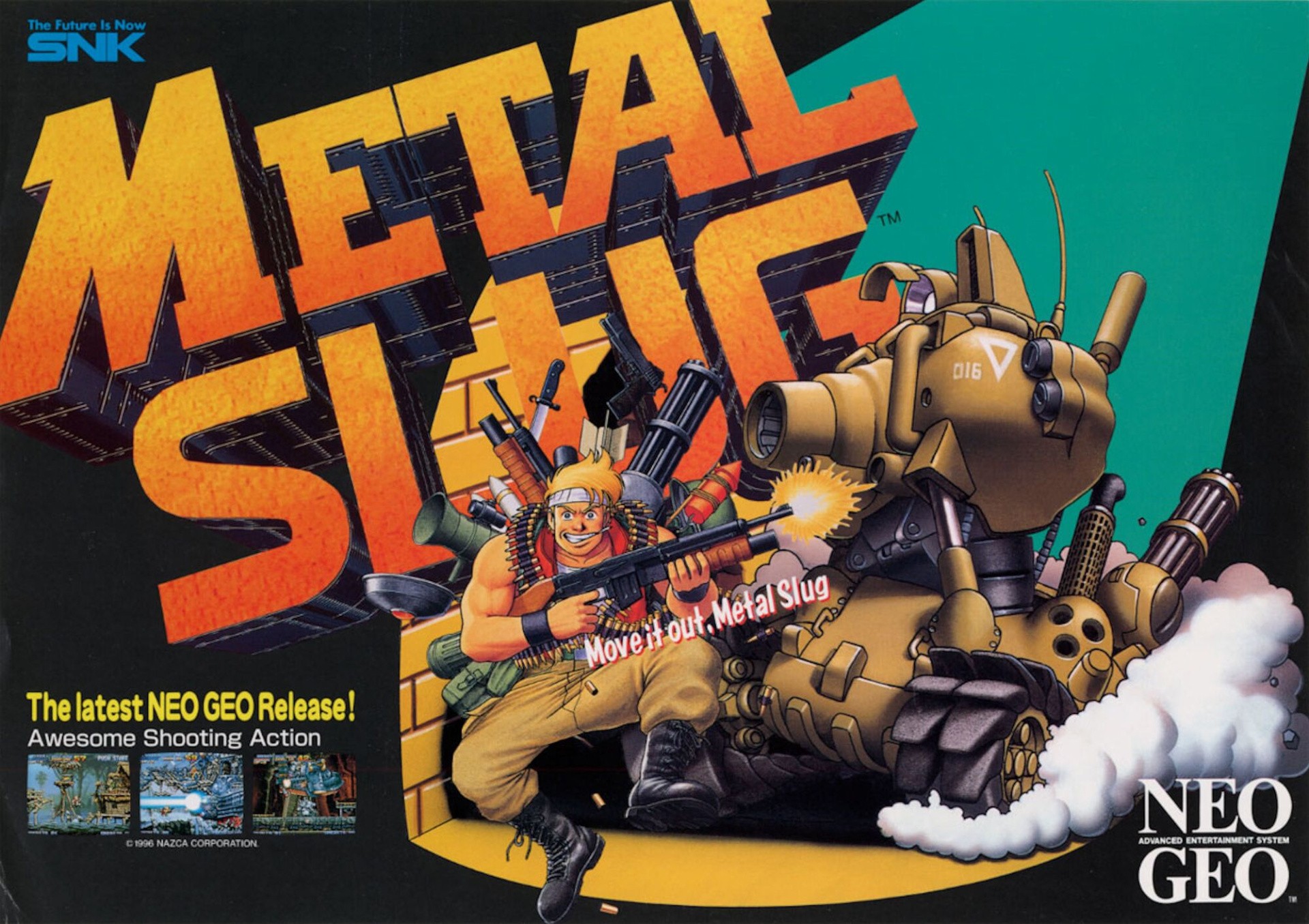
This statement about the game's initial poor reputation within SNK is interesting. It doesn't contradict the story in Bitmap Books' interviews, but it conveys the impression that it took time for Metal Slug to be properly appreciated. At least in Japan. President of SNK Europe, Kazuhiro Takeshita, told Bitmap Books how it was a hit in Europe, holding the record for his personal sales in the region. Management in Japan must have warmed to it, since work began on a sequel, coming out roughly two years later in February 1998.
When you think about it, even though Metal Slug is now the darling of the Neo Geo library, and an original AES cartridge goes for over $20,000, its existence required the closure of the legendary studio behind R-Type, a hundred layoffs, and it had to be developed twice over (technically speaking). And even then, development staff and SNK managers did not have faith in the changes, with its director resigning from Nazca after launch and nearly leaving the industry.
We're lucky simply to have received the first game, let alone a series that continues to this day. In fact, there's so much backstory to the painful birth of this majestic property that it's unsurprising that an entire book was written on it. We've only touched upon a few of the major points. So the next time you insert a credit to take down General Morden, give a thought to the struggle it took to get here.
Special thanks: Many people, both knowingly and unknowingly, helped along the way in producing this article. Special thanks to Ollie Barder, Yuko Ogawara, Kazuaki Yazawa, Samuel Melzner, Darran Jones, Mayumi Nishimura, Sam Dyer, and even my late mother, who helped with the screenshots when I literally could not find anyone else willing to control player two.