
 by

Digital Eclipse is back with another historical video game collection, and this time, it's Barbie's turn in the spotlight.
Like many other famous American licenses, such as Disney and Mickey Mouse, the Barbie brand has been adapted into countless video games over the years.
Her official console debut came on the NES in the 1991 platformer Barbie, from Imagineering and Hi-Tech Expressions (an earlier Commodore 64 game was produced by Eddy Goldfarb & Associates and Epyx in the mid-80s), which saw the doll commanding a small army of animals and sentient fast food to do her bidding. Since then, though, she's gone on to wear many different hats (both literally and figuratively), getting to ride and race horses, compete in extreme sports, play veterinarian to sick animals, and even give James Bond and Solid Snake a run for their money in her very own spy adventure.
Barbie Rewind, the new collection from Digital Eclipse, therefore, attempts to bundle all of this history together in a single package, containing 17 console and handheld games, including the previously unreleased Sega Genesis/SNES game Barbie Vacation Adventure from the defunct Manchester studio Software Creations. Unafraid of potentially doing battle with Grand Theft Auto 6 (which launches later this month on November 19th), the collection was released earlier this week across Nintendo Switch, Switch 2, PS4, PS5, PC, Xbox One, and Xbox Series X/S, and has received some pretty positive reviews so far (our sister site Push Square admittedly gave it a slightly more modest 7/10, but described it as yet "another great effort from Digital Eclipse"). As a result, I couldn't resist the opportunity to talk with Digital Eclipse's Barbie expert and the game's editorial lead, Rachel Simone Weil, and Atari's David Lowey.
We spoke a little about how the collection came to be, the impact of Greta Gerwig's 2023 movie in convincing the team the collection was the right idea, and how its launch's proximity to Grand Theft Auto 6 has inspired countless online memes, as developers flee November for a less competitive release window:
Time Extension: Hi Rachel, hi David, thanks for chatting with us. First off, it'd be interesting to hear about the origins of this project. How did the project come about?
Weil: David, do you want to speak a little to the origin of the project on your side?
Lowey: Yeah, so Barbie's an IP. There are so many studios that have worked on Barbie games over the years, and they have this really important role [for people], particularly these games from the Y2K era. So, it's been something that's been on Atari and Digital Eclipse's radar for a while as, 'Hey, this is something that we'd like to take on,' and fortunately, the team at Mattel and Barbie was game.
Digital Eclipse has its traditional approach to building a game collection — sort of this Criterion Collection approach, or a very editorial or contextually heavy approach to games, but as much as everybody on the team is very interested in working on Barbie, it really felt this time like, 'Okay, we need to bring in an expert.' And that's where the team found and reached out to Rachel.
Time Extension: Yeah, I'd love to hear more about how you got involved, Rachel. I know you've done some historical research into Barbie in the past as the founder of the Femicom Museum. I also noticed on your website there was a reference to a Living Museum exhibit called Barbie Gets With The Program that you worked on, and that you've also been interviewed for articles before about the impact of things like Barbie Fashion Designer. It seems you were the perfect person for the job.
Weil: So, I think I got the formal intro through the Video Game History Foundation, through folks there who I've collaborated with before. As you mentioned, I'm the founder of Femicom Museum, which is this project to preserve historic electronic games marketed to girls and to not only preserve them, but recuperate memories of these games and integrate them into retro gaming culture at large so they can be part of what inspires the next generation of creators.
So I've been a toy and video game historian for about 15 years. And I've probably carried the very tongue-in-cheek moniker of the world's foremost expert on Barbie video game history, which is highly unofficial, but it is a topic that I've researched, spoken, and written about extensively. And so that was the expertise I brought to Barbie Rewind as the project's historical consultant.
Time Extension: The game seems to be something of a departure from previous Digital Eclipse games in that it is a retro collection, but it is also built around this other game where you decorate Barbie's Dreamhouse. With that in mind, what can people expect from the project in terms of historical materials?
Weil: So I will say first that Barbie Rewind does include an interactive historical catalogue, so it is a very similar experience to other Digital Eclipse titles where players can kind of learn about the Barbie games in the context of when they were released and how they were advertised, how they connect to the Barbie franchise and things of that nature.
I think there may not be quite as much behind-the-scenes content, but there is behind-the-scenes content. We do have some development docs and discuss a little bit of the process for one of the GBA games. We also talk about games that aren't in the collection but are historically significant. We talk about Barbie Fashion Designer being in the Video Game Hall of Fame. We talk about BarbieGirls.com, which was an incredibly popular Barbie MMORPG with millions of players 20 years ago, which is something a lot of people don't know about. So I really love that historical catalogue. But I think one thing we do slightly differently is that Barbie is also a toy brand with a pre-electronic history. So, we talk a lot about the history of Barbie and technology and how they push each other, right?
We start in the 1960s with the kinds of technology that were in the Dreamhouse. She has a hi-fi, and then she has a reel-to-reel tape player, and in the '80s, she has a front projection TV, so we can see the evolution of consumer technology through the lens of the Dreamhouse, and I absolutely love that kind of thing [as a historian]. You can also trace similar paths through the technology of the dolls themselves, starting from the pre-electronic with the pull-string talking dolls, then to speech synthesis, microprocessors, infrared communication in Talk With Me Barbie. And that's also present in the games and how they evolved. So, there are plenty of those things that I think that the super fans will appreciate.
Time Extension: David, I have to ask, in terms of the business case for this game, how much did the incredible success of Greta Gerwig's Barbie film benefit this project during discussions? I imagine it must have helped demonstrate to Atari that there was a potential audience for something like this.
Lowey: It's a two-part answer. I know we were interested in doing something with the Barbie brand before the film came out. So, like Atari's interest in this goes back further than that. We've always thought it was a strong brand and a really interesting story to tell through a collection.
But I think the film probably did everything that you're suggesting it did. A, it was a proof point that our early desire made sense. And B, it also completely energised the fan base and then got everybody else in the world to probably pay more attention, even if they weren't in that core cohort that was already interested in the brand. So it didn't hurt. It was a great wind in our sails.
When you look at the fan fascination with how close Godzilla: Destroy All Monsters Melee Remastered, Barbie Rewind, and GTA 6 are in terms of release dates, and the massive outpouring of memes and fan content around that topic, it goes back to that Barbenheimer thing. It's proof that Barbie's fan base is really broad and deep, and that when there's an opportunity to celebrate and talk about the brand, people do.
Time Extension: I didn't even consider that — the fact that you're releasing in the same month as GTA. I don't know how much insight either of you has into the decision-making there, but I imagine there must have been some conversations about moving the date.
Lowey: A lot of people moved out. But with Godzilla. November 3rd is International Godzilla Day, or World Godzilla Day. We weren't going to miss that. It was perfect for Godzilla: Destroy All Monsters Melee Remastered. And that keeps doing very well in terms of visibility and excitement. Then, for Barbie, it's targeting a very different cohort, but you know that people are going to be playing Barbie and then going on for a marathon session of GTA. There is overlap in those audiences, but they're very, very different types of games at their core.
Barbie is very much a curl-up-in-front-of-a-warm-fire, cosy design game, and it's a different vibe. It's designed to be, in many ways, the opposite of some of the more hardcore action games that come out. People like variety in their gaming diet.
Time Extension: As mentioned, the game has this Dreamhouse decorating game that everything else is built around. Why did you think that was a good fit for this collection rather than, say, doing something more akin to Atari 50 or Llamasoft: The Jeff Minter Story with a more straightforward timeline approach?
Weil: So, along with what I said about the historical catalogue, there's this decorating game where players can decorate Barbie's house with hundreds of pieces of furniture, and what's so cool about that is it's still in the context of retro gaming and playing the past. So you have this pixel art style, the 2D isometric views of the rooms; you have hundreds of pieces of furniture that are all based on real historic playsets. Down to the trim on the pillows. Including some deep cuts like the Café Today playset.
We also have a chip-music soundtrack with artists like Chipzel contributing, plus a cast of characters from the entire franchise. So I think the goal there was that, regardless of your Barbie decade, there's going to be a lot of fun, nostalgic references and nice throwbacks for fans.
Lowey: Rachel did an inordinate amount of research around those play sets. I mean, it was a big part of your work on this title. Digital Eclipse is always thinking about, 'How do you provide a lens and a doorway into the collection?' and Barbie is a very unique brand. And the cosy game is an interesting way to do that because the Dream House is so core to Barbie.
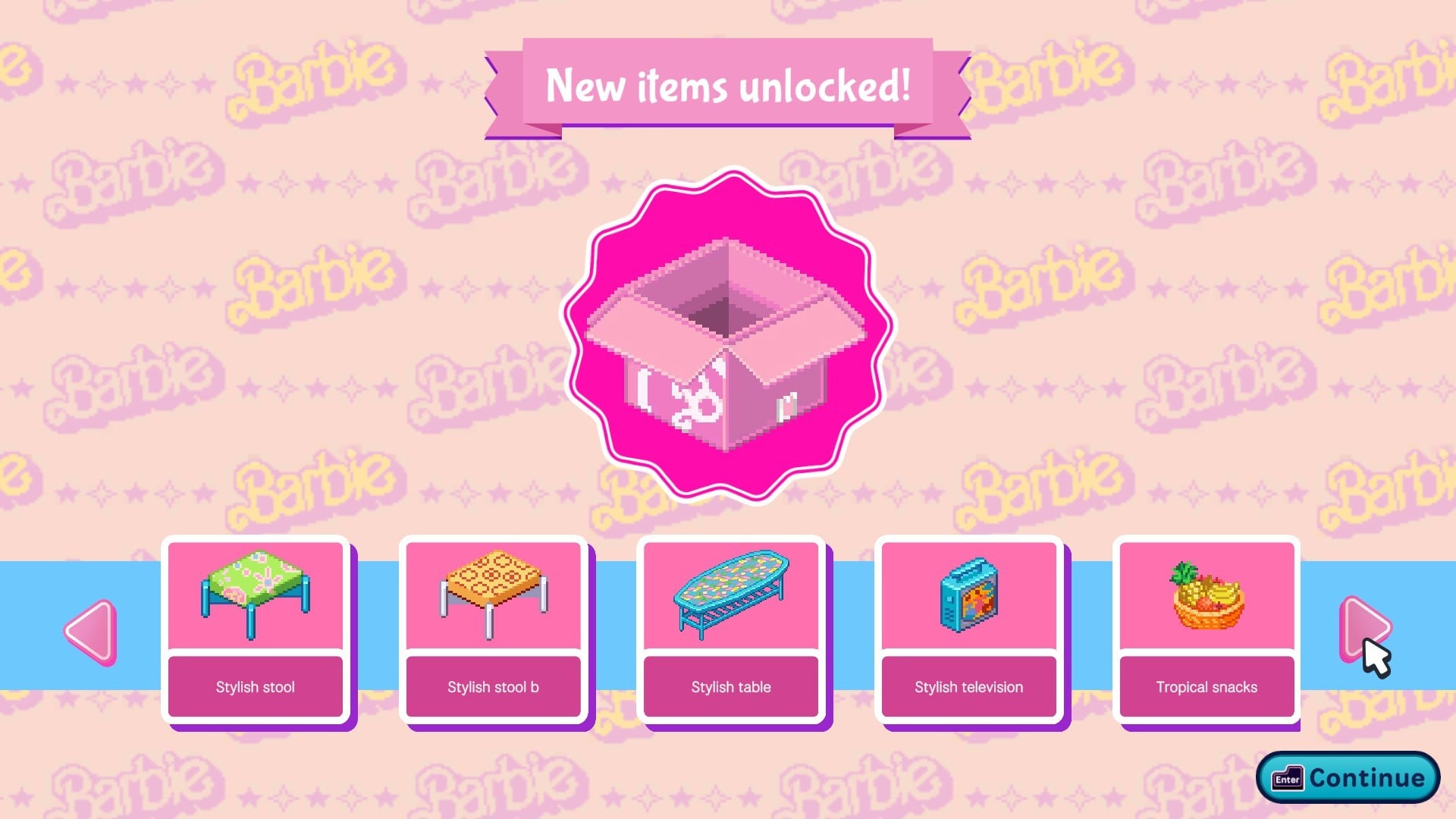
So many people remember lying down on the floor in their living room looking at the Toys "R" Us catalogue. That's like a burned-in memory for so many people. And those play sets that are actually in the game. So as you're playing this Dreamhouse design game, you're still walking through decades of Barbie, and then she literally, at one point, even calls you up and says, 'I'm sending you my old game collection so that you can set up my gaming room.' And of course, those are the retro titles we've included.
Time Extension: In terms of the selection of retro titles, specifically for this collection, how much was dictated by the emulation side of things, and how much was dictated by 'We want to tell the story of this iconic brand in gaming'?
Lowey: I'll take a shot at answering this. It's always a mix. So, Atari published a lot of these games back in the day. So, ever since I joined Atari six, seven years ago, there's been this constant flow of fans saying, 'Would you please bring this Barbie game back?' So, part of it was definitely, 'Okay. We want to bring back some of the more popular games.'
But then a part of it is also, 'Okay, what's available to us from a licensing standpoint? What's available to us from a technology standpoint? Which things can we emulate?' And then finally, 'Which games do we really feel we need to have in there to tell this story?' This is more of, I would say, a family-friendly collection. There's not like a strong narrative per se from one game to the next. But so many people grew up playing these games, and they'll bring their own order and narrative and story to it and fill in a lot of that detail.
So, I think the exciting thing for us was to bring in some of the things that people have been asking for the most, which are usually, for me, the riding games. But then the other thing, of course, is being able to bring in the unpublished game, which was a big win for us and something that everybody involved in the project was excited to do.
Time Extension: I imagine tracking down the rights to that must have been tough.
Lowey: I wasn't involved in that aspect of the game. What I will say, though, is that we're very good at understanding how to navigate IP waters.
If you look at Nightdive Studios, Digital Eclipse, Atari, that is one of our core capabilities; that, along with emulation and, of course, storytelling. So the team's very, very adept at understanding what's available, tracking down rights, and also tracking down the right versions of the game and understanding how to bring them back, both on and off console. So I didn't hear any stories from the team about, "Oh my God, we never thought we would be able to get this game, and we were able to land it." Sometimes that does happen on certain projects, but I think this one was fairly tidy in that regard.
Time Extension: Being the editorial lead on the project, Rachel, I'm curious, do you notice any interesting trends in the evolution of these games and how they primarily targeted their audience?
Weil: I think it's easier to tell that story on the PC side, where Mattel Interactive was very involved in the development. The console games tended to be taken on by third-party studios.
In some cases, there were studios that worked on multiple titles, like Hi-Tech Expressions. But in most cases, you were getting a fresh set of eyes on the IP, like, 'What should we do with this property?' I think probably the exception there is WayForward and their work on a series of GBA games based on the Barbie movies, because they did have some of this same team working on sequential releases. Speaking with the developers there, they were taking learnings from the game that they had developed previously and saying, 'How can we apply this and move this forward to push the games forward?'
So, I think each GBA game that they worked on, they iterated and got closer to addressing the super fans. They were watching the movies over and over. They were really trying to hew closely to what fans loved about those movies. They took a very considered approach to game mechanics in a way that I think is really, really special. And to me, those way forward GBA games really stand out for that reason. I think they were just made with a lot of care and respect for the franchise and for a fun gameplay experience.
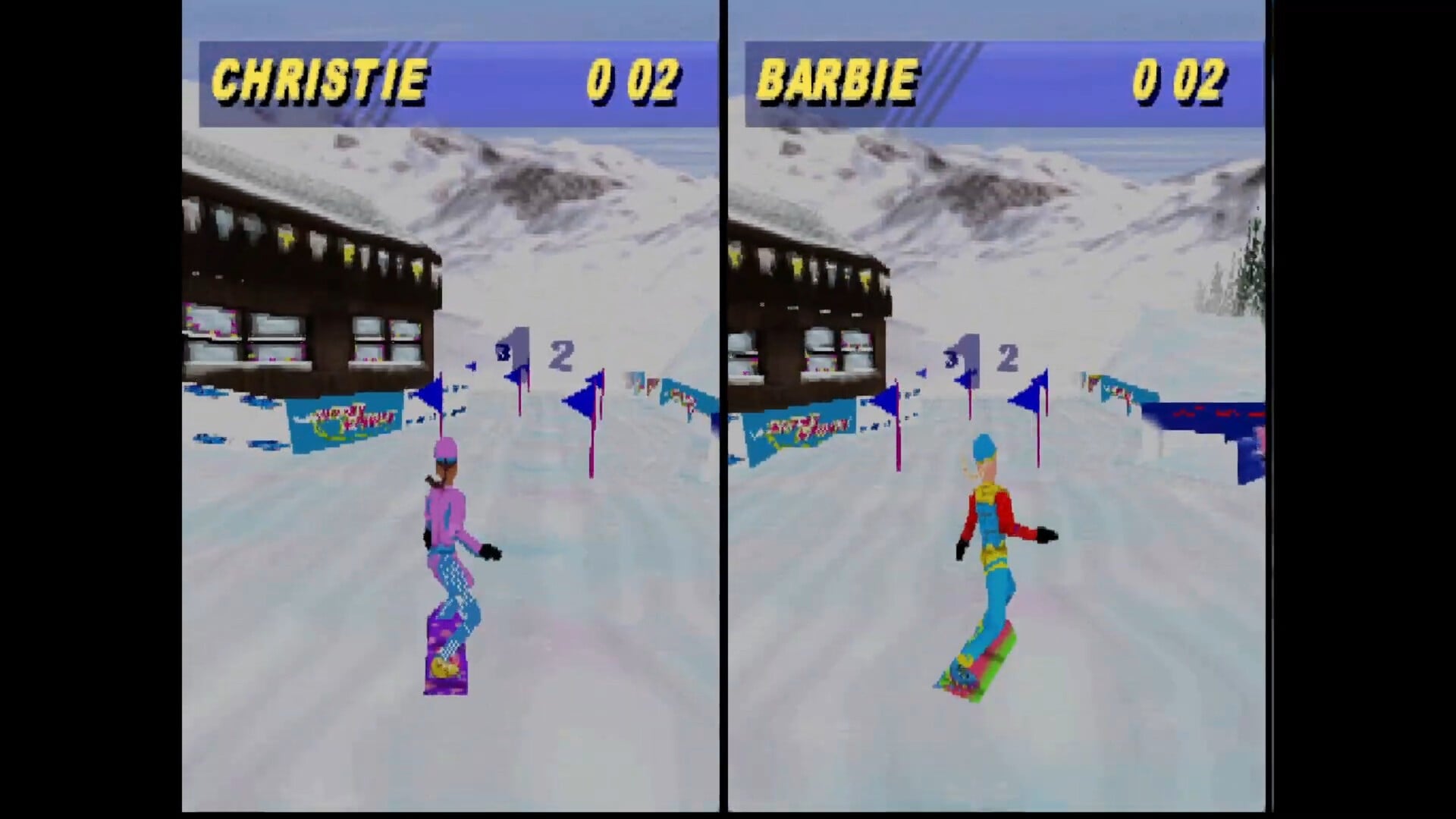
Lowey: One of the things that I've always thought about the Barbie games in this era is that part of their lane was having no lane, right? Barbie's a doctor, Barbie's doing sports, etc. The character does so many things, and that is part of the brand. That idea is that you can do anything. And I think that was very much reflected in the games, in the sense that there are so many different types of Barbie games. It wasn't, 'Okay, we're only gonna do fashion, or we're only gonna do this.' So it felt like it came through in the collection. There's eSports, there's riding, there's a detective game. So many different areas are covered.
Weil: Yeah, just speaking to the larger climate in the 90s and 2000s in particular, I think there was this concern that girls might fall behind in upcoming technology. Were they going to be as technically literate as their male counterparts if they weren't also part of gaming? If they were not brought into these technologies and excited by them when they were young? So I think a lot of developers were going into girl games thinking, 'What's good for girls? What's the right diet for them to model ideal behaviours?'
At the time, there was all this worry about, 'Are the games going to set up girls for success?' And I think those kinds of questions from the public and from the adults who were buying these games shaped those early expectations. I can't speak to whether developers had any of those things in mind, but I know that the public at least had that idea of, 'We need to make sure that girls aren't left in the dust in the upcoming computer and technological revolutions, ' and thinking about how to meet them where they already were.
So, many of the pink games of that era pulled from established play patterns in the toy industry: dress-up, dolls, friendship, crafting, caregiving. You did see some of those as traditional play patterns because the industry knew that those were already successful with girls, but then, as you said, David, it diversified into a broader selection of activities, sports, horse riding, all of that. And I think a little bit of that was to also counter those stereotypes and to really show girls you can be anything and to demonstrate that through play.
Time Extension: Just one last question, Rachel, in terms of the retro library. I'm wondering, are there any titles that maybe didn't make the cut where you were like, 'Oh, I wish that was in there'?
Weil: Of course, you want to include them all. I think, as a fan. [I would have loved to have seen] Barbie C64, just from it being so early. I can't really speak precisely to the emulation challenges there, but I assume that there may be some there with that, just due to the age of that game. I don't think there's anything that I'm incredibly sad is missing. I don't see any gaping holes in terms of the console story. I know there are also a lot of fans of the PC games: Barbie Fashion Designer and Generation Girl. Those were just outside the scope of this collection. This collection is really focused on the console and handheld games.
Barbie Rewind is out now on Nintendo Switch, Switch 2, PS4, PS5, PC, Xbox One, and Xbox Series X/S. Do you plan on picking it up? Let us know in the comments!