
 by
by 
A new PS1 and N64 asset library (and "digital museum") has just launched, giving players the opportunity to view and compare models and animations from various classic games.
Alfred Baudisch's Pardall Games Library went live late last month and currently features assets from 18 games in total, including the likes of Final Fantasy VII, Resident Evil 2, Spyro the Dragon, Tomb Raider, and GoldenEye 007, among several others. Understandably, given the impressive scope of the project and its potential applications, it immediately went viral, racking up thousands of shares and likes across Twitter/X and BlueSky, while drawing attention from artists, journalists, and other preservation-minded individuals. It even went on to inspire a small number of articles from publications like Destructoid and PC Gamer, the latter of which used the library as a jumping-off point to talk about "the best frog in all of gaming."
As you can probably tell, the reaction to the project was pretty overwhelmingly positive all in all, but that didn't stop some cynicism from surfacing online about how quickly the project came together, from suggestions the website may be vibe-coded (something Baudisch vehemently denies), to concerns about how Baudisch plans to sustain the project's momentum given the amount of material he is handling daily and the fact he is just one person.
Because of this, I thought it might be a good idea to reach out to Baudisch — not just to learn more about how the project came together and his aims in launching it, but to give him a chance to respond to some of these questions and concerns. Fortunately, for us, Baudisch was happy to talk — more than happy, in fact — sharing with us a bit more about his background in games, the kind of approach he's taking, and how he is reacting to the site's viral success:
Time Extension: When did you start thinking about opening the Pardall Games Library? Was there any one particular game that kickstarted your interest in making a model/animation viewer of this kind?
Baudisch: It's a bunch of factors that all came together in the end. I am obsessed with PS1 and N64 games, but I'm even more obsessed with PS1 and N64 graphics, and I also like making them myself (that's why I have two tools to make art like that). I also hoard models and textures. In 2022, when I was making my game Brazilian Street Food Simulator, I wanted to study how vehicles were modelled in the PS1 era, and thus I started my first extraction project, which was Driver. I didn't do anything else until November of last year. That's when I started yet another project where I wanted to make a game like Banjo-Kazooie (BK).
Before starting development, I began researching how to make levels and environments like Banjo. The first step was discovering how their levels were made. For that, I found noclip.website, but it doesn't let you download data from it, and I wanted to have the models and textures with me. That led me to start extraction work again, and it's this extraction that finally sparked that feeling of 'I want to do more of this.'
With all these things in mind, I started to get annoyed with how difficult and time-consuming it was to view the models and textures I had extracted: 3D models were always imported into a 'playground' Unity project and then catalogued and tagged with the 'Asset Inventory' plugin, and textures were tagged and imported into Eagle App.
Every time I wanted a model or compare something, I'd have to wait for Unity to load, import the model from Asset Inventory in the playground scene, then delete it from the Unity scene again, and so on and so forth. As for Eagle, it creates a subfolder and multiple sidecar files for every file you import, so if you import 10,000 textures, you end up with 10k folders and 40k files. What I wanted was an INSTANT way to see and compare these assets. I also wanted to easily play animations. Thus, Pardall Asset Browser was born as an internal tool, and then eventually turned into the website you see today.
Time Extension: In your mind, who is the ideal user for the Pardall Games Library?
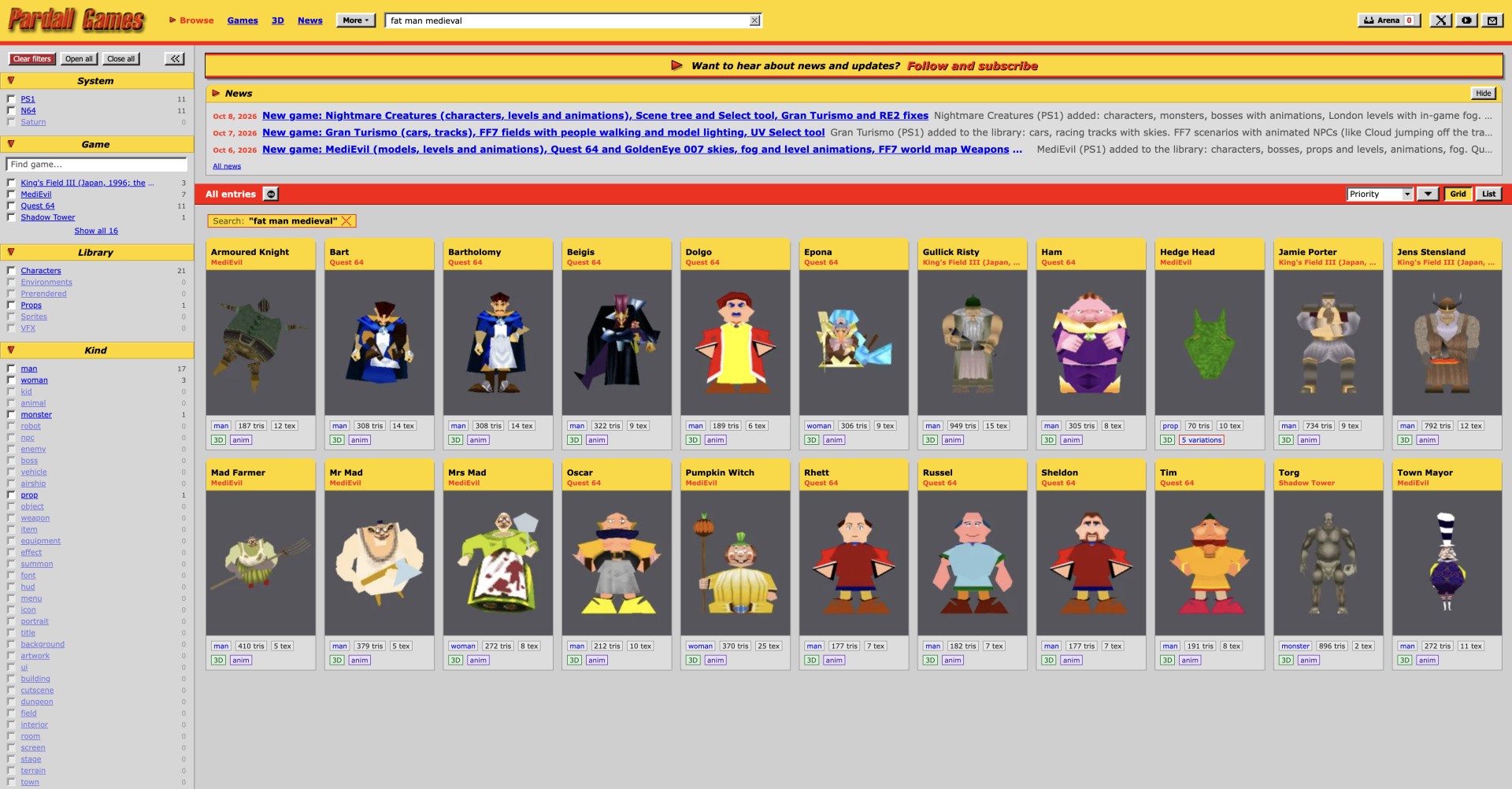
Baudisch: First and foremost, artists, level designers, and game developers interested in learning how these games were made. They can also use the website as a database of character design, level design, prop design, texture design and more, since there are thousands of filters; for example, if you want to make a character that is a 'medieval fat man', just search for it.
But the website is also very useful and fun for those who just appreciate these games, and I imagine the majority of visitors are non-developers. The website has a very fun feature, which is the 3D Arena, where you can add models of different games side by side, including maps and levels, play their animations, and then export that as a GIF. Especially on X/Twitter, people shared a lot of fun Final Fantasy VII and Resident Evil 2 GIFs. I created the 3D Arena to use it as a study and reference tool, but in the end it's also fun to create these silly mashups.
Time Extension: There are obviously already sites like The Models Resource, which do a great job curating 3D models. I’m wondering, what made this project incompatible with that one in your mind? Are you still broadly supportive of each other’s goals?
Baudisch: The Models Resource (TMR) is great, and I've been a user for years. I also contributed more than 80 models there and a few sprites, and honestly, initially I wanted to upload all of my extractions into TMR. They have their own requirements (they require an icon, preview image, a preview 3D model and a zip), and for that I made a Python script that exports from Blender to the TMR format (the end result of all my PS1/N64 extractions are .blend files of the game's assets).
I was really hooked on uploading my full dump of FF7 into the TMR, but when I was going to upload, I saw that they only allow one at a time (and I had more than 20k things to contribute). I tried to reach out via their Discord, but it seemed like nobody cared. So I decided to make my tool (the Pardall Asset Browser) a public website.
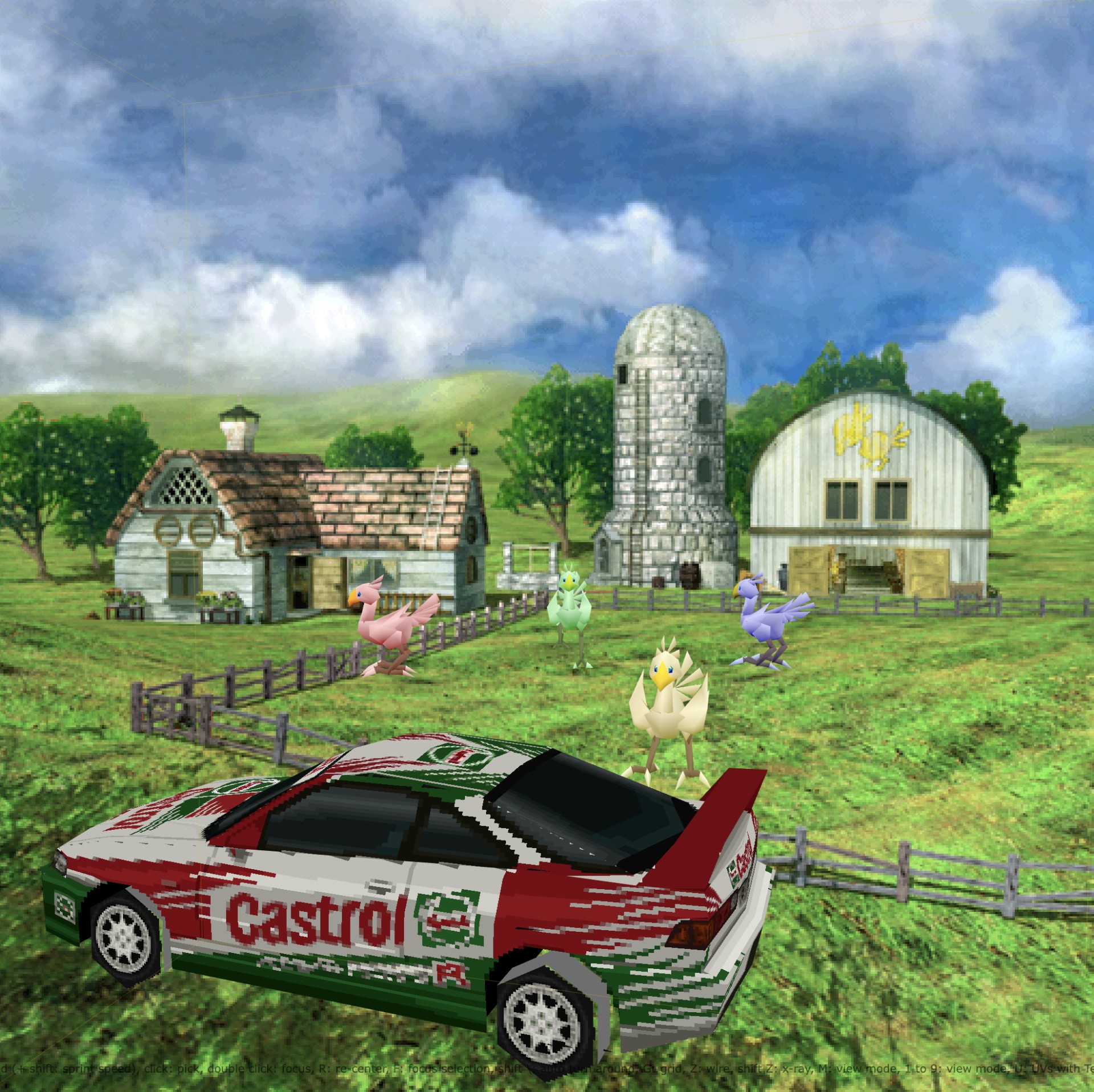
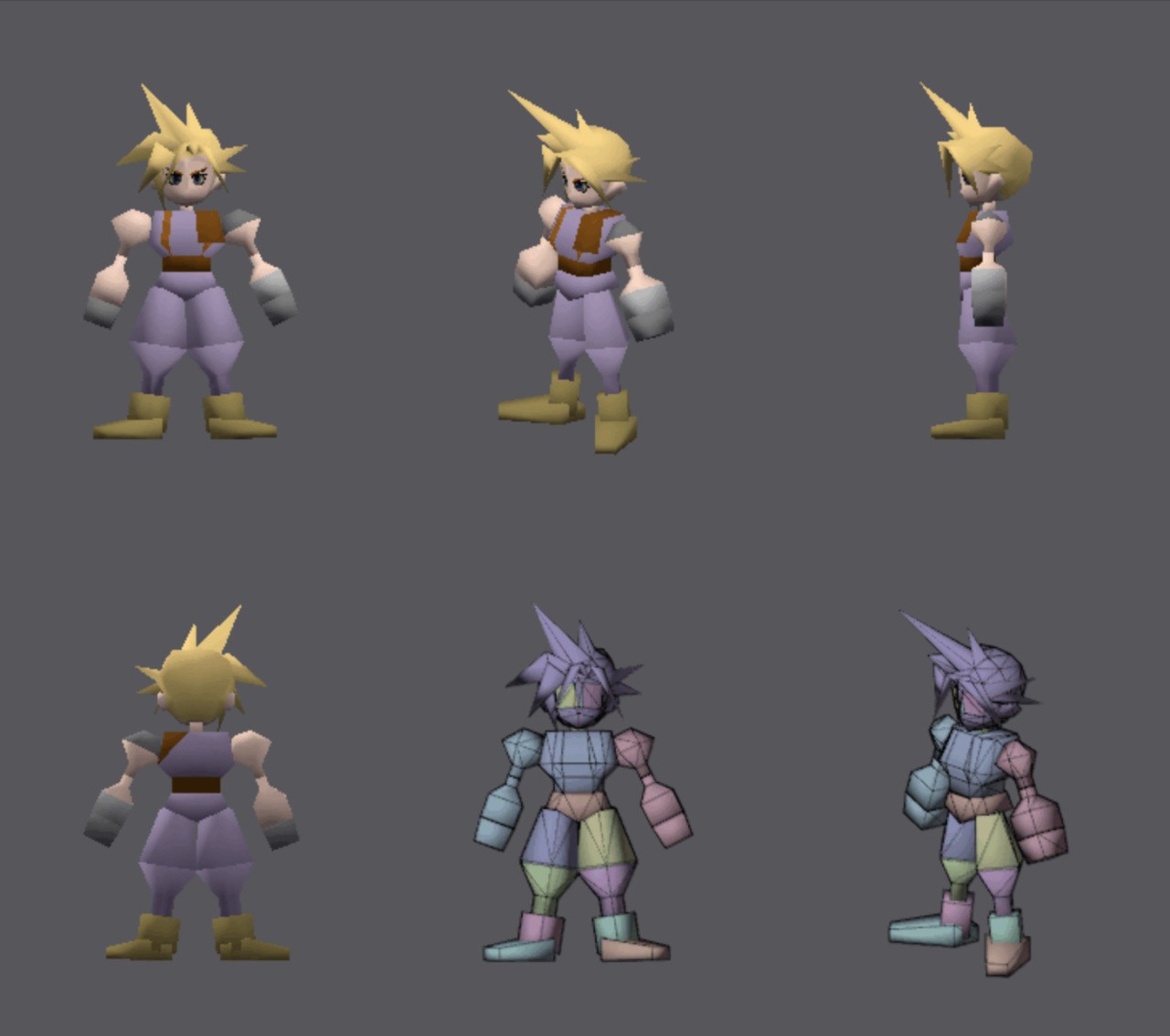
Ultimately, what I do with Pardall Games has a very different premise than that of TMR, starting from the model viewer. My model viewer is very advanced, with many different view modes (you can view a model's vertex colours and wireframes, for example). You can also see models side by side; you can toggle dozens of different features when viewing models; and you can explore game levels in the browser, with their animations like water and lava, placed monsters and NPCs, game lighting and fog, like in the game. Then you have all the search and filtering options: Pardall Games content has thousands of tags and searching happens instantly (apart from download times, of course). Unlike TMR, I'd say Pardall Games is more of an exploration, appreciation, study, and reference tool, truly a digital museum, since I don't enable model downloads. So it's great to have TMR and Pardall Games side by side.
Time Extension: Can you share any information at all about your process for extracting this data? Are you using any of your own custom tools?
Baudisch: It's a mix of everything:
- Finding pre-existing open-source projects related to the game I am working with.
- Making my own tooling with whatever language is best for a given task (I use mostly C and Python, actually, A LOT of Python. Recently I've started using Odin instead of C).
- I like to add GUI tools to my tools; I use Dear ImGui for that.
- Of course, there's a lot of Emulator usage; I rely on them most of the time.
- A lot of VRAM dumping.
And this is what I think I do differently from other game preservation efforts: my end result is that game data always goes to Blender files (.blend) and glTF, then to the browser into Pardall Asset Browser (and now Pardall Games). I am very happy with my pipeline that goes from N64/PS1 to Blender. I managed to convert PS1 skeletal and vertex animations to Blender rigs, with Blender action strips (which are separate animation data). For example, for a character's walk animation, you have the character's 3D mesh, then a skeleton, then weight painting of the skeleton onto the mesh, and then you have the animation itself called 'walk'. You then take this animation data and put it in Blender's timeline as an 'action strip' representing the walk animation.
Time Extension: I notice you’ve been averaging roughly one new game a day, which seems like a ridiculous amount of data for one person to handle. Two things: how are you keeping quality up with these bulk submissions to the site? Do you have any worries about the project's long-term sustainability?
Baudisch: As I said before, I've been hoarding these privately for some time, so I'm not actually doing one per day. I'm publishing one per day, and as I go, I make adjustments to my browser and the website, and I've been doing that daily, non-stop (while holding a day job)!
As for keeping up the quality, the internal Pardall Asset Browser has a batch edit tagging tool, so I can easily compare and catalogue hundreds, if not thousands, of assets at the same time. Unfortunately, some flaws still go unnoticed. Today I fixed 2 broken Final Fantasy VII NPCs, but considering there are thousands of assets in the catalogue, I consider it a success that just a few are broken here and there. Visitors have been helping me with reporting errors (each asset on the website has a 'Report Error' button).
Time Extension: When you posted the project announcement, it got a ton of positive attention online. People seem to love the idea behind it; PC Gamer and Destructoid covered it, and I saw a lot of people inundating you with requests for new games to feature. I’m wondering, how have you been coping with all the attention from the project?
Baudisch: Having my tool, Pixel Art Studio, explode in popularity, and Pardall Games also reach millions, in the same month, has been a crazy, exciting ride! But honestly, at one point I started to worry about server costs and possible copyright issues, so I took the website offline for 24 hours to make tons of adjustments and consult a lawyer. I won't mention what changed or what I removed, but there were dozens and dozens of things.
I treat Pardall Games as a digital museum, for browsing, exploring and referencing. I also like to say, 'It's like watching a YouTube video of the game' or 'browsing a Wiki page about the game,' but instead, you can turn 3D models around and inspect them closely. The only problem I'm having now is lack of sleep. I keep looking at the website and its contents, and I always find something new to do. I have to take care of myself to avoid burning out.
Time Extension: One concern I saw online from people was worries that the project could be 'vibe-coded' or created with the help of generative AI (likely due to the amount of GenAI projects that have gone viral on social media lately). I'm fairly confident that's not the case. But I'm curious, would you be willing to share some of your thoughts on generative AI?
Baudisch: If you are a professional software developer in 2026, there's no way that you are not using any kind of LLM, because the whole corporate and startup world embraced Claude Code for every single stage of a software development pipeline, from the specification, to distribution of tasks, to development, to review, QA and deployment. And if you don't agree to use it, you are simply fired.
Believe me, I resisted until the end; I cursed about these things so many times in meetings for the past 2 years, but in the end, it was either embrace it or lose your job. And I don't believe corporate software developers who say that they don't use it at their job; it's already intertwined in every single non-critical corporate codebase around the world. Every single codebase is tainted with this toxic waste; there's no turning back. I'm not a 'software engineer' at work anymore; I'm an 'agent operator'. Do you think I'm happy with it? I'm happy that I still have a salary!
The silver lining? While I wait for Claude, I have idle time to do my own things. I don't use [any kind of LLMs] for my own projects; otherwise, what would I have left to do? What would be the point of caring about things if I let a robot do even my personal things? I have a clear split between professional work (which, as I said, now I'm an official robot-meat-proxy-Claude-slave) and personal projects. I love my tools and retro graphics so much, and I don't want to start dreading them, too. We're already conveyor belt drones in the corporate setting, so let's not taint our side projects with that.
Time Extension: Finally, do you have any long-term goals for this project?
I started a YouTube channel a few days ago that runs alongside the website. As of writing, the first video got... let me check, 4 views after 24 hours, which is way less than the website has been getting. But I hope the channel grows with the website.
I want to keep making videos comparing 'in-game vs behind the scenes', especially comparing the vertex colours and texture usage of PS1 and N64 levels and maps. I made some silent videos on X 2 months ago, and they got tens of thousands of views (for example, this one about Mario Sunshine got more than 40K views). But so far, nobody really cares about the YouTube channel.
As for the website, I just want to keep adding PS1, N64 and Saturn content, and I'm hoping I keep the hosting costs at bay, especially because I can't monetise the website at all. It's a website that makes me spend money and takes up a lot of my time, but I do it out of pure love.