
 by
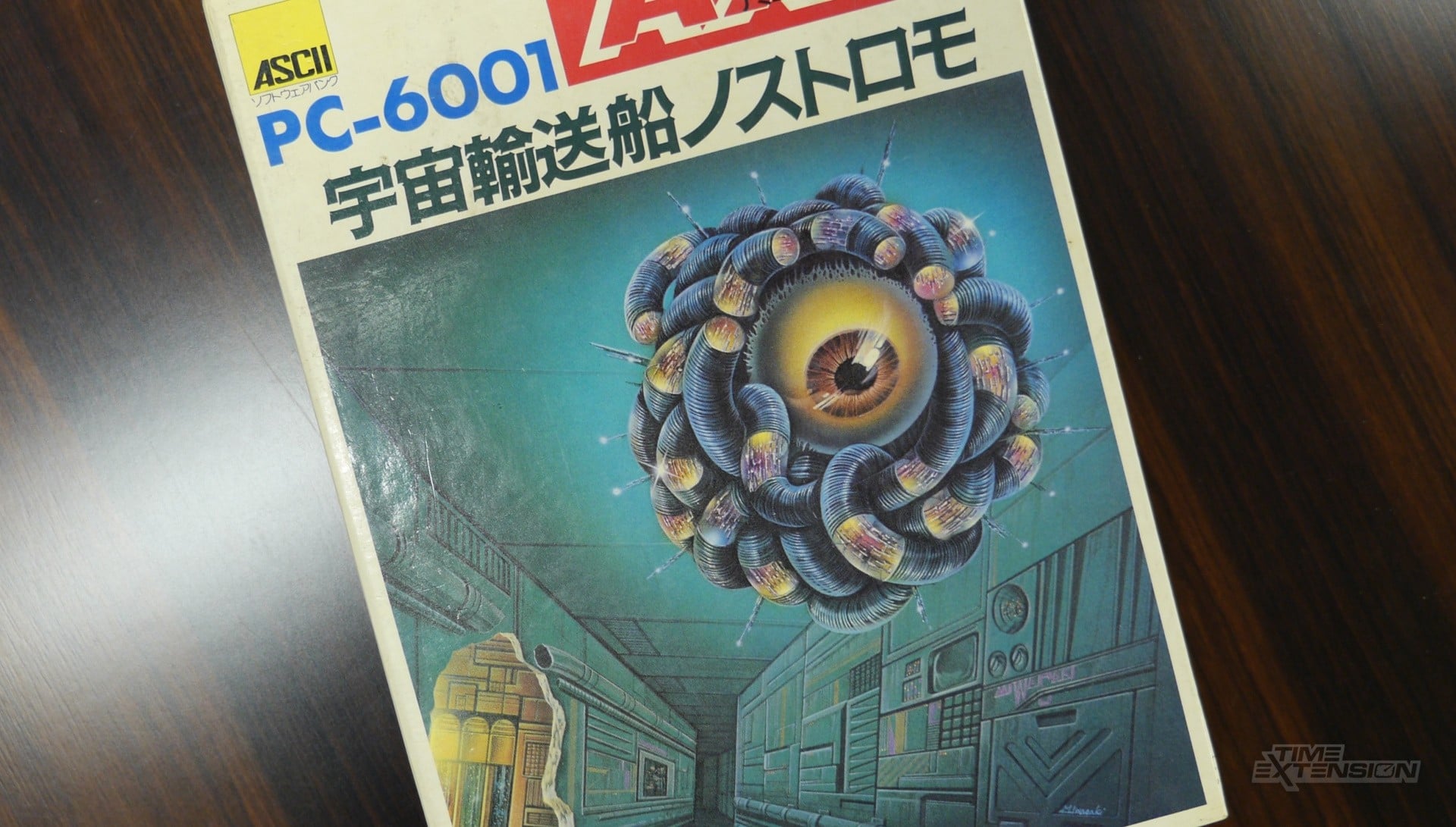
Given that Halloween is upon us, now is the perfect time to examine Japan's first survival horror, and how it evolved from the first-ever stealth game. Along the way, we'll also take on the role of Doctor Frankenstein and revive the missing link between them, an unreleased title thought lost forever.
What's interesting is just how much overlap the genres of stealth and survival horror have, with both cross-pollinating over the decades, in Japan and globally. Thief was as much about stealing treasure undetected as it was a survival horror in later levels, while the horror series Siren relied heavily on hiding from Shibito.
Would you believe that the origins of both genres in Japan came about from a group of just three friends: Hiroshi Suzuki, Akira Takiguchi, and Masakuni Mitsuhashi (aka Hiromi Ohba). Their journey together is surprisingly complex, taking in the shifting landscape of computer software, the AX range of PC-6001 games, a bizarre Taito deal, and companies such as ASCII Corporation and Game Arts.
But first, let's journey back to 1979...
Manbiki Shounen - The First Stealth Game
For a long time, Silas Warner's Castle Wolfenstein and Sega's 005, both from 1981, were considered the first stealth games. That is, until I interviewed Hiroshi Suzuki, who described the creation of Manbiki Shounen (aka: Shoplifting Boy) for the Commodore PET, when he was a university student. As Suzuki describes things:
"We worked on these games and then at the university festival in November other students could play them. We didn't sell them. At the festival I exhibited Manbiki Shounen, which was later published as a BASIC type-in listing in the February 1980 issue of RAM magazine. And a game called Alien, which was only ever shown at the festival. Manbiki Shonen was developed in less than a month. Sometime leading up to the end of November, so... Maybe October of 1979?
This was still a time when convenience stores were not yet all over the place; they were still kind of new to me. I remember there was a 7/11 near the university, and when I went there I noticed the shelves were stacked high and the walkways were so narrow, making it difficult to see. I remember thinking to myself, there's a game in this somewhere. I thought it was the kind of layout which might entice a shoplifter. So that's the reason its contents came about. [laughs]
I don't have a terrible shoplifting history, or anything! [opens magazine; article on the game with photos] This is me, and this is the old style of 7/11 from the 1970s. [laughs] The pose I'm doing here, I'm pretending to shoplift. Probably because the title was provocative, a [different] weekly magazine reported that a certain Parent Teacher Association was making accusations about the game..."
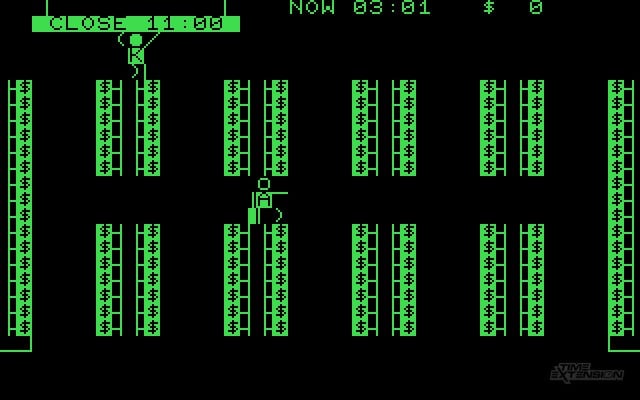
Gameplay consists of avoiding the line of sight of the roving security guard while stealing every $ symbol on the shelves. It has an amusing, comical style, with little cut-scenes before and after; if caught, you're dragged to the police station and kicked in the rump. At least in the February 1980 type-in listing in RAM magazine, meaning it predates Donkey Kong's cut-scenes by a couple of years. Everything uses text graphics, and it's obviously very simple, but the core loop is fun, and for 1979 it was inventive. It certainly caught the eye of Taito at the festival, since according to Akira Takiguchi it was likely the stimulus for Taito to offer the friends a contract.
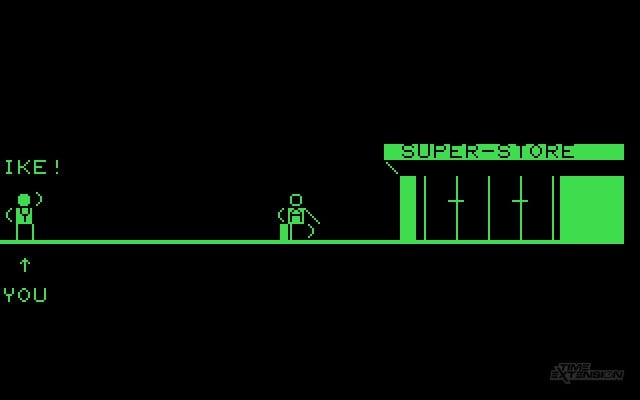
The deal itself is one of the strangest footnotes in the company's history: Taito paid fair amounts of money for students to use a fully equipped computer room and present their games, but nothing was ever commercialised.
According to Takiguchi:
"Suzuki-san's contract with Taito was very beneficial. There were some computers, I mostly used PET, and I wrote several programs in BASIC. Like the first version of Nostromo, before the AX-2 remake. I showed it to Taito. We had a contract that if we created games and made a presentation, Taito would give us money. It was 180,000 yen for a game.* But the games were never published. We did not give them any code. [laughs] Maybe they were recruiting? That's a possibility, but nobody ever joined Taito. Taito's terms weren't bad, but it was work that didn't lead directly to a retail product, which is a bit weak in terms of motivating game development."
(* roughly £400 / $800 in 1981; roughly £1,800 / $2,800 today adjusted for inflation)
Takiguchi emphasised that Taito's payments didn't depend on whether they liked what they were shown; simply presenting a game was enough. The original PET version of Manbiki was ported to other systems, notably the PC-6001, in 1982. In recent years, thanks in part to my interview, it's gained attention online as the world's first stealth game. One of the earliest modern ports was by Professor Jim Gerrie. His work preserving the code of old computer games is phenomenal, and if you've got time, it's worth perusing his website and YouTube channel.
Following Professor Gerrie's example, YouTube channel 8-Bit Show And Tell embarked on an epic research project, utilising Gerrie's work, my interview, scans of the source code, other ports, and then made his own revised versions (six of them!) which fixed aspects from the original, notably flickering and control lag. His video explores the game's history and concludes with it running on an original PET (playable in a browser). After this would be a conversion to C64, the ZX Spectrum, and even an AI generated remake.
At the next festival, Manbiki Shounen saw a sequel by Suzuki, titled Manbiki Shoujo, or Shoplifting Girl. This was coded in assembly and featured synthesised speech. It was displayed alongside Dojin.
Dojin - The Missing Link
In 1980, Suzuki programmed another significant game for the PET, using machine language, titled Dojin. The Japanese is 土人 and means indigenous person; it's not to be confused with the similar word doujin.
The game would only be displayed at the university computer festival, and then to a few Taito employees; it did not receive a type-in listing like Manbiki Shounen. All three friends confirmed it was lost, with no surviving materials. So we spent a lot of time going over how it functioned. Both Suzuki and Mitsuhashi gave different accounts, highlighting the challenge of oral histories. Both drew sketches, and I filmed them recounting the gameplay. Their descriptions would change in real-time.
Hiroshi Suzuki's recollection:
"Sort of a chase game... You were chased into a randomly generated forest, and there would be cars coming, up and down the road, and if you could get the natives to cross the road at a point where it would hit them, they would be killed. Like a moving block, going up and down. It would push them into the north or south wall and squish them. You were chased through the forest and there were paths going through, and they were trying to get you. [sketches] These were the sort of things you'd hide around, they were generated at random."
Masaukuni Mitsuhashi's recollection:
"There were walls on the outside, and he would be shoved along by the car and squashed into the wall. It wasn't a highway. It had a piston action to it. These are crushable walls. You could break through these to create paths, and then in the middle is like a piston, that would crush any characters... Backwards and forwards, like a pendulum. The player can blast through the walls in one go, but the natives could not, it would take them some time to get through the walls."
After Mitsuhashi finished his description, Suzuki laughed, saying that actually Mitsuhashi's version was closer, so Suzuki then modified his answer, adding:
"The way the game progressed was, as you kept running away you would end up having to knock down more and more walls, or the natives would knock down more and more walls, so it became much harder to avoid them - because they were being held up by walls less and less. So if you could get every single one of the natives using that crushing machine, before they caught you, that was how you won the game."
Regardless of which description is more accurate, and although both are still chase games akin to Heiankyo Alien or Pac-Man, both also present interesting ideas for 1980. Especially the idea of a destructible maze environment, which makes it similar to Dig Dug and Mr Do!, both released two years later in 1982. It's a shame Dojin was never widely distributed, because it sets some major precedents. Notably, enemies could also destroy the environment, albeit more slowly than the player, adding even more tension to the Dig Dug / Mr Do! formula.
Nostromo - Japan's First Survival Horror
Which brings us to Nostromo, the first survival horror in Japan, and possibly the world, depending on how you classify things.
Players are trapped on a spaceship with a roaming alien and must collect four distinct resources, housed in eight separate rooms, to escape. Players can break into these rooms, but the alien roams the corridors. Players are safe inside a room or the red escape pod airlock. If the alien sees the player, it gives chase, but players can kite it by hiding in rooms. On higher levels, the alien is only visible when the player has a direct line of sight.
Although it looks simple, it offers plenty of tension and strategic fun, and it certainly earns the "survival horror" classification. But was it actually the first?
The problem with game genres is that they can be thematic or mechanical. Nihon Falcom's occult-themed game from 1984, Demon's Ring, could be regarded as a horror game due to aesthetics, but it's a graphic adventure. Survival horror typically involves direct control, limited resources, and avoiding enemies in confined spaces - often without the ability to fight back, or with only limited opportunities based on finite resources.
But it also needs a layer of thematic horror; otherwise, something like Pac-Man technically fits the description. Good examples would be Clock Tower, Resident Evil, and the Siren series; the emphasis is on surviving the horror, not just witnessing it. Taigen Moon's The Cellar channel has a great overview on the differences at the 8:57 mark.
The other challenge is release dates. Nostromo is actually two separate releases: Takiguchi's original for PET, coded after seeing Manbiki Shoujo and Dojin, thus putting it circa 1980; and Mitsuhashi's remake for the PC-6001, titled AX-2: Uchuu Yusou-sen Nostromo, which is often listed as December 1981.
The earliest proto-survival horrors are typically cited as 3D Monster Maze on ZX81 (1981) and Haunted House on Atari 2600 (1982). We're conveniently omitting Hunt the Wumpus (1973), since it was text-based, not graphical; however, its graphical port to the TI-99/4A is cited as mid-to-late 1980 by different sources (YouTube video).
Takiguchi's original Nostromo was part of the Taito deal, meaning it was never distributed, whereas Mitsuhashi's AX-2 remake made it to retail. So you can see the quandary we're in, on ascertaining precisely what came first.
Chatting with Takiguchi, he recalls making prototypes while in high school (1979), but completing Nostromo once at Tokyo University the following year, using the Taito computer room. He admits he took inspiration from both of Suzuki's games:
"My idea was different from Dojin - actually, Dojin was a very interesting and playable game. But the enemy was always viewable by the player. So because I loved [the film] Alien, as well as Star Wars, I wanted the enemy invisible to the player. Visible only when it is viewable by your character. What I remember is I showed Taito Nostromo on a PET CBM. It was never published. But sometimes I gave the idea to Mitsuhashi-san, and it was published eventually. Mitsuhashi-san ported it to PC-6001."
I suggested that Dojin lives on through Nostromo, to which Takiguchi laughed, adding:
"You could say that! And Manbiki Shoujo. What I found lacking in Manbiki Shoujo was that the manager could always be seen. So it's easy for the player to avoid the manager's movement. I wanted the manager to be invisible, unless he was actually visible to the character. That was the idea of Nostromo."
As stated by Professor Gerrie in his video:
"This is a port to the TRS-80 MC-10 from source code for the NEC PC-6001. In this playthrough I make it to the stage, often missed by commentators, that really demonstrates the suspense and horror aspects of the game. At higher levels the alien appears and disappears at random while moving, creating a creepy suspenseful atmosphere conducive to jump scares."
When Mitsuhashi remade it for the PC-6001, he didn't use Takiguchi's source code, instead recreating it by eye. He also described an intentional nightmare scenario players would find themselves in:
"There's a situation in Nostromo, where there is nothing to do except kill oneself to end the game. You have to collect certain items, but if there are none of that item left in the warehouse, your only choice is to be killed by getting caught by the alien. There is no way to end the game successfully, so you just have to kill yourself after losing certain resources that are necessary to exit the ship."
In this way, Takiguchi and Mitsuhashi took elements from both Manbiki and Dojin - the item collecting, breakable walls, maze chase enemy, and a vulnerable player - while evolving the line-of-sight mechanics to create more tension. Instead of avoiding the enemy's gaze, the player had to gaze at the enemy to avoid them. And all of it was themed around Ridley Scott's Alien. In a way, they had created a primitive prototype of Alien: Isolation roughly 34 years before it. Comparing the two is a great example of just how far games evolved over three decades.
For those wanting to experience Nostromo today, Professor Gerrie explores it extensively. He produced several remixes, reworking the mechanics. There is a browser version and download on Game Jolt; Internet Archive mirrors this, albeit with long load times. Pr Gerrie's version requires movement buttons to be held and assigns wall breaking to the space bar, whereas on PC-6001 both were automatic. The Neo Kobe set includes the PC-6001 cassette image if emulating (reduce speed to 80%); the game does not require buttons to be held, tapping an arrow key has you run in the that direction until you hit an obstacle. It takes a while to learn, but is honestly lots of fun.
Recreating Dojin today
When Taigen Moon asked for assistance with his history of Japanese horror video, and reusing my footage of Dojin, I had a wild idea: what if we asked Professor Jim Gerrie to recreate it? He'd remade both Manbiki Shonen and Nostromo, so he knew exactly how these old games were built and felt. To my surprise he agreed! Professor Gerrie and his son Charlie, who understands Japanese, went over the material. The plan was they would recreate Suzuki's description and I would recreate Mitsuhashi's description. We would be reviving that which was thought lost!
As for my version... I would like to apologise to the readership for failing to complete it. I prototyped the woods and collision detection, but never got around to adding the enemies. The reasons: a lack of time, and also reduced motivation due to my Itch.io page being banned under UK law. More significantly, it's actually really hard to recreate a compelling game experience with only limited historical evidence. I'd originally pitched it to Pr Gerrie as being our own Jurassic Park, but ultimately I developed empathy for the difficulty palaeontologists face in recreating even skeletons.
This experience was a testament to why AI can't replace human design - good games need careful iteration. If you held a game jam of 10 different teams trying to recreate Dojin, you'd get 10 different and equally enjoyable offerings.
Pr Gerrie summarised it nicely in one of his updates:
"So many questions remain unanswered: How many enemies? Do their numbers increase with each screen cleared? Their speed? Levels of play? Does the player have lives? How many? Can they earn new ones? Where do they respawn? Splash screen? Points awarded for enemies eliminated? Scored displayed? Lives? Where? Instruction screen? High Score displayed? Where?"
His analysis, research, prototyping, and then refining is a phenomenal master class in archaeology and preservation. With nothing more than a couple of sketches and some verbal descriptions, he approximated a facsimile of how Dojin might have played. And he succeeded in making it fun! He wrote four substantial blog updates (1, 2, 3, 4), which are well worth reading. Has such a thing been attempted by the community before? The source code is on Github, while the game itself can be found via Game Jolt (click tapes and scroll to the Japanese collection). It's also on the Internet Archive.
We still need to recreate Mitsuhashi's version, but at the very least one half of this enigma has been brought back from oblivion. We now have three clear examples tracing the origin of Japan's earliest survival horror.
Have you played any? Post your thoughts in the comments!
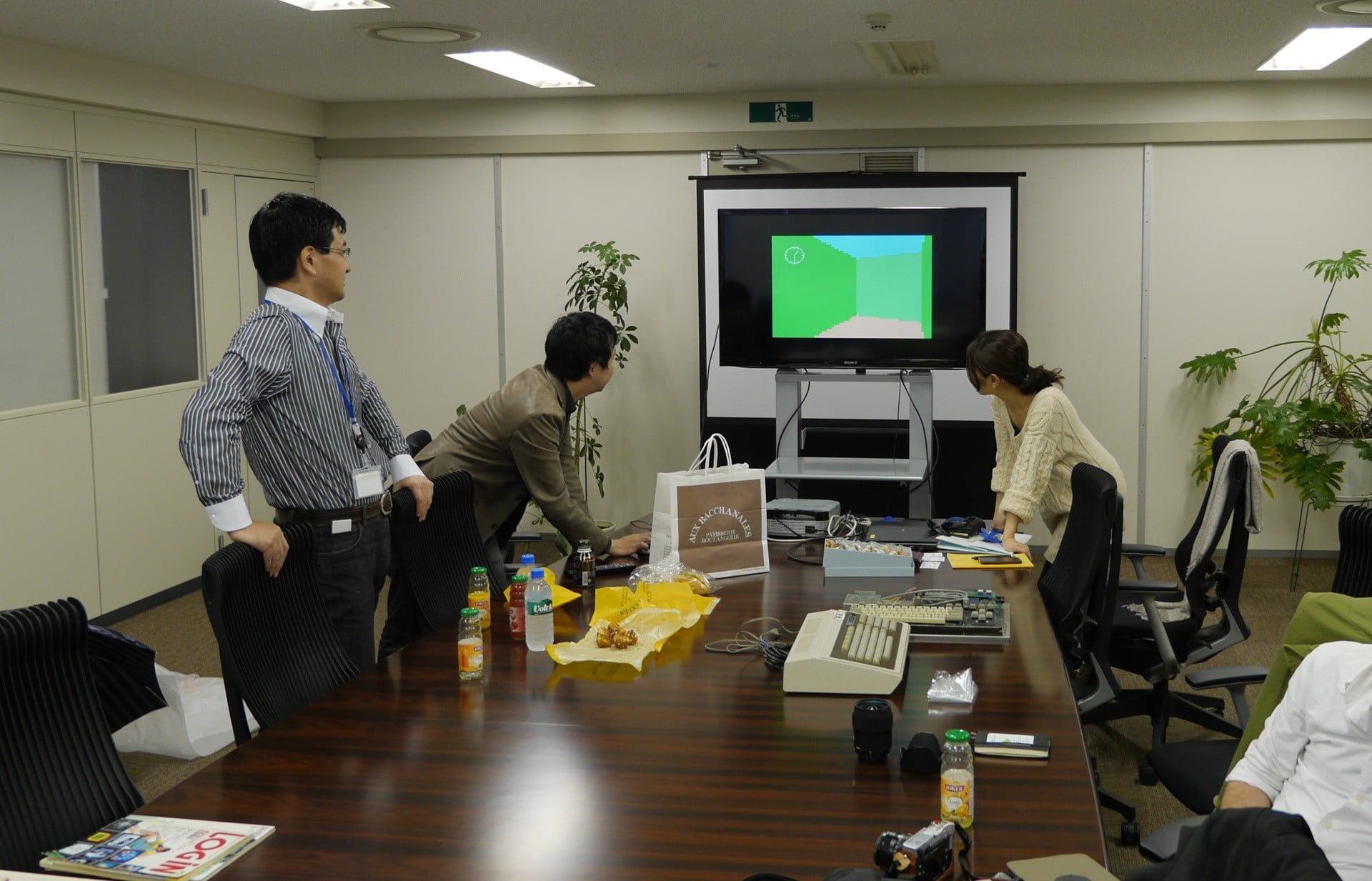
The various quotes above have undergone major edits from their original interviews. If you'd like to read the nearly 50 pages worth of original Q&A, please check out Volume 1 of The Untold History of Japanese Game Developers, pages 360 ~ 410.
Also, my eternal gratitude and thanks to Professor Jim Gerrie, not only for indulging my mad request to recreate Dojin, but also for his work preserving old computer games and making them accessible again.
Thanks to Coury Carlson of My Life in Gaming for helping with extracting a clip from the Untold History Blu-Ray.
Comments 0
Wow, no comments yet... why not be the first?
Leave A Comment
Hold on there, you need to login to post a comment...