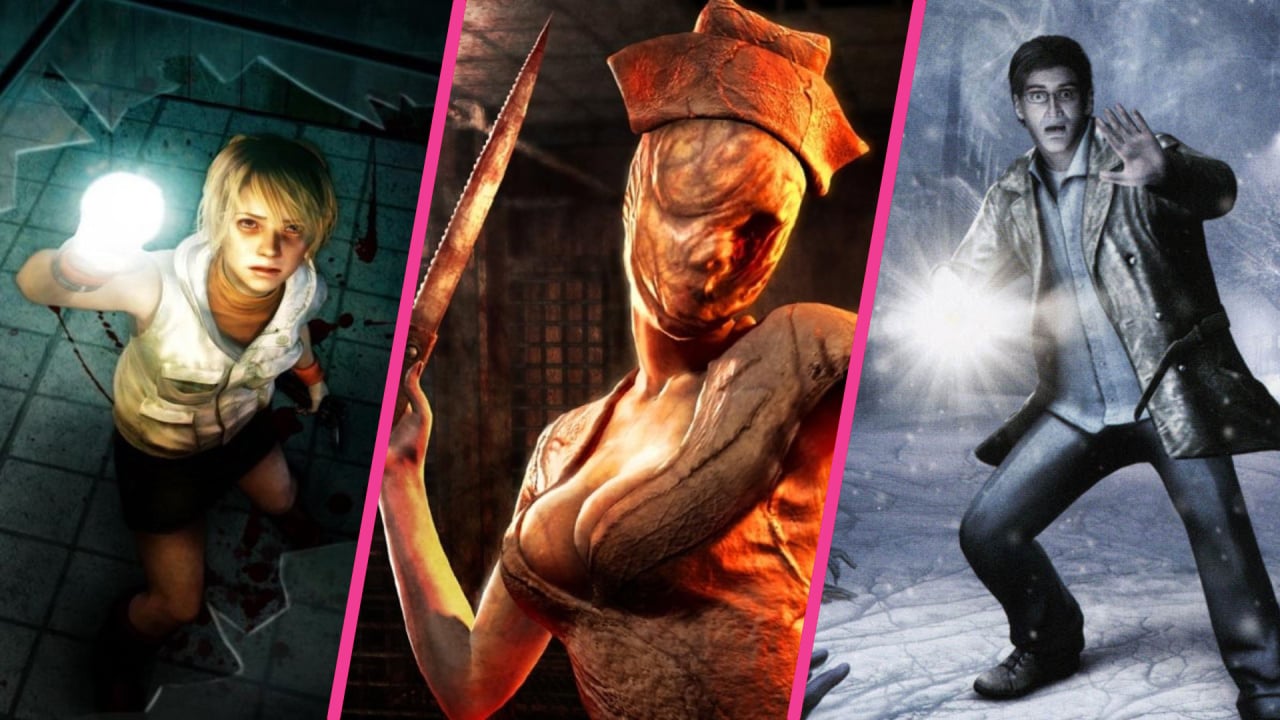
This fourth instalment was Team Silent’s last involvement with Silent Hill, and a departure from form. Set in a different locale (the city of Ashfield), it focuses on Henry Townshend’s exploration of alternative, nightmare worlds through a hole that appears in his flat. Plagued by recurrent nightmares, he is unable to leave the building, his room both a nexus and safe space.
For the first time, the developers employed a first-person view while in the room in order to elicit a more claustrophobic, oppressive atmosphere. Things revert to the usual third-person perspective once Henry travels to the nightmare realms, where he teams up with his neighbour while facing off against the ghost of a serial killer, Walter Sullivan.
And it’s here that the recipe starts to lose its flavour, as puzzles are dumbed right down in favour of more combat-heavy gameplay. Item storage is also very limited storage, and with no way to dump redundant gear, Henry has to return to his room to manage resources. Annoyingly, this is the only way to heal or save, meaning frequent re-treads in order to ensure progress isn’t lost.
Silent Hill 4: The Room certainly had a great concept, but the world outside doesn’t quite live up to the promise, especially given the clout of the first three games.
Following its work on Silent Hill: Origins, Climax Action returned to the series in 2009 with a new title sporting three major plus points: first, it was for Wii, bringing the series to the Nintendo crowd. Next, it starred OG Silent Hill hero, Harry Mason, a welcome move aimed squarely at old-school fans. But last, and most important, it was a decent game.
The approach was a bold move, splitting the gameplay into two distinct scenarios; initially a first-person psychological test with Dr Michael Kaufmann, then a third-person exploration of the town itself. The former setting directly affects the latter, and the Wii remote is put to elegant use controlling Harry’s torch and mobile phone.
The real trick, though, was the clever choice to remove all combat from the game, instead relying on evasion, hiding and escape to engender player fear. And, goodnes, does it work. With no gun, lead pipe, or plank of wood to batter monsters with, the desperate chase sequences are supremely tense, amplified by a neat ‘look-back’ function.
A welcome return to form, there’s no doubt that Silent Hill: Shattered Memories is one of the most compelling and novel approaches to the series, and well worth braving. It was also released on PSP and PS2, minus any motion-sensing controls.
After the pinnacle that was Silent Hill 2, it was always going to be a tough task for the follow-up to even equal, never mind surpass it. That’s not to say Silent Hill 3 is a bad game – far from it. On its own merit, it’s a great-looking, scary-as-hell Survival Horror outing that stamps all over much of the competition. But it’s also more of the same, without much in the way of evolution or development.
Set some 17 years after the original Silent Hill, main character Heather searches for her father’s killers after a grisly vision of her death in an otherworldly amusement park. Everything you’d expect is present and correct, from the radio and torch, and the varied arsenal, to the rusted, chainmail constructs of the nightmare world.
It’s absolutely one to play, but it’s not as strong plot-wise, never quite reaching the poetic, supernatural hell of its two predecessors. Even so, it stands head and shoulders above many of the other games in the franchise.
This is where it all began. Where Capcom had coined the term ‘Survival Horror’ three years earlier with Resident Evil, Konami instead took a more cerebral approach, choosing to tell an occult tale that fostered a creeping dread through fear of the unknown, rather than the gore and jump scares. The entire opening sequence is worth the price of admission alone.
Starring ‘everyman’ Harry Mason, the hunt for his missing daughter was smartly simple and doubly effective once the crumbling, nightmare world made its horrifying appearance. Trawling everyday locations like holiday homes and schools – now replete with disturbing monsters – made a huge change from the overused ‘haunted house’ setting.
Elsewhere, the idea to mask the draw-distance shortcomings of the PlayStation with fog was pure genius. It not only played to the game’s strengths, but enhanced the sense of claustrophobia and tension, eventually giving way to outright terror, during the supernatural, conspiratorial climax.
There’s no doubt Silent Hill was the start of one of the greatest horror video game series ever, but the best was yet to come.
It says something when a game that’s over two decades old still has the power to genuinely scare. Having refined the blueprint in the original Silent Hill, Konami used the PlayStation 2’s advanced power to deliver hugely improved visuals in Silent Hill 2, allowing for a greater depth of character emotion and more detailed, decayed staging.
But it was the story that really hits home, where James Sunderland returns to Silent Hill after receiving a letter from his dead wife. As he explores, he meets lost souls struggling with their own demons, and the game delves deeper into James’ psyche, his vulnerable, sympathetic demeanour peeling away. It’s fair to say the denouement is utterly heartbreaking.
While the human element is the true achievement, the environments and set pieces underpin the story brilliantly, supported by a suite of vile, twisted creatures born from James own guilt. Indeed, Pyramid Head (AKA ‘Red Pyramid Thing’) has become a classic depiction of punishment, and the de facto antagonist.
Make no mistake: Silent Hill 2 is both the series’ zenith, and one of the greatest video games ever, horror or otherwise.

 by
by