
 by
by 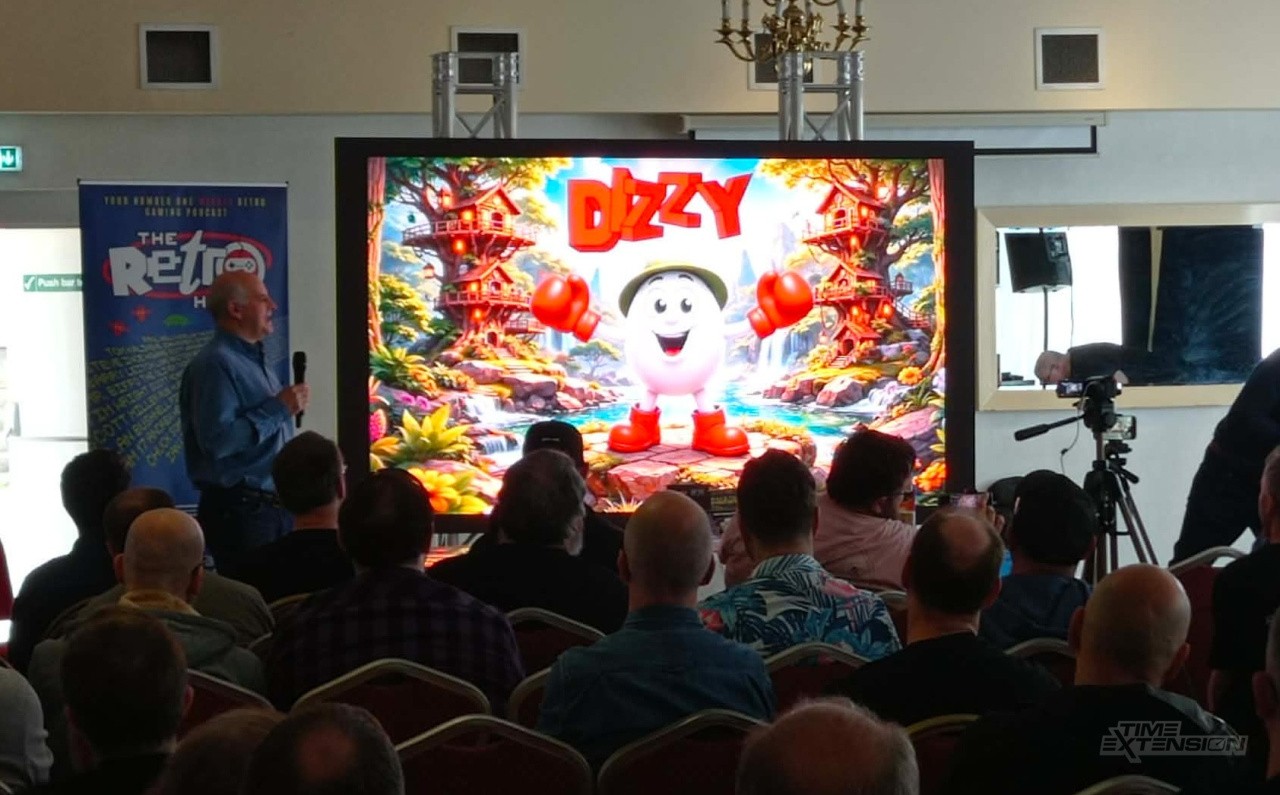
Over the weekend of 3-4 October 2026, I attended the Play Expo in Blackpool. It was a 5-and-a-half-hour drive with Paul Drury; we attended to mark the launch of Drury's new book, The Arcade 1979-2000, and fellow book contributors Martyn Carroll and Frank Gasking also attended.
The expo featured a large market room (with even larger prices), a gargantuan gaming hall filled with arcade machines, networked computers, consoles of every sort, a row of pinball machines, and a stage for performances. There were also high-score tournaments throughout. These aspects alone would have made it worth attending, and organiser Andy Brown said they'd enjoyed their best footfall in the history of Play Expo.
For me though, the highlight was the talks by industry figures: Eugene Jarvis, Stoo Cambridge, Tony Warriner, Dominik Diamond, and the Oliver twins. (Drury also did live interviews with Jarvis, covering '80s games on Saturday and '90s games on Sunday.)
In fact, there was so much on that you couldn't attend every talk, and you needed both days to experience (almost) everything. Multiple colleagues were keen to see the Oliver Twins talk, given the recent controversy over AI. My editor Damien feels especially strongly about it. There was anticipation around AI use, so I made it my goal to attend and, if no one else broached the subject, challenge them on their use of AI.
Now, I want to be honest: I have absolutely no malice toward Philip and Andrew Oliver. In fact, I'm a fan of their work. A lot of people focus on the Dizzy series; I owned Fantastic Dizzy on Mega Drive and found it excellent, but for me their wider portfolio deserves more attention (see Philip & Andrew).
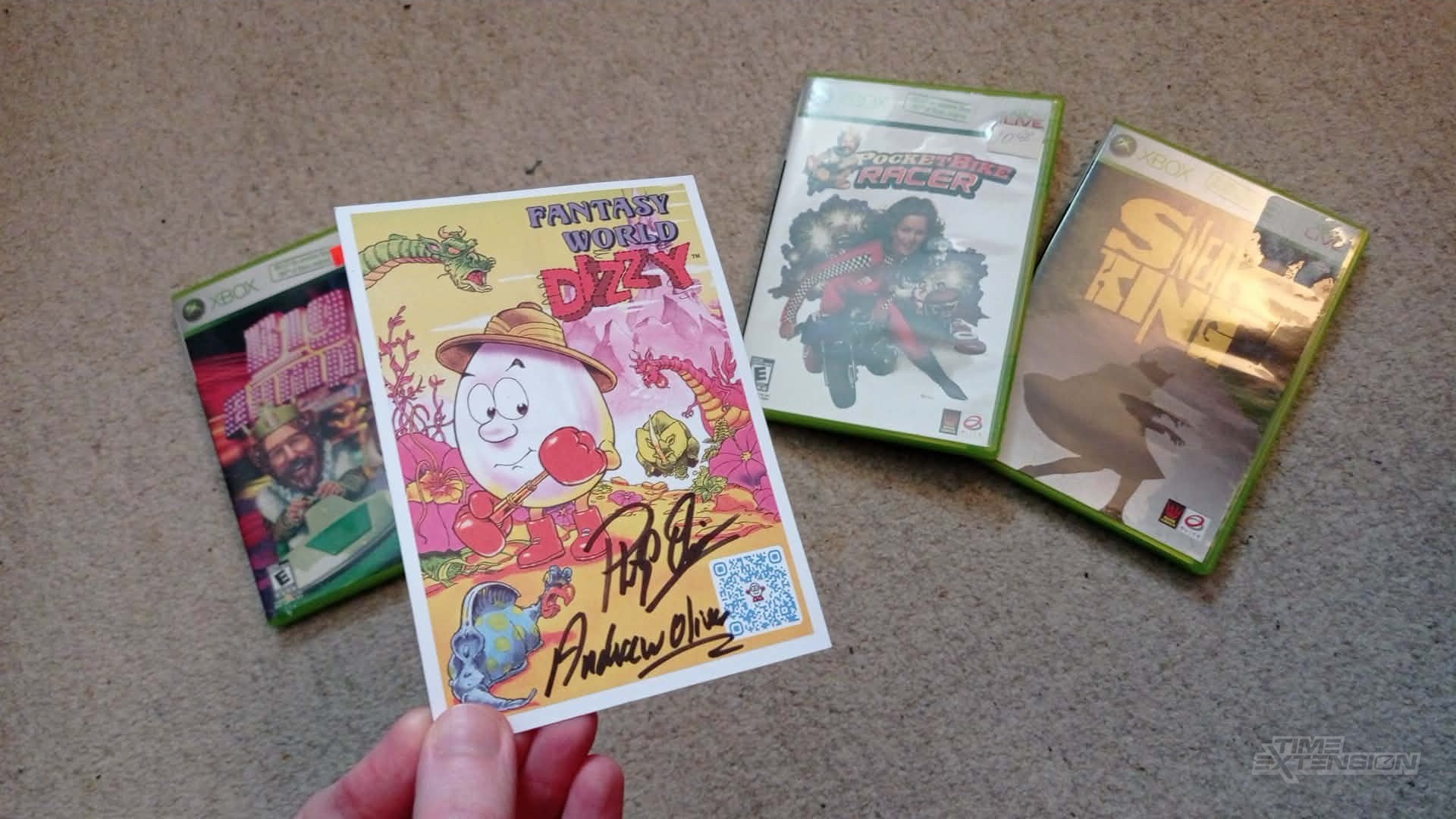
Firehawk on NES had tight controls, great visuals, smooth gameplay, and was tremendously fun; one of the system's absolute best. Firo & Klawd on PlayStation was an anthropomorphic fever-dream of isometric action, which I'd like to document. Reservoir Dogs was an ambitious license which gave us closure on what happened to Mr Pink. I even own their Burger King trilogy, which I love without irony.
The Oliver Twins talk was packed; I got one of the last seats at the back, with people standing behind me. A conservative estimate would be 120, but more wouldn't surprise me. They spoke for an hour, describing their careers, the Dizzy series, an unreleased MMO, with time at the end to discuss Philip's new Kickstarter, Journey to the Emerald City, and Andrew's plans for new Dizzy games.
It's worth emphasising that while they collaborate, each brother is focusing on their own project - there was some fun brotherly banter on whose project was better. Andrew's proposed next Dizzy title would recreate Treasure Island Dizzy, combining the ZX Spectrum and NES versions, with a newly made Mega Drive iteration, and then also a modern update ("Ultra"), with players able to switch between the four at the push of a button (similar to something like Rare's Perfect Dark remake on Xbox 360).
However, Emerald City openly uses GenAI, and while not explicitly stated, the modern update of Dizzy appears to use it, too. At the end, I raised my hand to ask questions, along with maybe three others. I was the only person to ask about AI. As best as I could, based on the recorded audio, I've delineated Philip and Andrew; apologies if a quote is misattributed. Answers have been edited for brevity and clarity.
Time Extension: Hello, John Szczepaniak of Time Extension. A lot of your recent work extensively uses Generative AI. What would you say to people who feel that Generative AI is unethical due to its scraping the creative work of others?
Philip: Oh, hello John. We should have a chat. I know [Time Extension has] made some other comments on that, and I did wonder if you would be here. So thank you, and thank you for coming along. So, Generative AI is a bit of a contentious issue, and I know there are issues surrounding it.
We believe that, as creatives, it is another creative tool. And we believe that in the right hands, we can create some awesome stuff that would have been impossible to create any other way. I'm sorry, but as an experiment, to create Emerald City, and all of the art that went into this, it would have been an over-a-year project with a couple of artists, probably a hundred thousand pounds, all said and done when you're looking at all the costs. I wouldn't have made that bet; I wouldn't have done that experiment, no way. To be honest, it would never pay itself back. So for creatives, especially small teams, indies, these are some powerful creative tools that you can use.
Now, as for scraping IP and all of that kind of stuff, which is the main question you had, I believe that there should be regulations about what AI is trained on. I, unfortunately, do not run OpenAI or any of these other big gigs. I believe there should be guardrails on what AI is allowed to do, what material is given for its training. If it goes to people who have IP that's valuable and is trained on it, then something needs to be sorted. They either need to be paid or not to be used on that.
But as humble little guys just making Dizzy games, we can't control that. We could completely ignore a very powerful creative tool and then decide to produce nothing because it's too difficult to produce the quality that we want. And so we could go quietly into our retirement or, we can go, this is exciting! We love tech. We are sci-fi guys. This is an incredible time to be alive for a creator.
Andrew: We have always used the best technology at our disposal. We did that on the Spectrum, and as every new machine came out, we jumped onto it, and we were trying to use the best we could to make the best game possible. And so it would seem weird if we didn't use that technology. And as Philip said, we got to the point where we were tired because we didn't want to have large teams and large overheads, and possibly collapse and go bankrupt. We've done that a couple of times now. It's not fun going bankrupt. So we're not going there. And we don't want offices and nine-to-five jobs. We want to work from home.
But after a while, we did get kind of bored and thought, we just want to go back to making Dizzy games. We realised that without an army of artists and programmers, we're not going to do it. But actually nowadays, these tools are incredibly empowering. I am absolutely loving getting back into making games, and I can say that it is 100% my work at a computer, using some AI. It may have scraped my own IP; it may have looked like Dizzy, but it's mine, and I'd like to go back and make new games.
I would like to think that people want to have new games; but they expect it to look up to scratch, [it's] what modern people expect from these things. The only way I can do it is by using some of these powerful tools, and if I didn't have these powerful tools, I wouldn't do it at all.
Philip: Somebody came up to me yesterday at the signing table and they basically said, it allows indies to compete on a level with the production quality that these massive studios with really good financing can afford, it gives them an opportunity. The door is opened to actually be able to compete on a quality level, for visuals and everything else. So they said it's really good for indies, and I have to say yes to that.
Andrew: I'm sure, John, you have lots of other points you'd like to make. Would you like to make another point or should we hand it to somebody else?
Time Extension: No, you've been very articulate. Thank you very much.
Obviously both brothers said a lot more over the hour of their talk, and the brevity of the quote here is only due to space. It's also worth adding that Philip revealed he's working with an artist who produces the AI imagery for Emerald City, and he explained that this individual (not named) was frustrated by comments about their work.
I was surprised to learn this, but there are "professionals" out there who openly produce content through prompts. This led to a rabbit hole of reading about how "The Prompt Engineer Is the Artist of Our Age", which genuinely made me sick to my stomach.
Before I comment on the points the Olivers made, I want to paraphrase (very loosely) two private conversations I overheard between attendees on opposite sides of the room.
- First group: "Even if they do use AI for the art, they still need to be creative when using it."
- Second group: "Whether they use AI or not, if it's a good game that's fun to play, it's still a good game."
I highlight these because I felt like the odd man out - while colleagues and I are opposed to AI, the attending public seemed apathetic.
I've been quite vocal in the comments of Time Extension and online with my anti-AI stance, because I'm a writer, and with friends who work in illustration and music, we have seen our work harvested to feed the machines. The result is fewer commissions for our work, because companies are increasingly using "free" AI instead – AI that has been expressly trained on human work to directly compete with human work.
Which makes the Oliver Twins' position (and Richard Garriott's) so deeply painful. Because I respect their legacy as creators, and the passion and ingenuity that defined their earlier careers, but I strongly feel they are on the wrong path. While Andrew is correct that AI would have scraped his own IP for the new Dizzy material, it also scraped everyone else's, too - it doesn't discriminate based on what it's fed. AI image models are only as good as they are because they have literally scraped the entire internet without any respect for copyright or ownership. So the assertion that what you 'create' using AI belongs to you is inherently false (and the law, at the current moment in time, agrees; GenAI works cannot be protected by copyright).
If I were to make one comment on their reply, it's how heartbreaking it was to hear a developer claim that for indie developers to remain relevant, they need to use AI to match the output of the bigger triple-A studios. I like indie games specifically because they do NOT match the output of bigger studios.
I like the simpler visuals. I like the smaller scope and shorter playtimes. I find the rough edges charming. One of my favourite games of the last two decades is Brigand: Oaxaca, made by one man, whose graphics look like he got them free in a packet of cereal. I have no interest in a recent big studio release like Wolverine, which allegedly cost $300 million. But I will seek out charming, janky, fun little games that were made by passionate auteurs.
Listening to the Olivers, I began to question myself: am I the minority? Can indies compete only if they match the output of bigger studios? Is the cost of development, versus projected sales, so askew that the only way to recoup costs is through AI?
If we as human beings have reached this point in our cultural history, then I am truly bereft with anguish.
Also, I'm not convinced the Oliver Twins even believe this themselves, for two reasons.
Firstly, Andrew was very enthusiastic about how the new Dizzy game would allow swapping between ZX Spectrum, NES, Mega Drive, and modern versions. He excitedly described how players could choose their favourite at the push of a button, swapping between them in real-time during gameplay. He was acknowledging the existence of customers who would specifically gravitate towards simpler visuals.
Secondly, after the talk, I went up for a chat and to request their autographs, and I mentioned Firo & Klawd to Philip. Immediately, he launched into a passionate recollection of how he regretted not going with 3D polygons, feeling he'd been misled into using pre-rendered graphics, when what he truly wanted was proper polygons. The game came out in October 1996, exactly 30 years ago. The fact that he still carried this memory, and expressed it with such intensity, revealed a man who cared about his work and regretted compromising.
Pause for a moment and reflect on these two points in contrast to their earlier Q&A answer.
Human beings dedicate their lives to writing, painting, and composing. We need to stop conflating using AI as tools and using AI to generate content. These are two vastly different implementations of AI, and we need to start thinking about it with more nuance. This mistake is something I've seen repeated online everywhere.
Would you only buy an indie game if it looked like the output from bigger studios? Let us know in the comments.